
Video corner cabinet with marquetry


Antique corner cabinet with display cabinet top and fine marquetry
Southwest German
Walnut, plum and others
around 1770
Dimensions: H x W x D: 207 x 90 x 58 cm, side depth: 59 cm
Description:
Exceptional corner piece of furniture from the Transition period with a still baroque form but already classicist surface design.
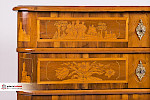
The base of the two-part piece of furniture is particularly characteristic, with a door covered in a strictly geometric pattern of maple and walnut. The surface is framed by a band of thread inlays, which in turn are filled with light and dark contrasting veneers. A band of plum wood running diagonally to each other forms the outer frame of the door.
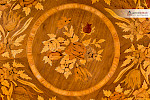
The cheeks are also geometrically designed with central medallions with fire-shaded floral marquetry.
The curved skirting board can also be found in the same form on the upper part of the base, where it is complemented by the precisely fitting counter shape of the top - a detail of the carcase assembly that is worth mentioning because it is extremely rare to find it in this form.
The panes of the showcase section are predominantly old and original, see attached video. The curved moulding still reflects the taste of the mid-18th century. As we already know from the door of the base, the frame of the upper door is also veneered in plum wood laid in a herringbone pattern. The surrounding walnut timbers are also laid with a diagonal grain.
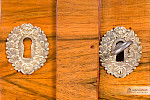
The doors are hung on hinges, typical of the period, and two shelves organise the interior.
Interesting facts:
When the piece of furniture on offer here was made, glass panes were predominantly produced using the drawing process. Narrow and often slightly uneven sheets of glass were obtained from the viscous melt. Larger, flat panes were hardly technically feasible and very expensive, which is why 18th century furniture glazing almost always consisted of small panes held in place by fine glazing bars.
Condition:
Restored condition with a shellac hand polish.
Price: 6350,-€
Article found under: Cupboards & Showcases
Add to shopping cartVideo corner cabinet with marquetry
Also interesting
Small Biedermeier cabinet
Southern Germany
Walnut
Biedermeier circa 1820

Single-door Biedermeier wardrobe
Austria
Walnut
Biedermeier around 1830

Cylinder secretary with rare mechanism
Middle German
Cherry
Biedermeier around 1815