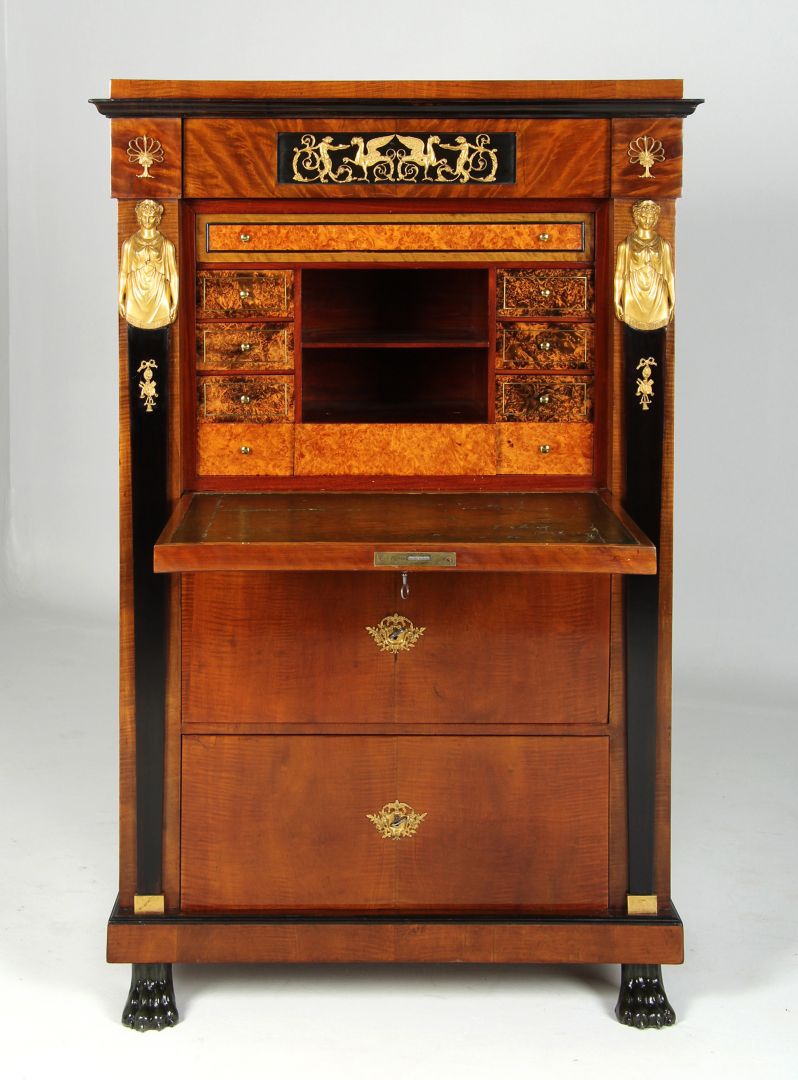
Video Berlin secretary with bronze busts
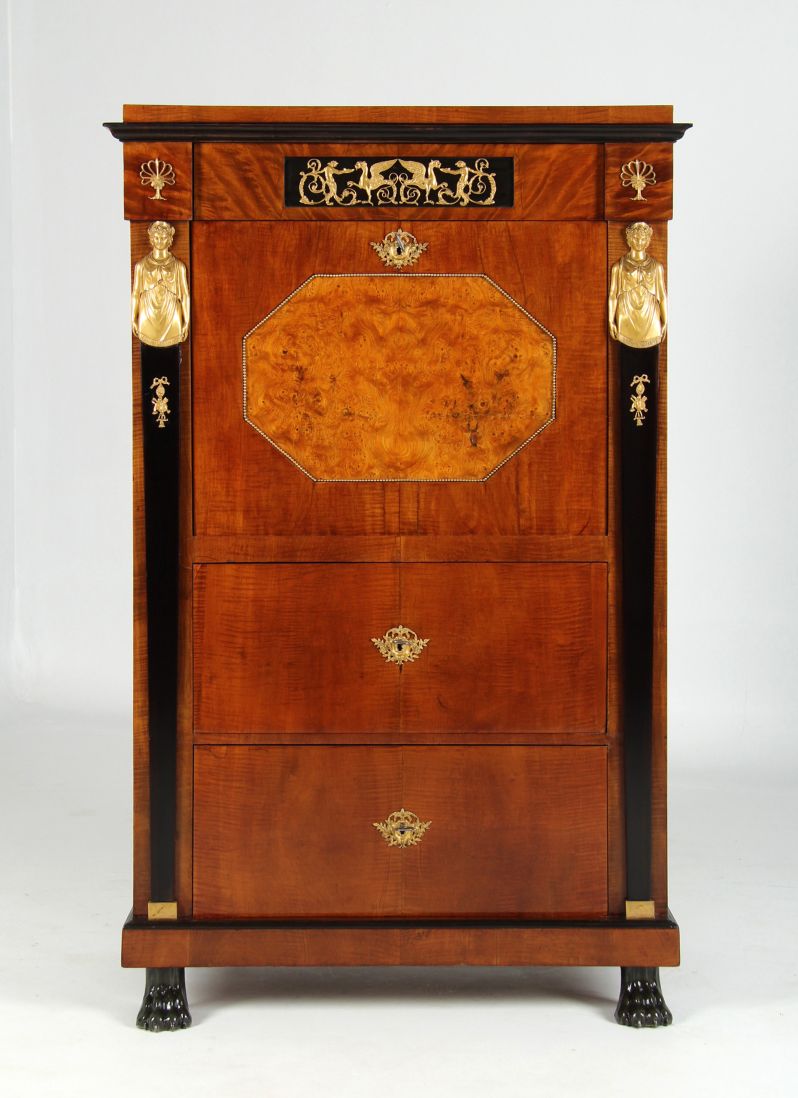
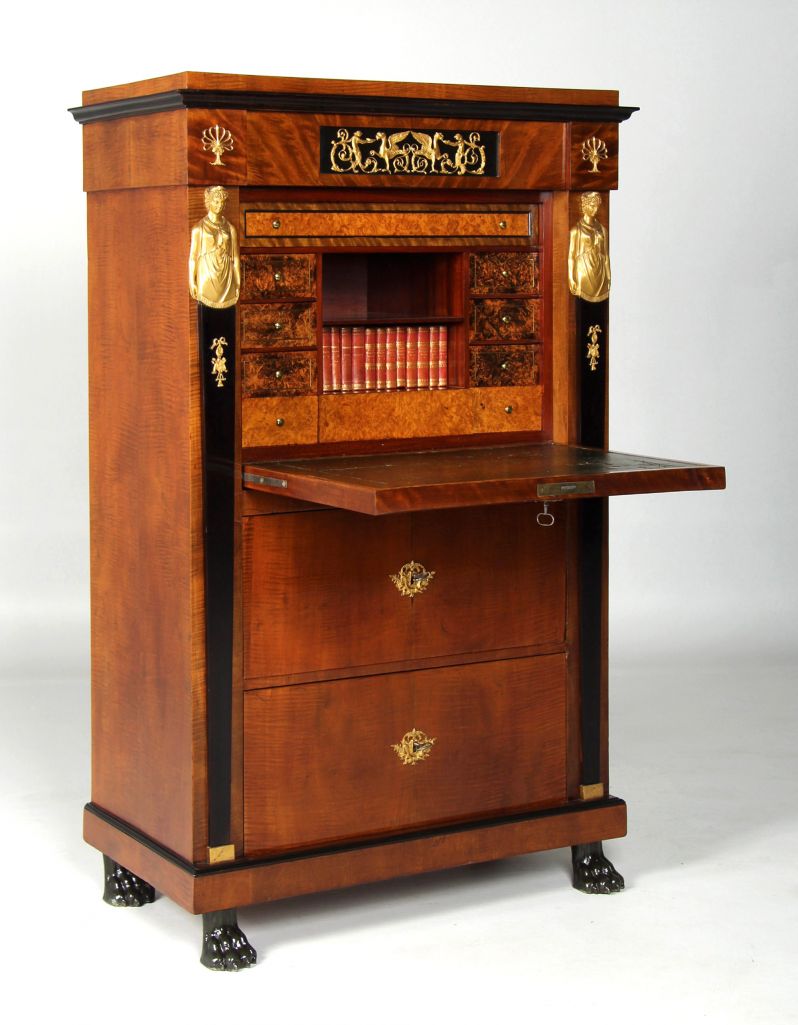

Antique Biedermeier secretary with fire-gilt bronzes
Berlin
Curly maple and others
around 1810
Dimensions: H x W x D: 141 x 88 x 49 cm
Description:
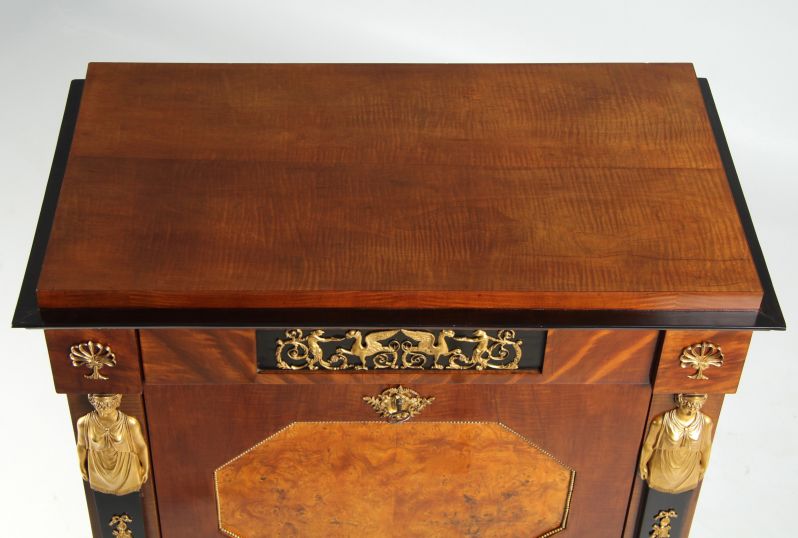
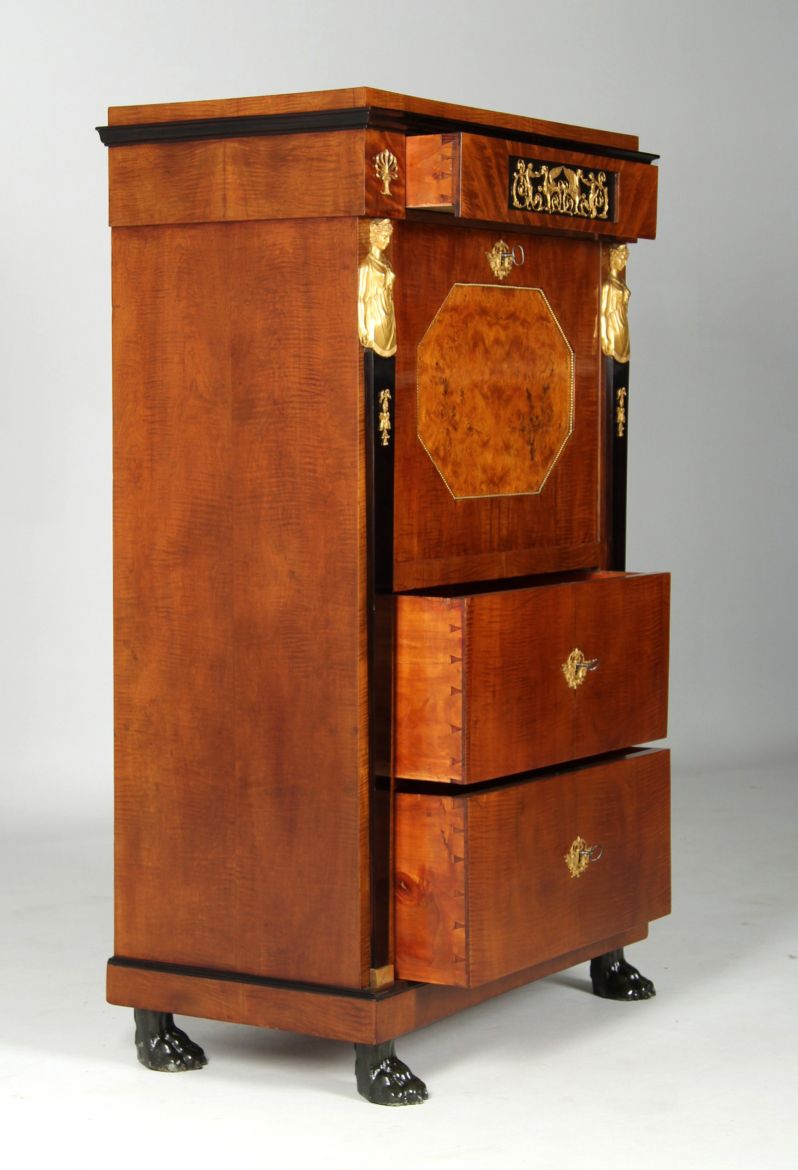
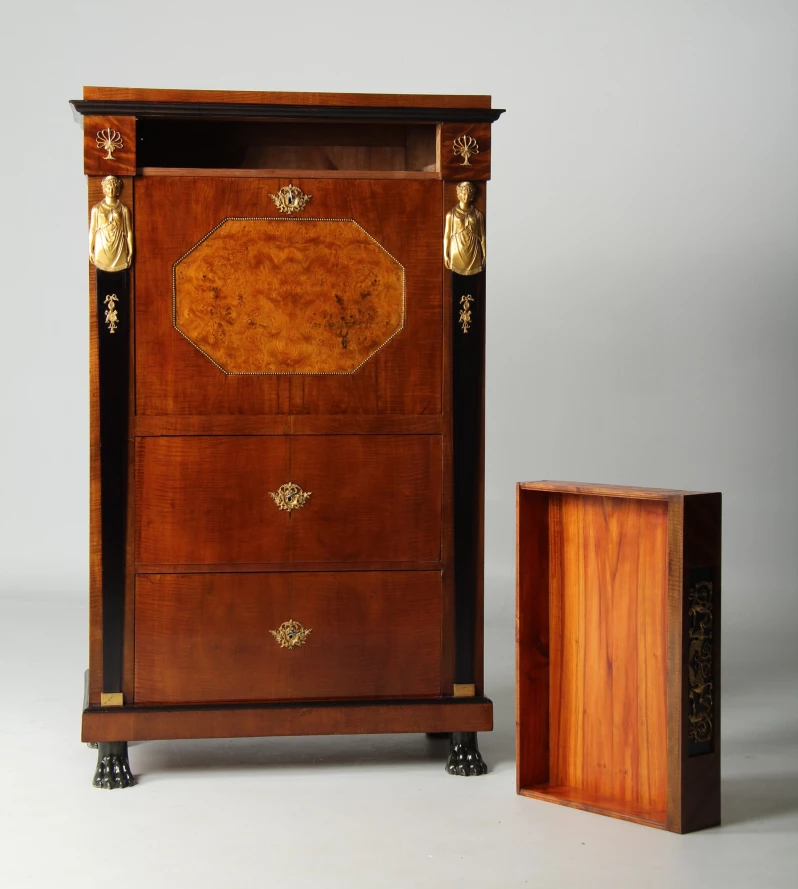
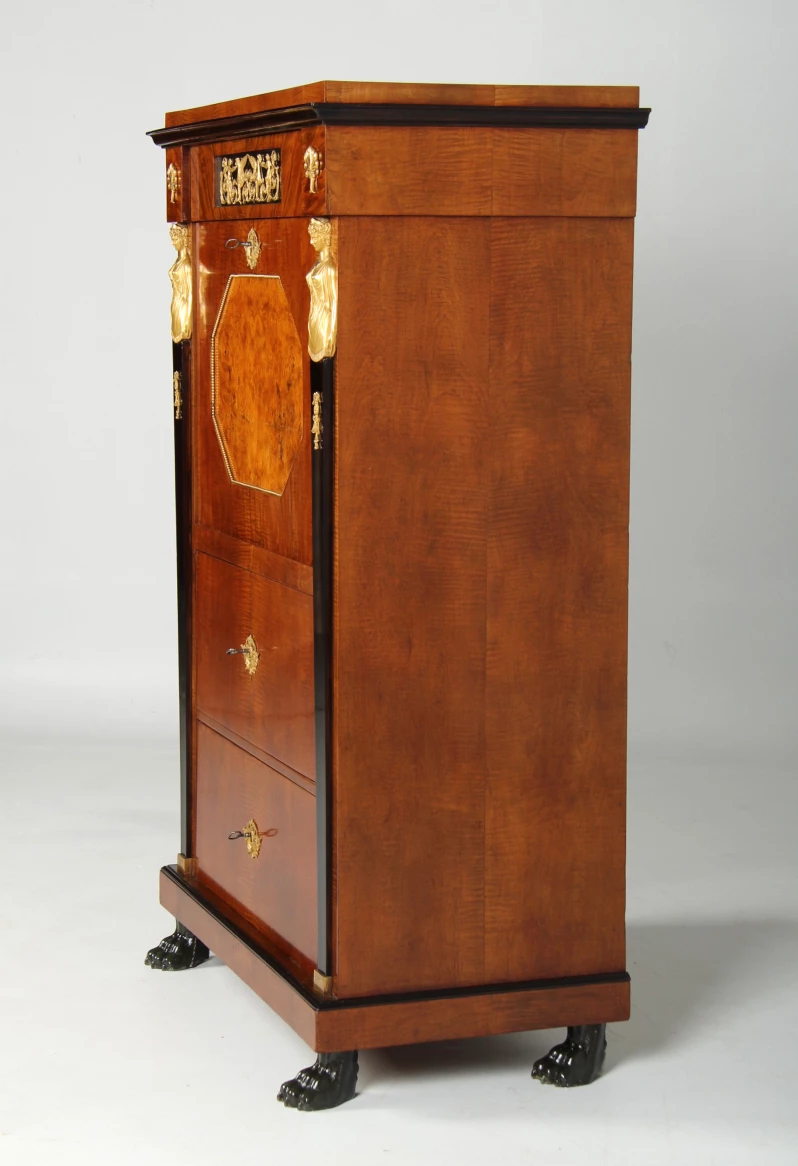
Rare and highly refined Berlin writing cabinet from the early 19th century in very delicate dimensions.
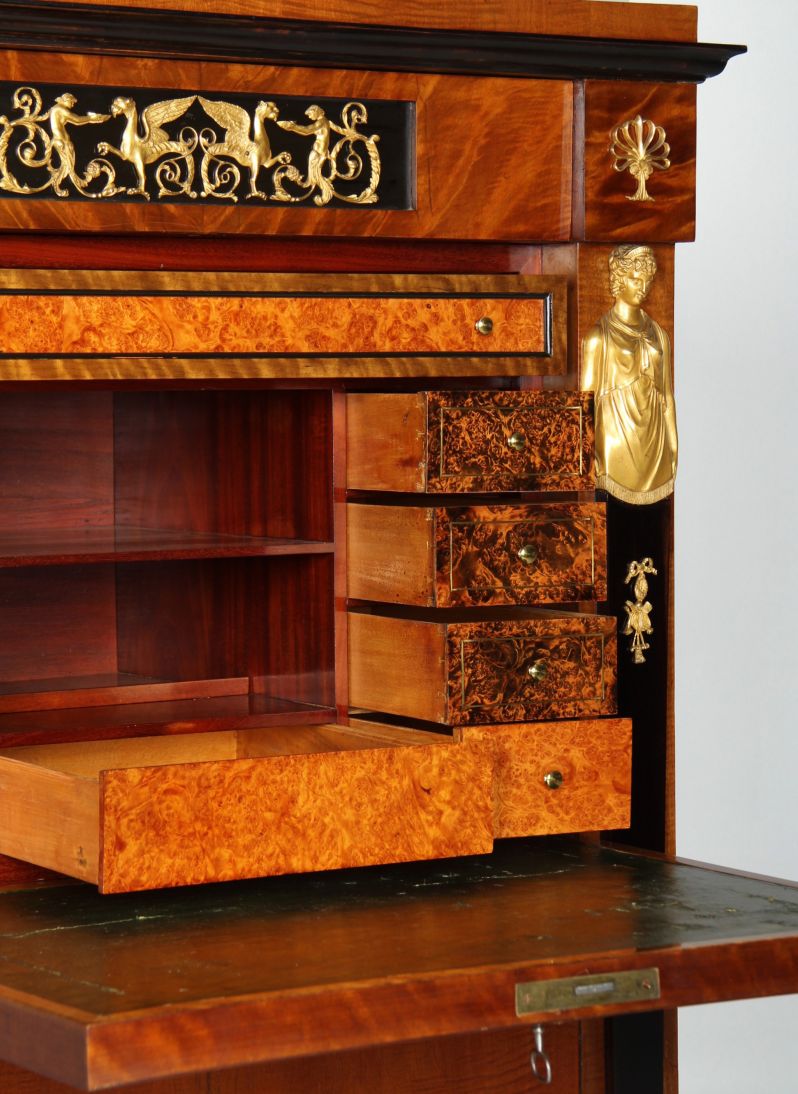
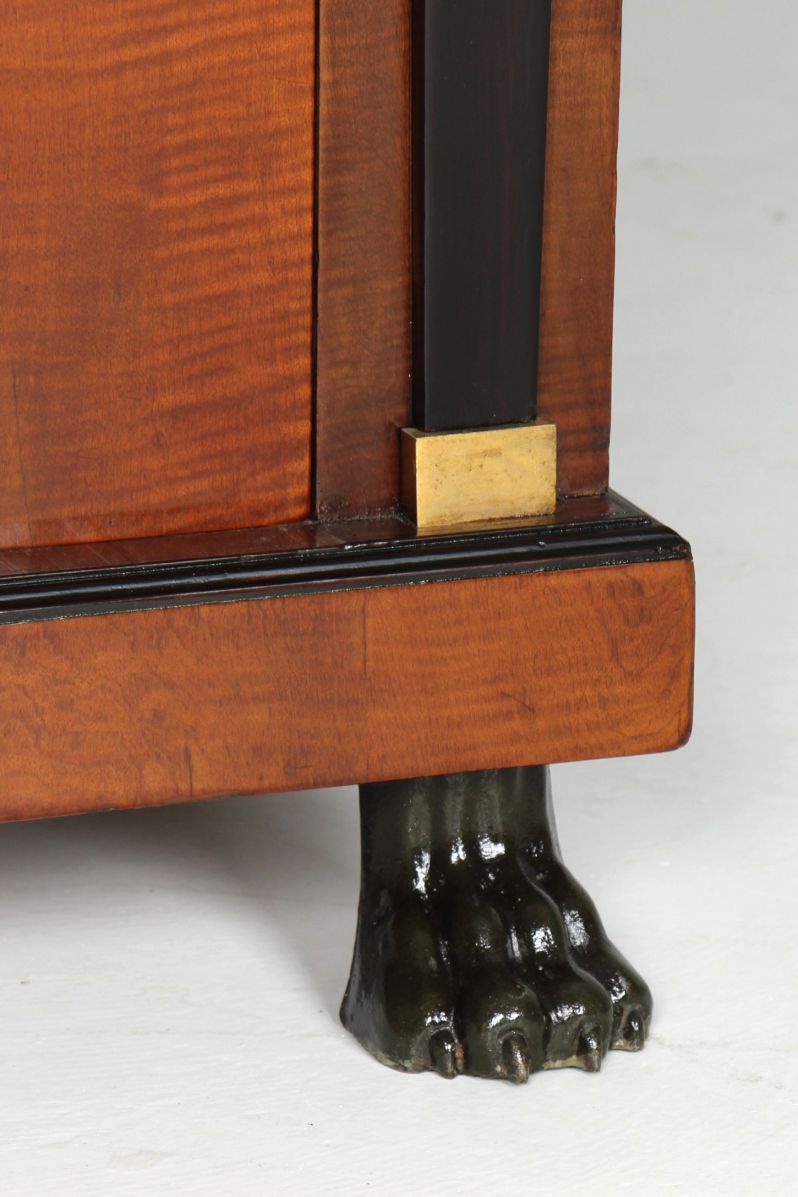
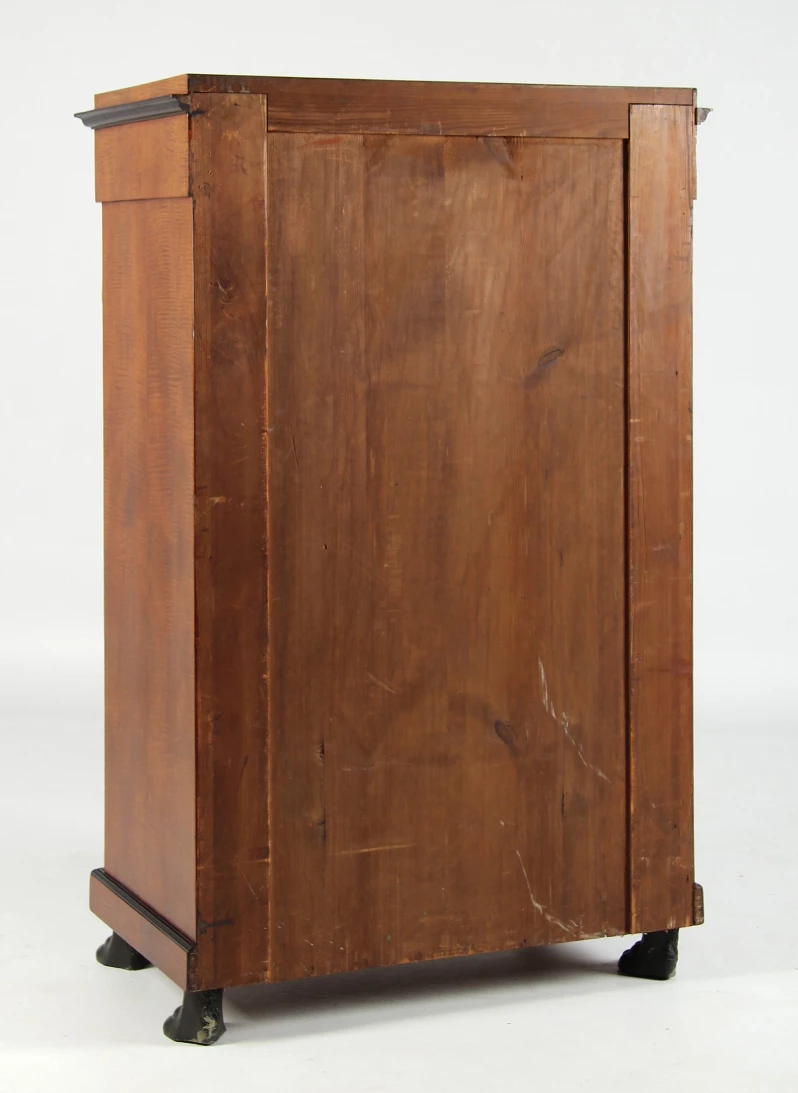
The piece of furniture stands on cast iron lion's paws with two large drawers at the bottom, the writing flap above and a head drawer below the moulded and ebonised cornice.
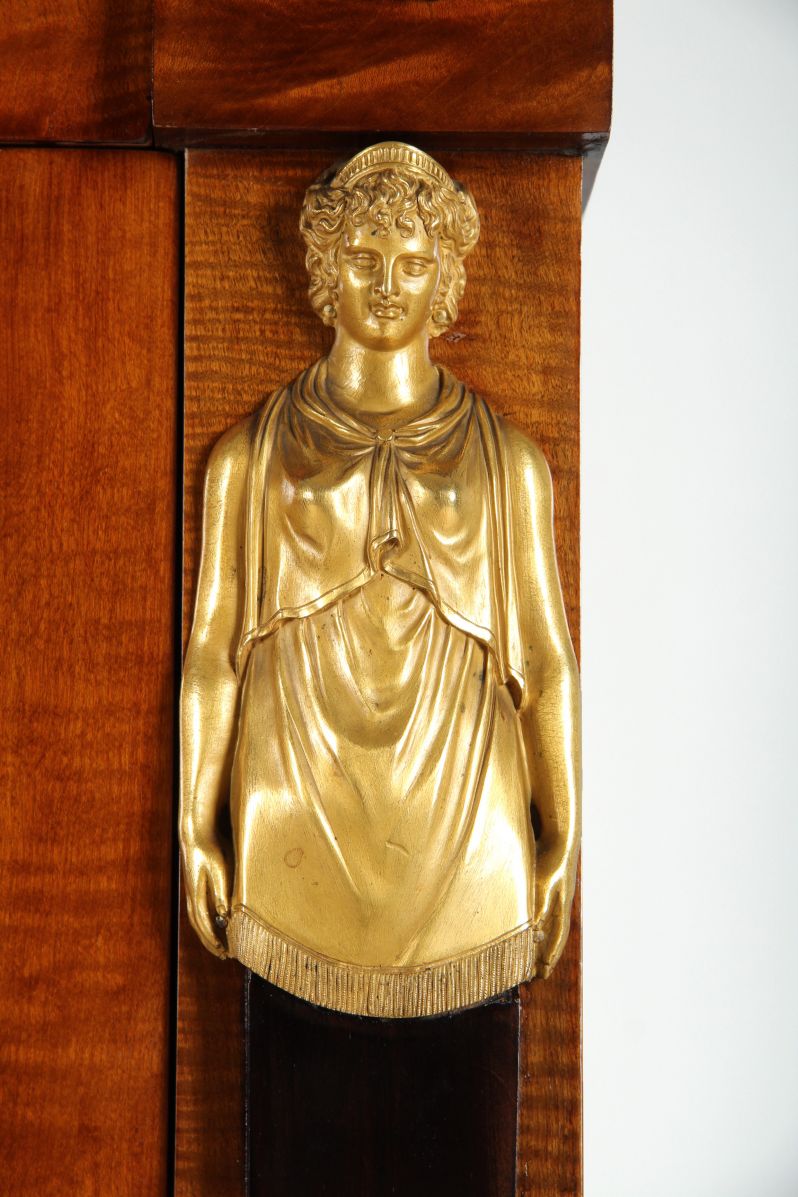
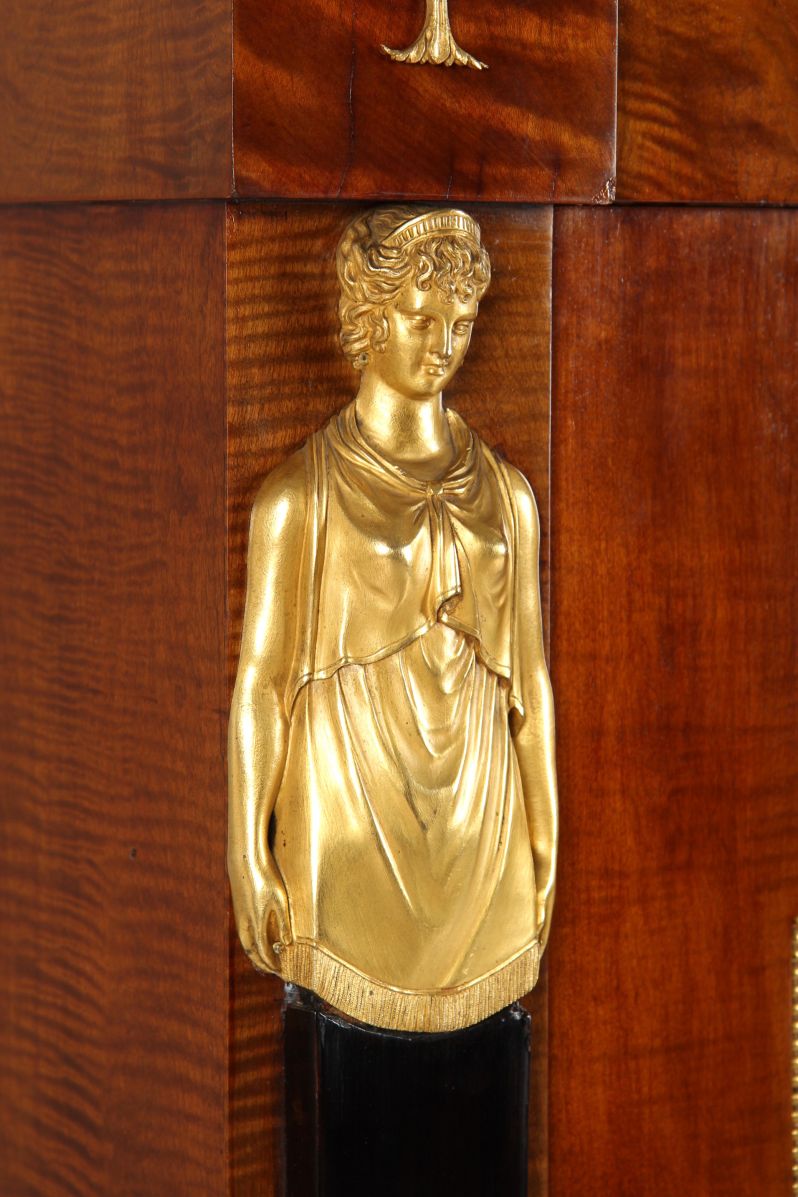
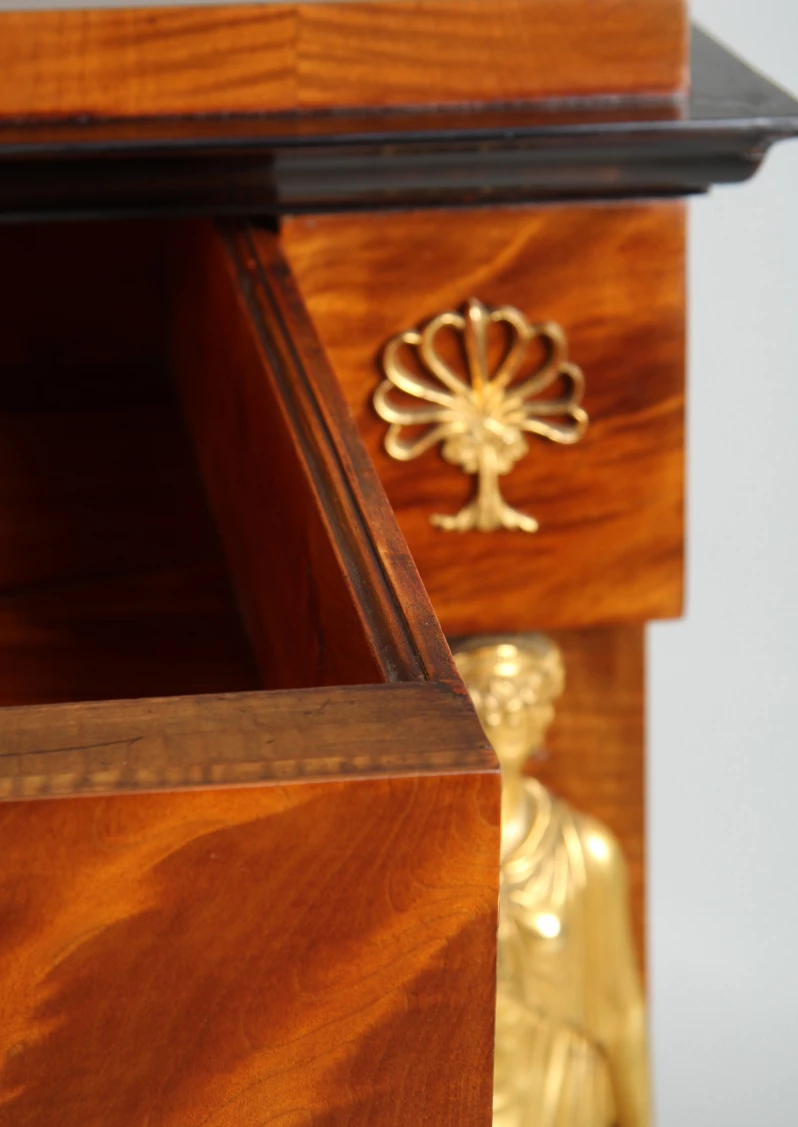
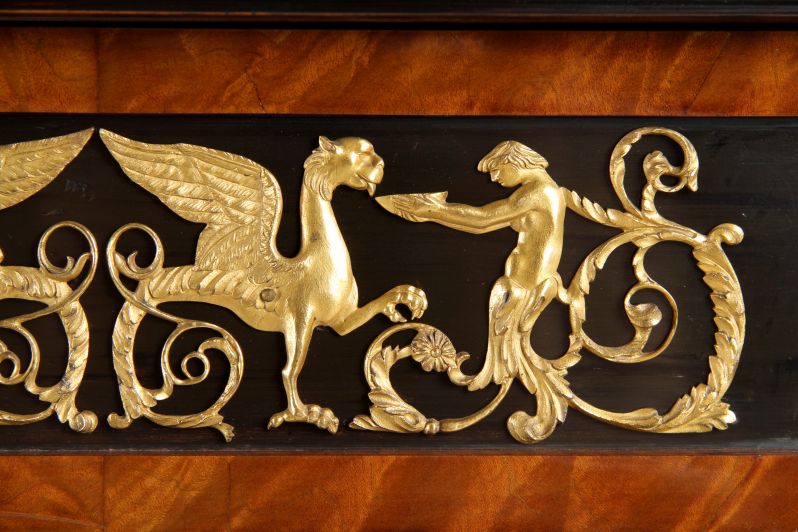
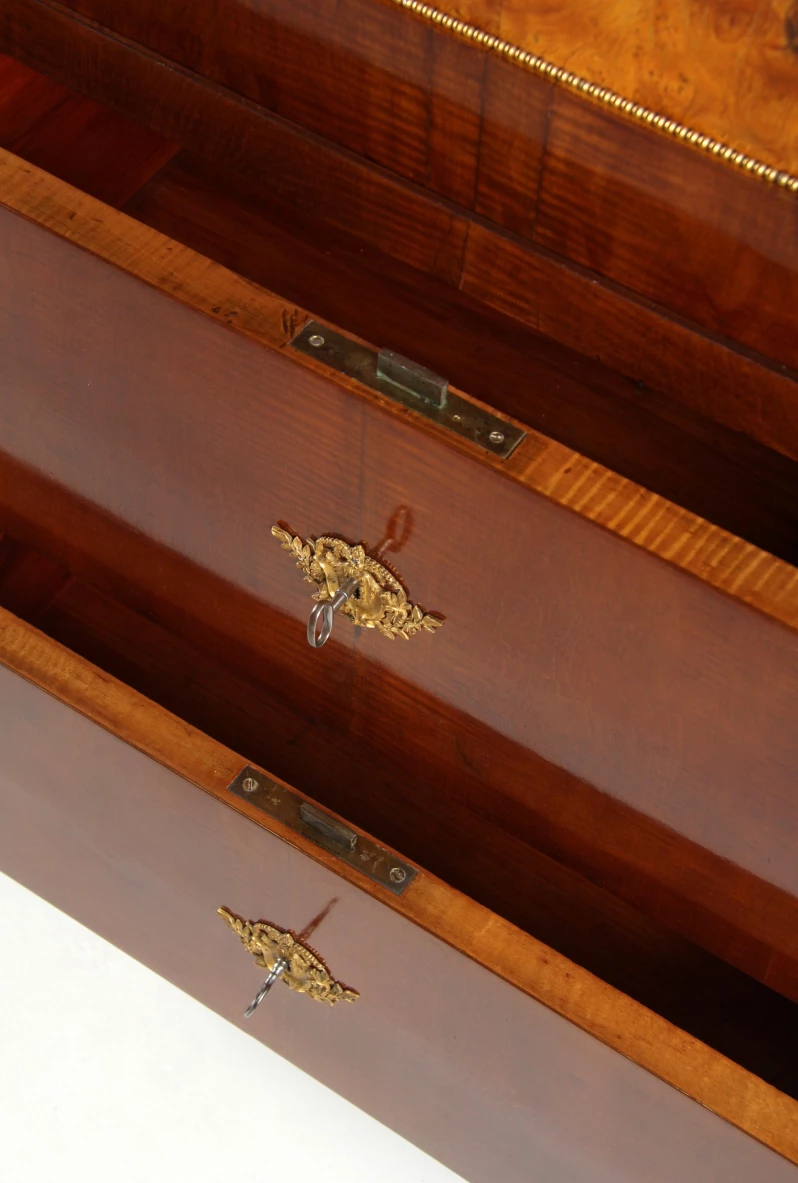
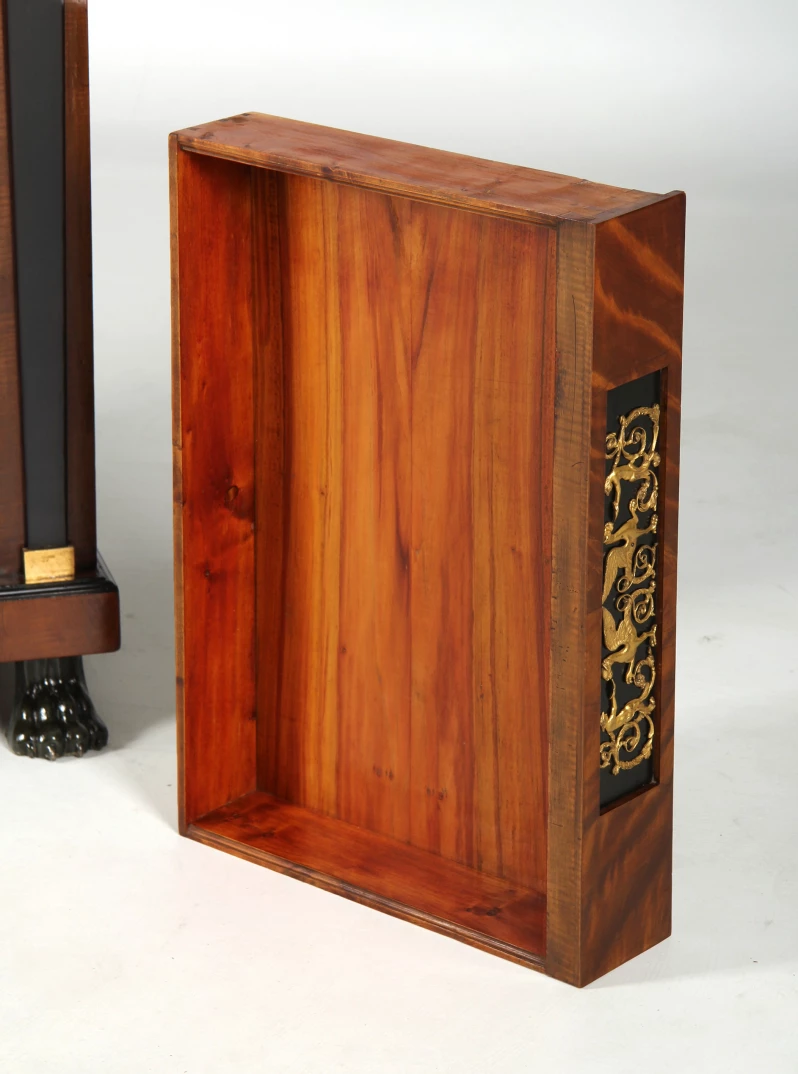
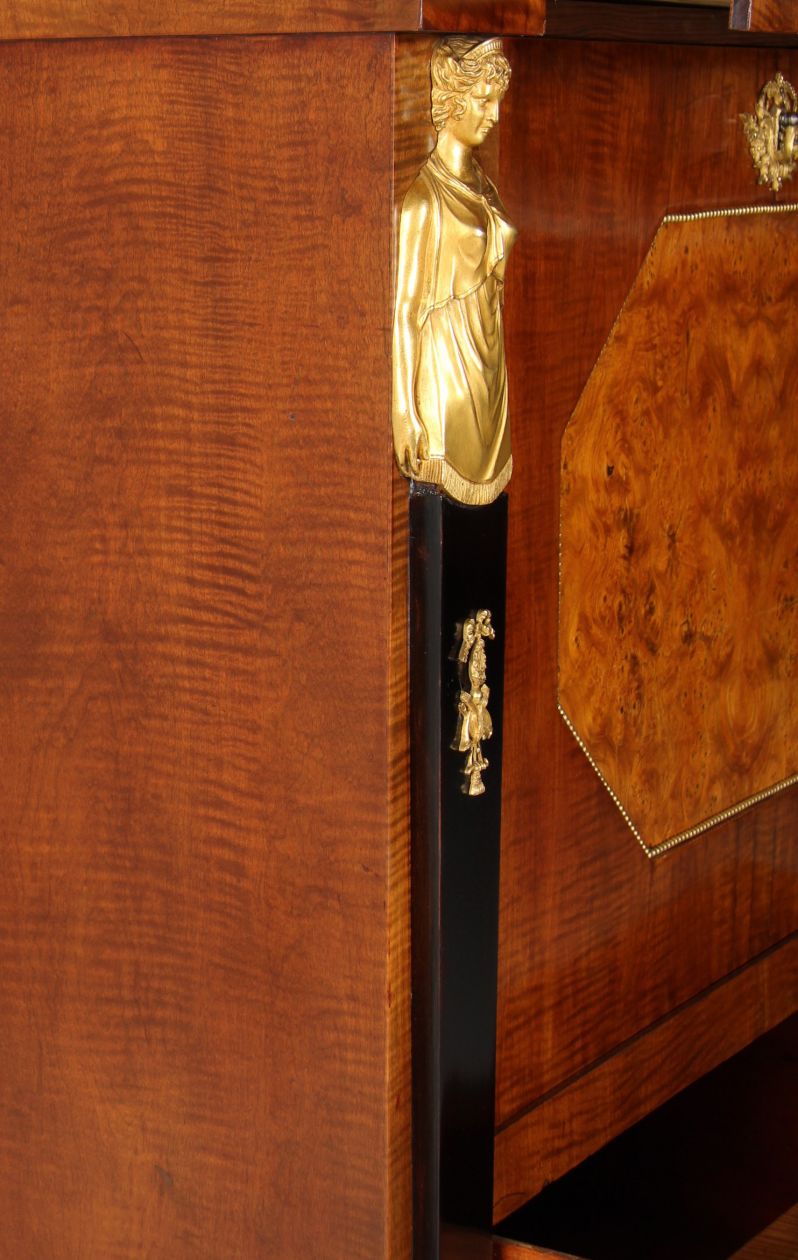
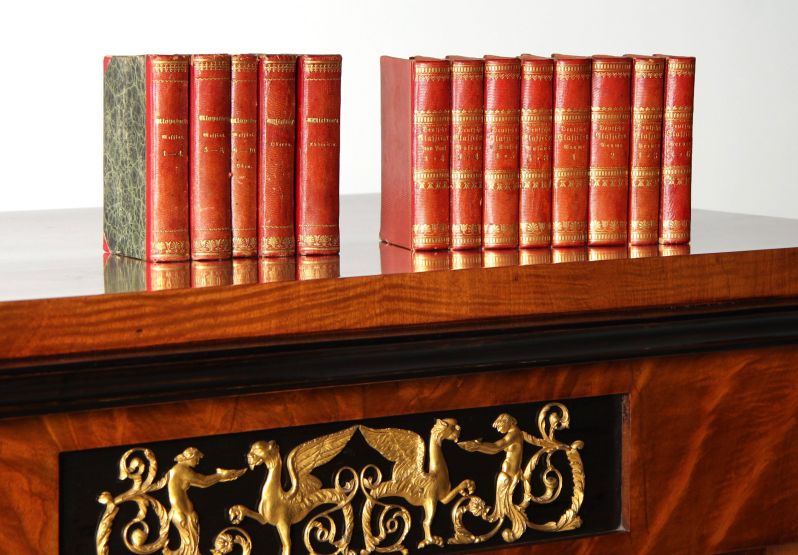
Two blackened and downwardly tapering pilasters accompany the front of the furniture on the left and right. They are crowned by two cast and fire-gilded bronze busts of the highest quality. The busts are complemented by keyhole fittings, which are also excellently crafted, and griffins mounted on a black background and surrounded by water-dispensing servants and tendrils.
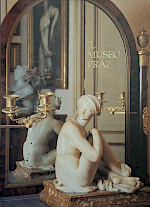
The mounting of bronzes on a blackened background was widely practised in Berlin classicism. The strong colour contrast enhanced the effect of the fire gilding and the fineness of the chiselling was more clearly visible without the distracting surrounding wood grain. A particularly fine example of this, very similar to the piece of furniture offered here, can be found on a chest of drawers and a secretary in the Museo Mario Praz in Rome [see Patrizia Rosazza Ferraris - Il Museo Praz p. 30]. Here too, mythical creatures surrounded by tendrils are arranged symmetrically in a black rectangular field and are of the finest quality. The bronzes were supplied by Werner & Mieth, a foundry founded in 1792, which was regarded as the leading Berlin manufacturer of artistic bronzeware in the early 19th century. The company made a name for itself primarily through the high-quality realisation of Karl Friedrich Schinkel's designs and thus also came into contact with the cabinetmaker Karl Wanschaff, who worked for Schinkel and to whom the furniture now kept in Rome is attributed.
The flourishing craftsmanship in Berlin in the late 18th and early 19th century is due, among other things, to the dismantling of the guild monopolies. From the mid-1790s, numerous bronze casters and gilders founded and established themselves. In addition to Werner & Mieth, Hanff, Ermisch, Schröder and Ravené should be mentioned here. It is not clear which foundry produced the bronzes mounted on the piece of furniture on offer here.
In addition to the bronzes, the secretary offered here also attracts attention through the choice of wood and the colouring of the wood. For example, maple veneer was used all over the outside instead of the expected mahogany.
The increased use of European woods in the early 19th century is directly linked to the revolutionary and trade wars between England and France, as a result of which the import of exotic woods from the West Indian colonies came to an almost complete standstill. After decades of specialising in the processing of mahogany wood in Berlin, it was now necessary to use high-quality alternatives from domestic sources. The desire to become permanently independent of imports led to a legal ban on the import of exotic woods in Prussia and the awarding of bonuses for the successful processing of local material. Whereas European woods had previously only been used in small quantities - for example as a light contrast to the dominant mahogany - they initially appeared in the period around 1800 with an equal design presence and then completely replaced the tropical woods in the following years.
In order to imitate the valued effect of the tropical veneer, the Berlin workshops now also specialised in the further development of staining and surface techniques: light woods were darkened to match the colour of mahogany. This technique can also be seen in the secretary presented here - its relatively dark surface is due to the intensive staining of the maple used.
The use of veneer cut from burls also became increasingly popular at this time, but also posed special technical challenges: For example, these veneers tended to warp much more than sheets cut from the straight trunk and ensured that the great art of veneering was further perfected in Berlin.
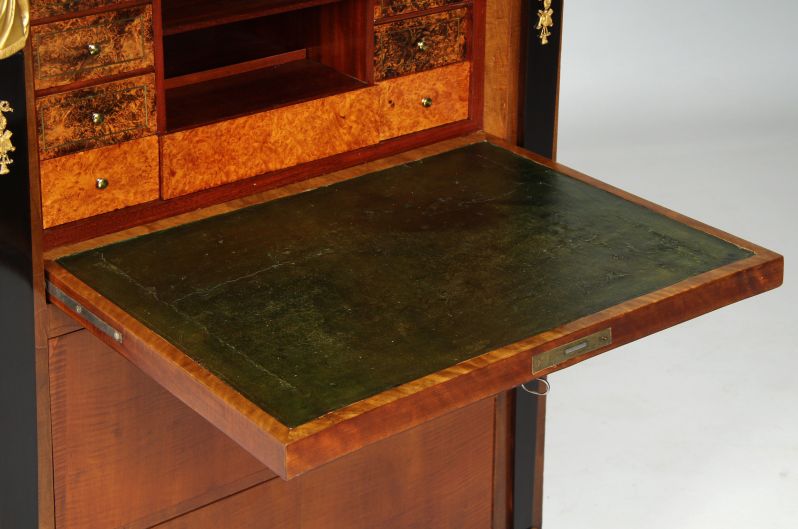
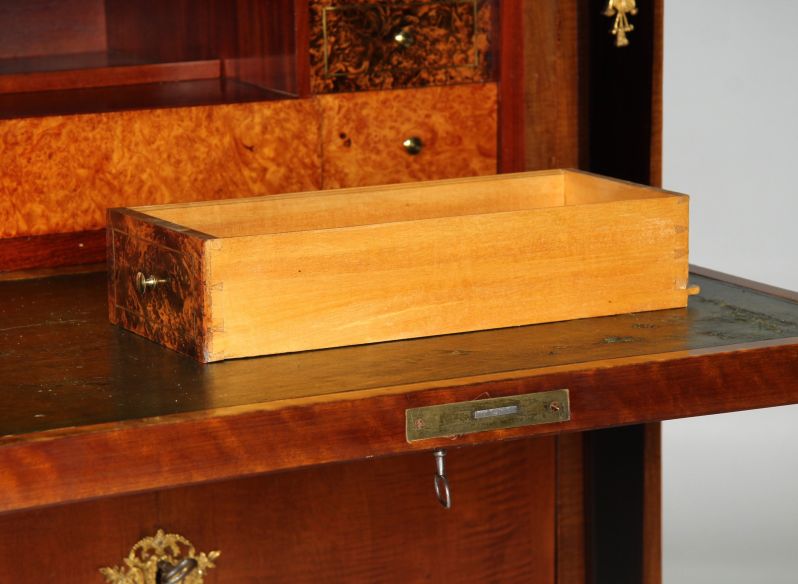
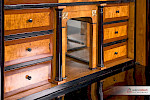
When we open the writing flap, we are presented with an interior veneered in these same burl woods above the leather-covered writing surface. The light and dark stained woods are geometrically veneered in the style of early classicism with brass string inlays and dark-coloured wood. Smaller remnants of simply grained mahogany were used for the outer border of the writing compartment and the central open compartment.
The secretary offered here is therefore an excellent example of early 19th century Berlin furniture making. It combines dark-stained maple with variously coloured burl woods and is complemented by finely chiselled, elaborately gilded bronze contours.
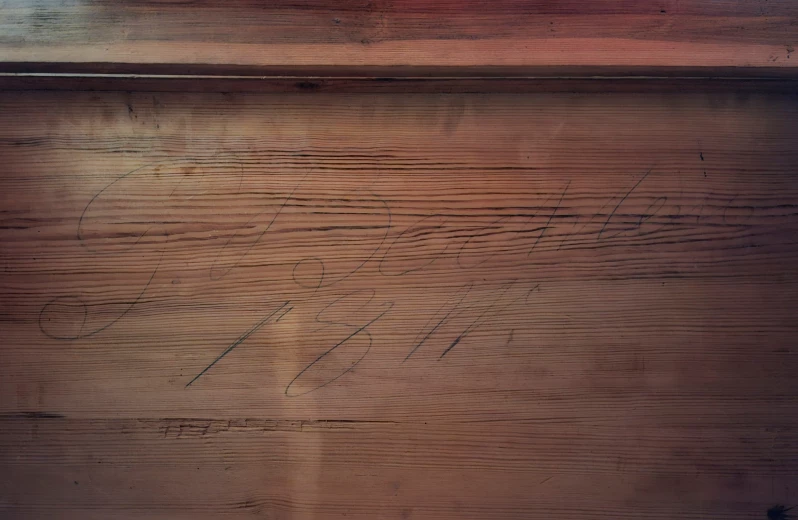
Below the top plate is a barely legible signature: G. Beuthen (?) 1801 or 1811 (see photo).
Condition:
Restored with a shellac hand polish to preserve the patina. The bronzes have been lightly cleaned and are in a very good and authentic condition together with the gilding.
Price: 15500,-€
Please compare the following specialised literature:
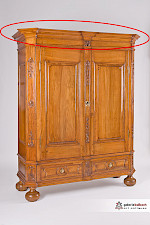
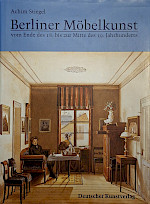
Achim Stiegel - Berliner Möbelkunst vom Ende des 18. bis zur Mitte des 19. Jahrhunderts S. 97, 493
Patrizia Rosazza Ferraris - Il Museo Mario Praz S. 30
Article found under: Secretaries
Add to shopping cartVideo Berlin secretary with bronze busts
Also interesting
Secretary with Architectural Marquetry
Italy
Rosewood a.o.
second half 18th century
Small Flensburg secretary
Schleswig-Holstein
Mahogany and others
Biedermeier around 1815
La Bibliotheque - In the study room
Paris
fire-gilt bronze, enamel
Empire around 1820