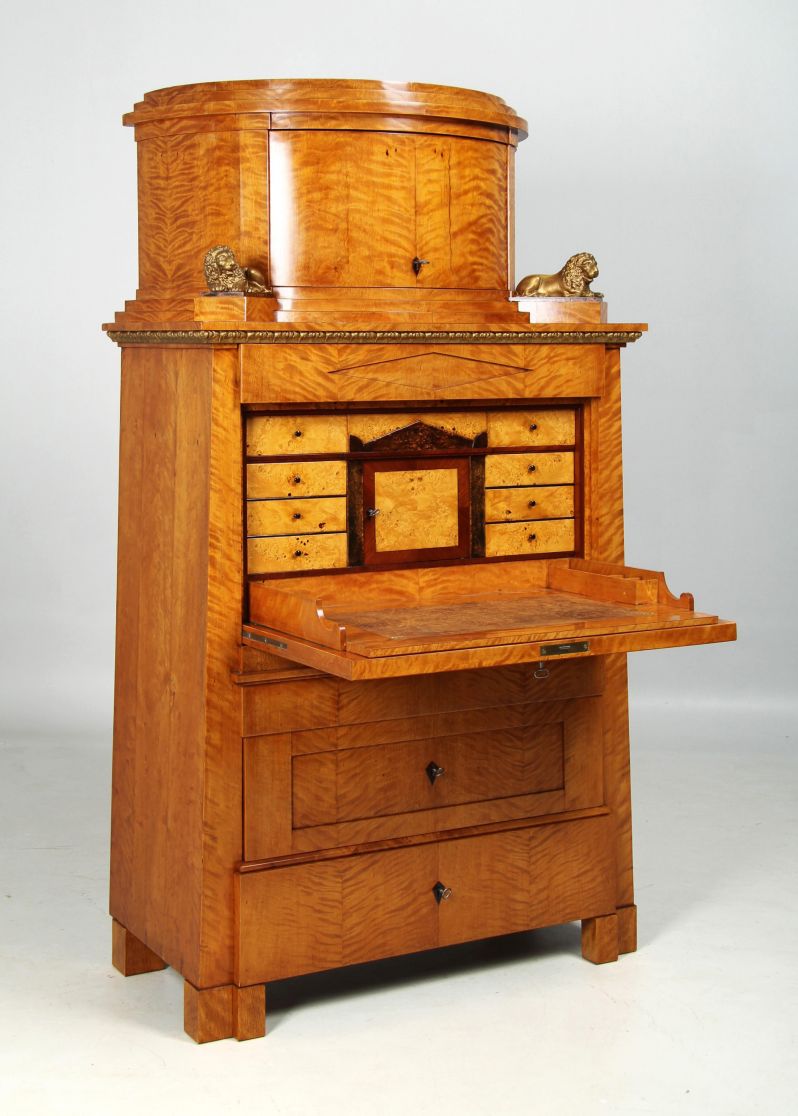
Video conical Biedermeier secretary
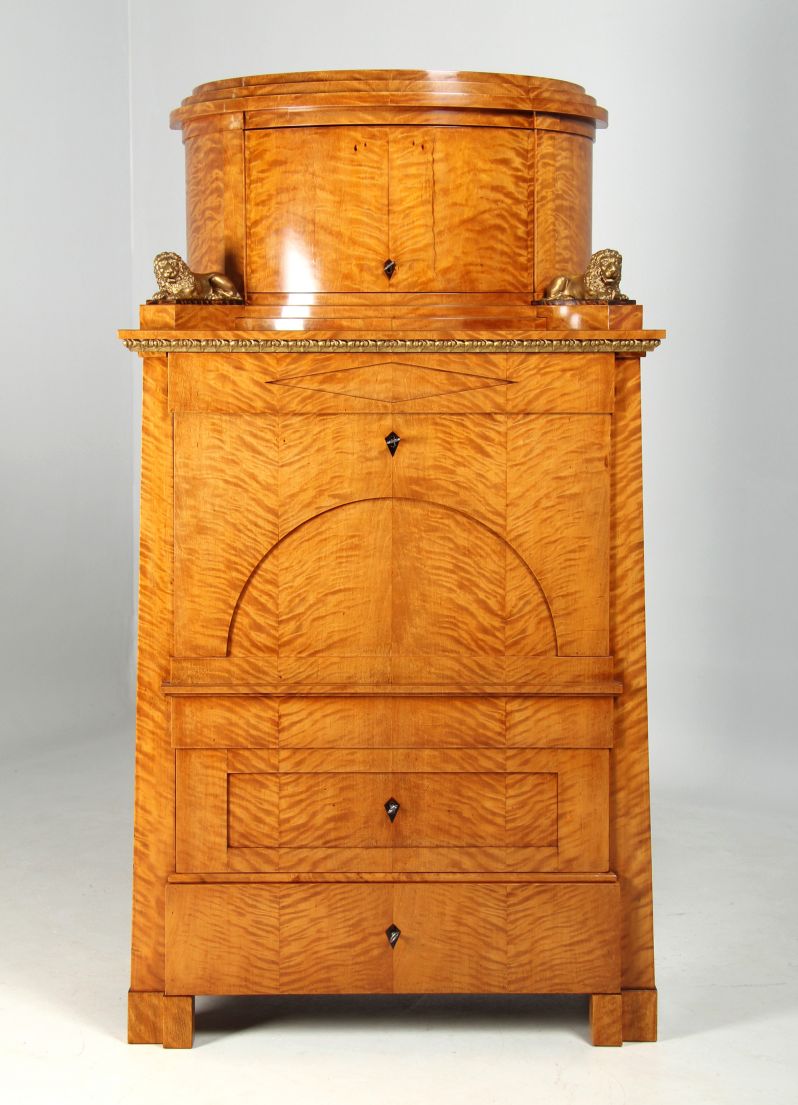
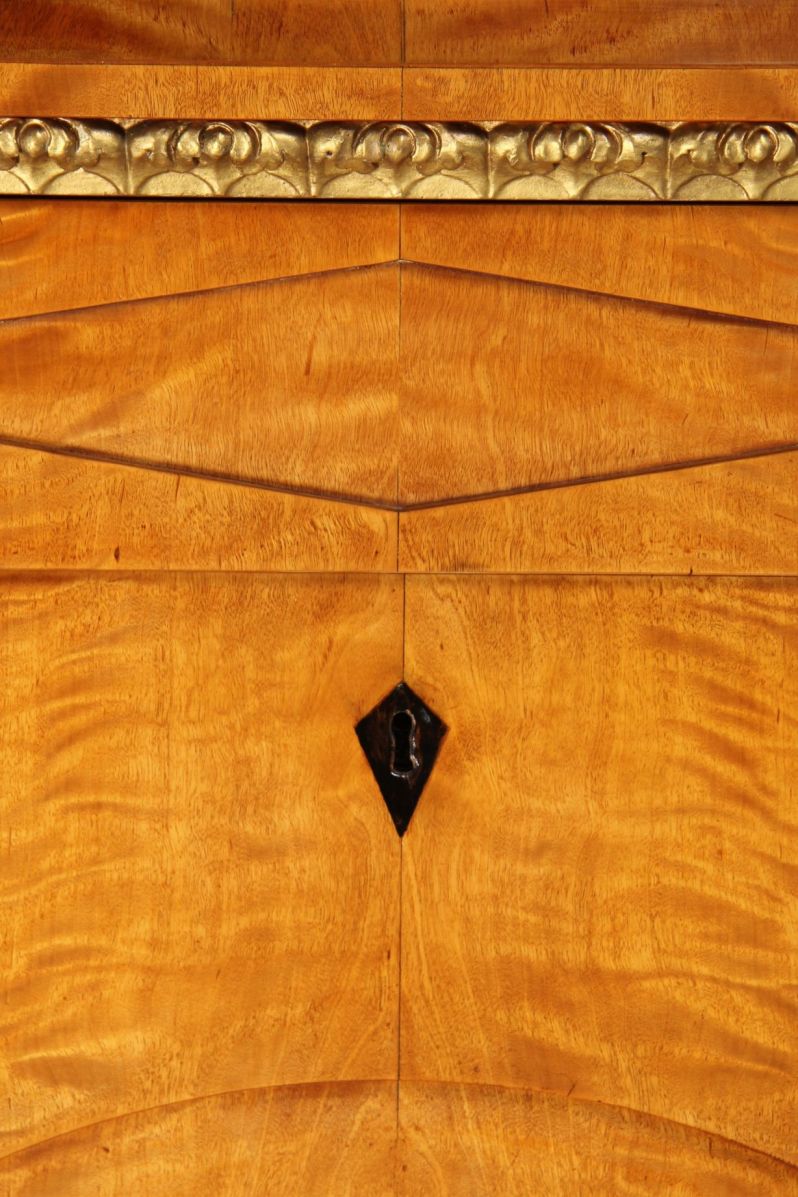
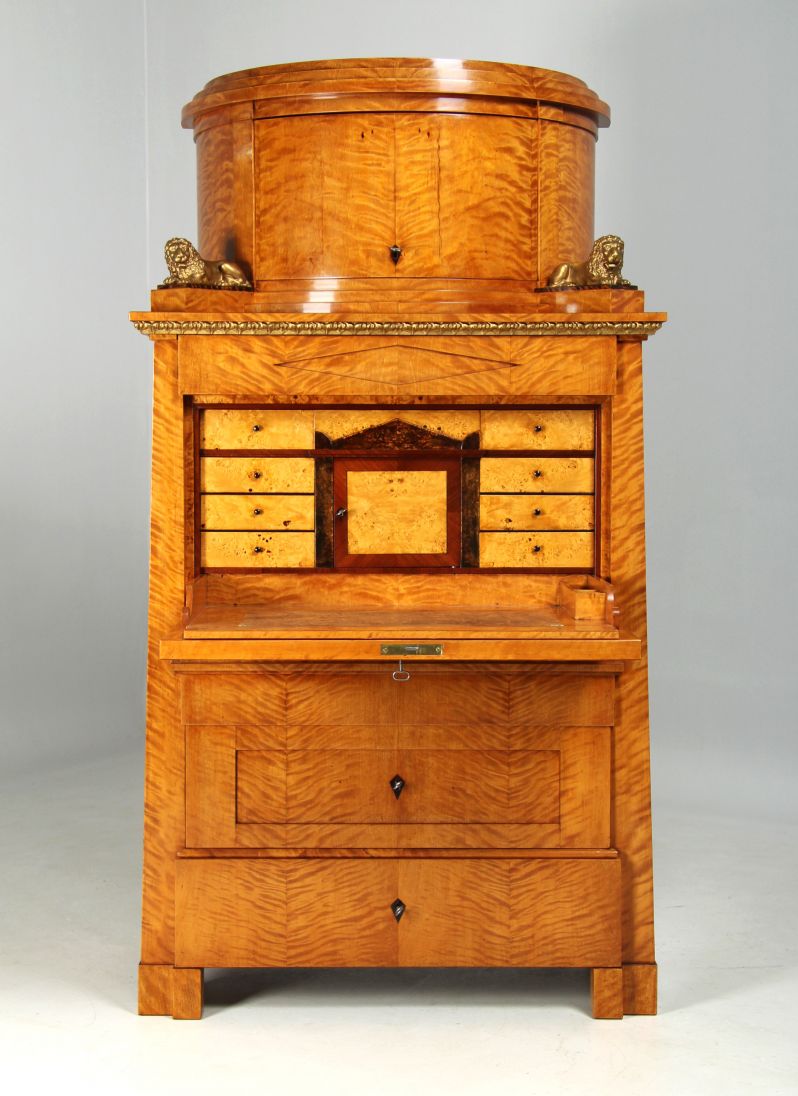
Antique Biedermeier secretary in conical form
Berlin / Brandenburg
Birch tree
Biedermeier around 1825
Dimensions: H x W x D: 186 x 101 x 52 cm
Description:
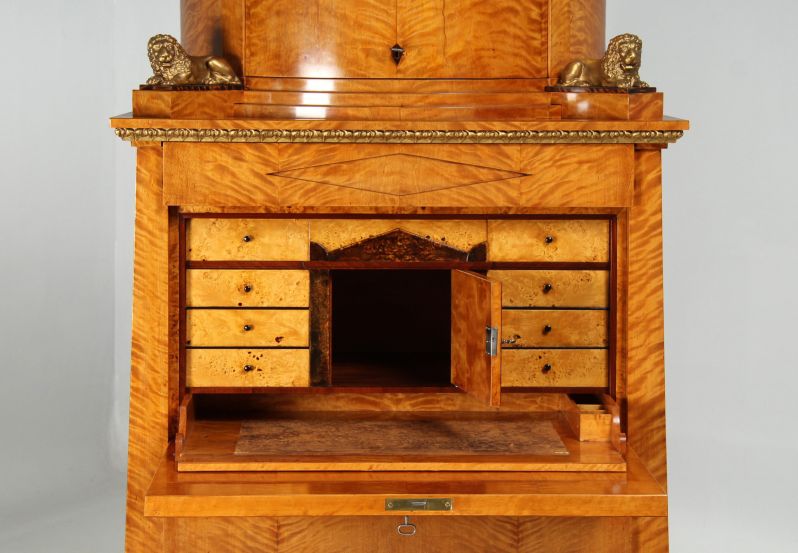
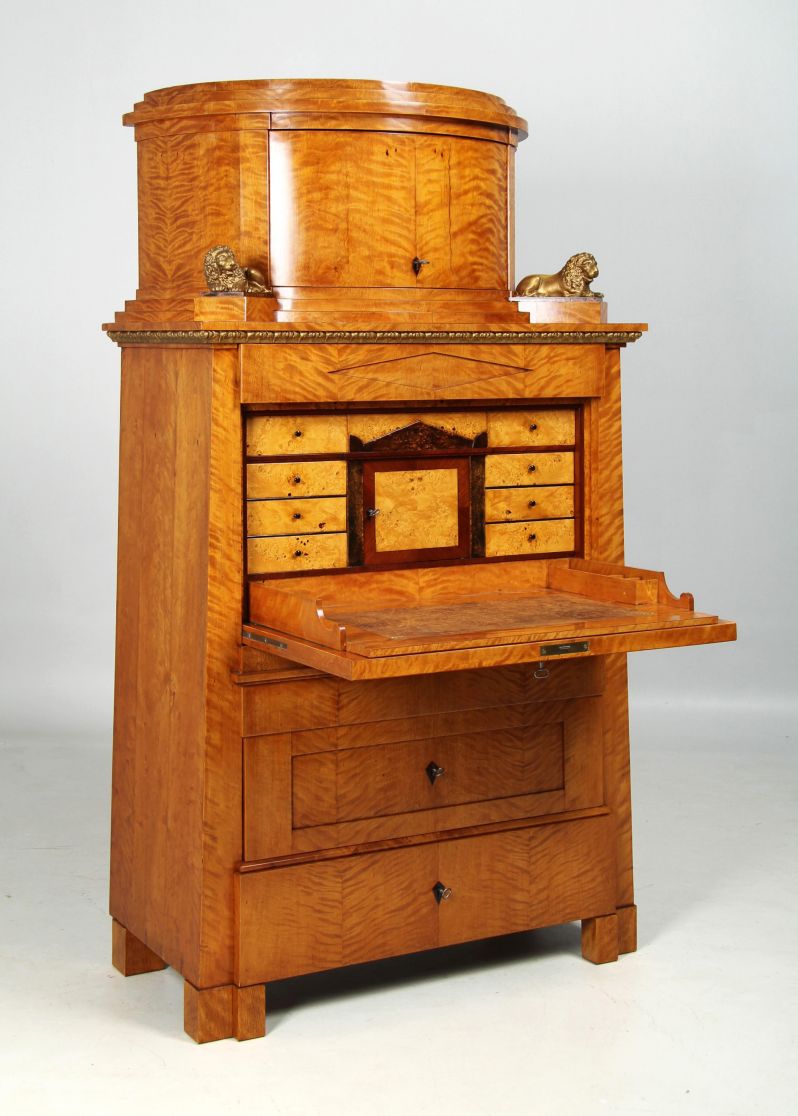
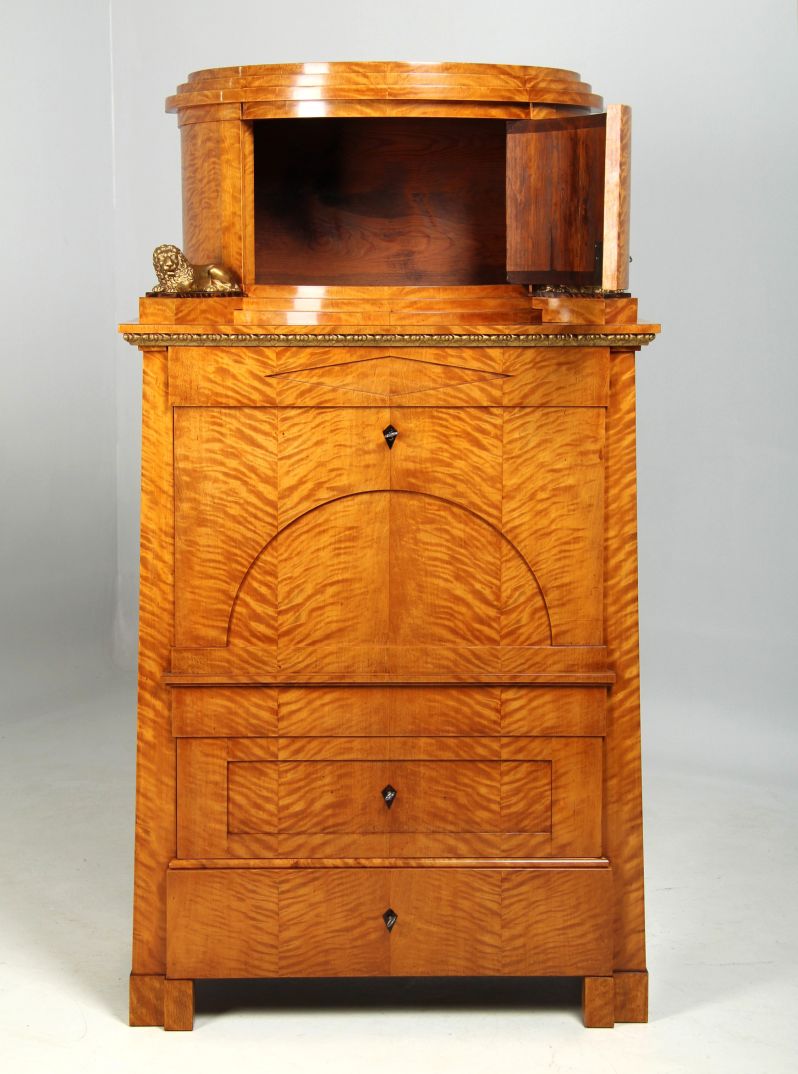
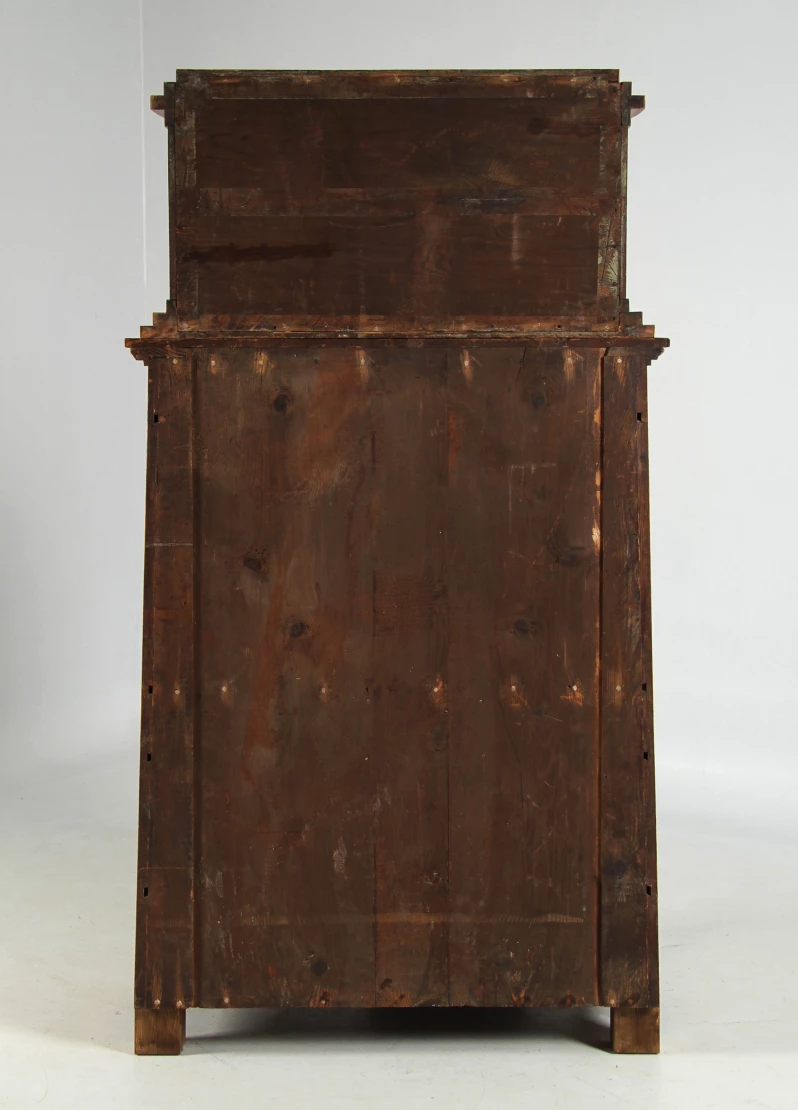
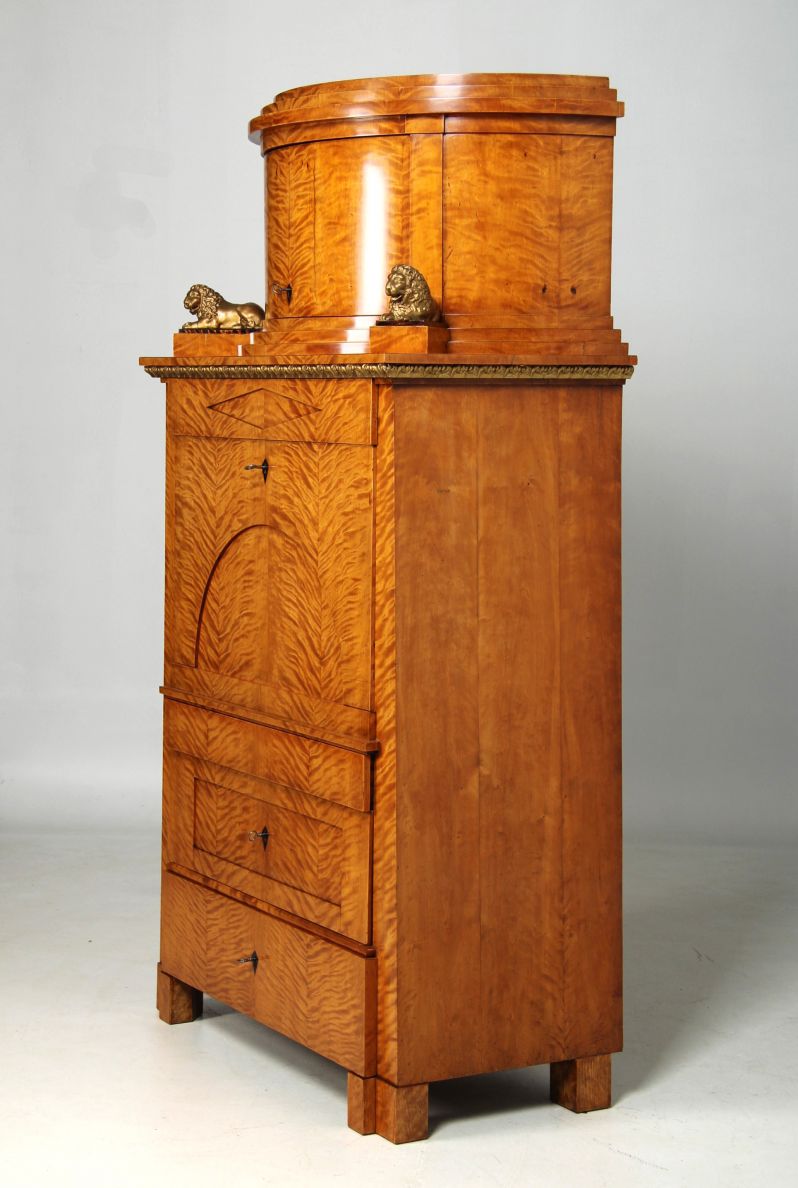
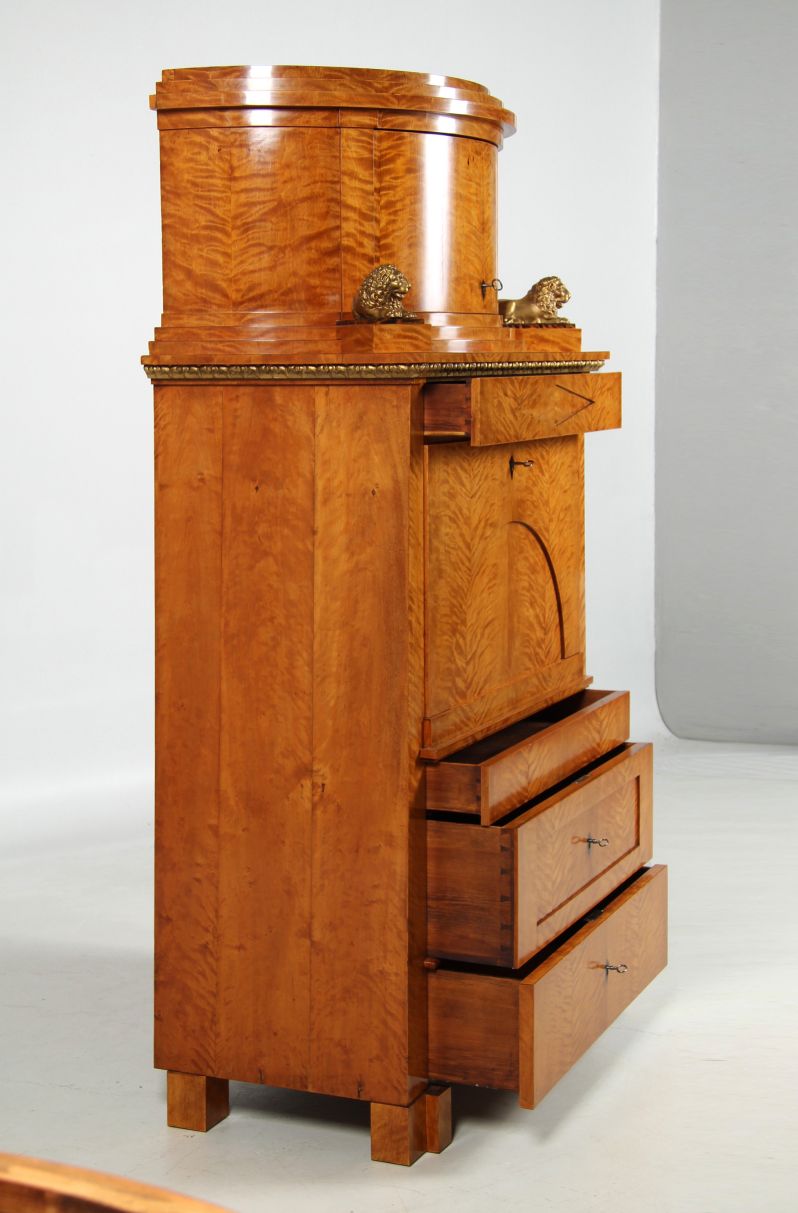
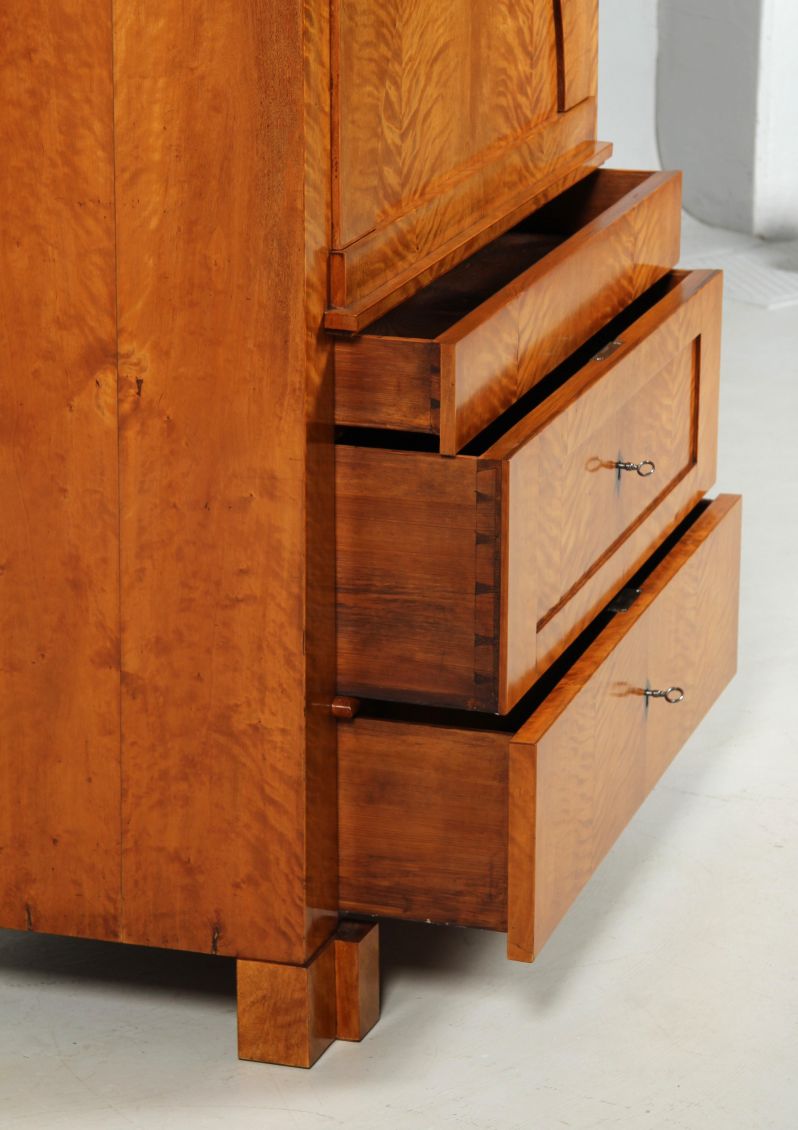
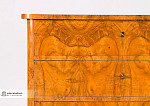
Extravagant Biedermeier secretary from the Berlin-Brandenburg area with several features characteristic of this region. These include the block feet that follow the shape of the body, the drawer fronts that protrude beyond the depth of the body, the segment-like recessed panels, the striking flamed birch veneer and the tapered body shape, which tapers from 100 cm wide at the bottom to 92 cm below the moulding.
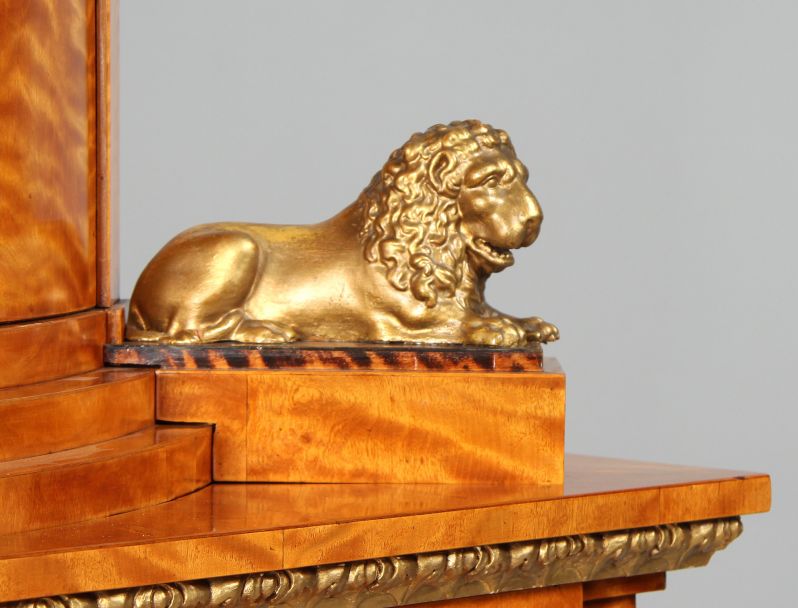
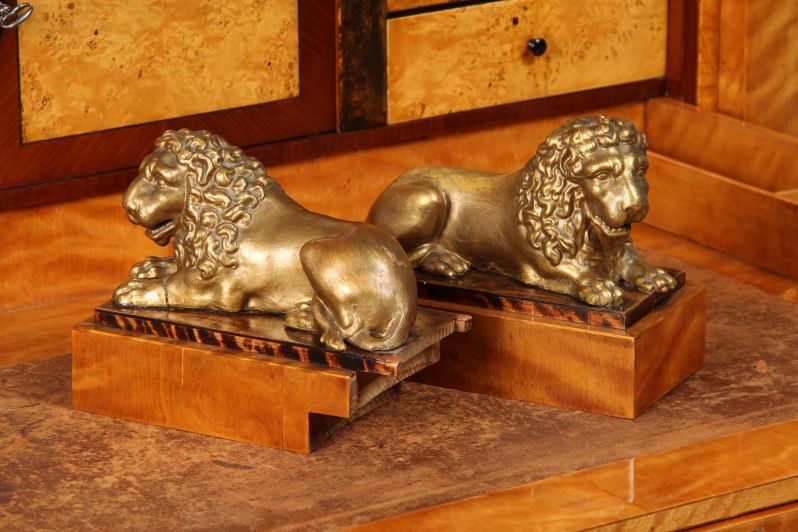
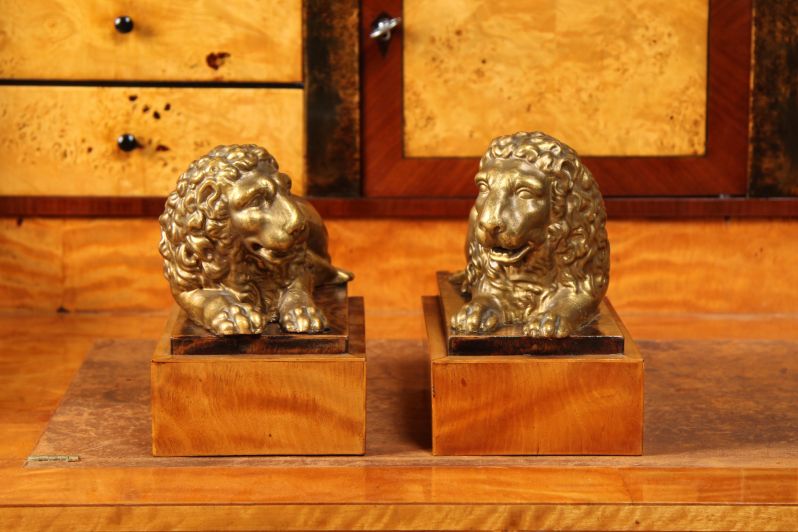
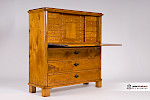
The two-part structure is divided into a substructure with four drawers and a writing flap and a crescent-shaped, single-door top hat box with two bronze lions. These are located to the left and right of a semi-circular staircase, which in turn is complemented by the stepped cornice at the very top.
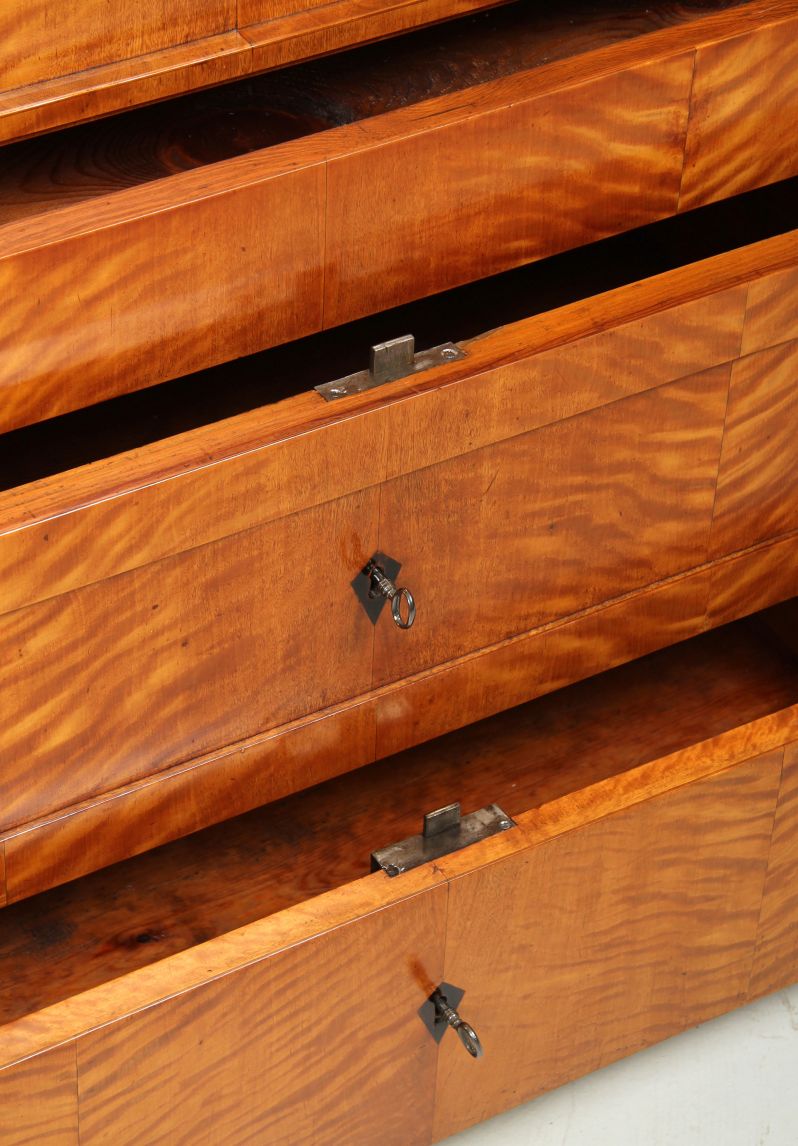
The oil gilding of the lions corresponds with the horizontal moulding, which visually divides the furniture into an upper and a lower section. The aforementioned segmentations in rectangular, semi-circular and diamond shapes break up the flatness of the front. The dark key plates on the centre axis emphasise the strict symmetry of the unit.
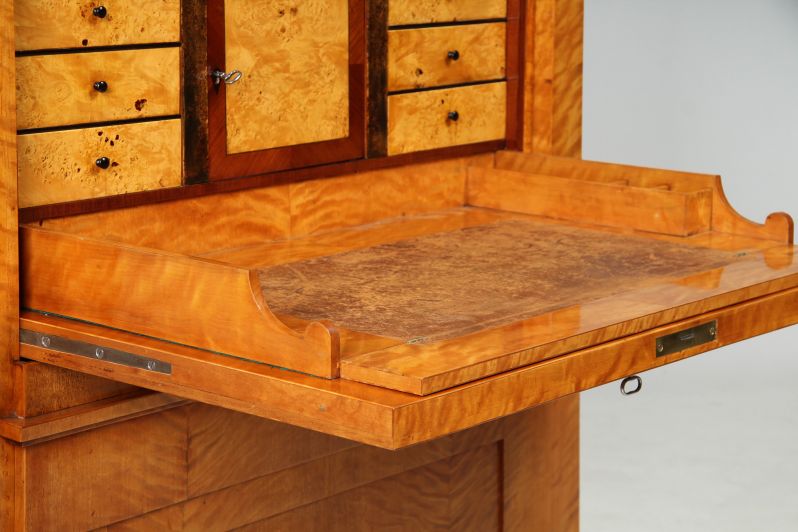
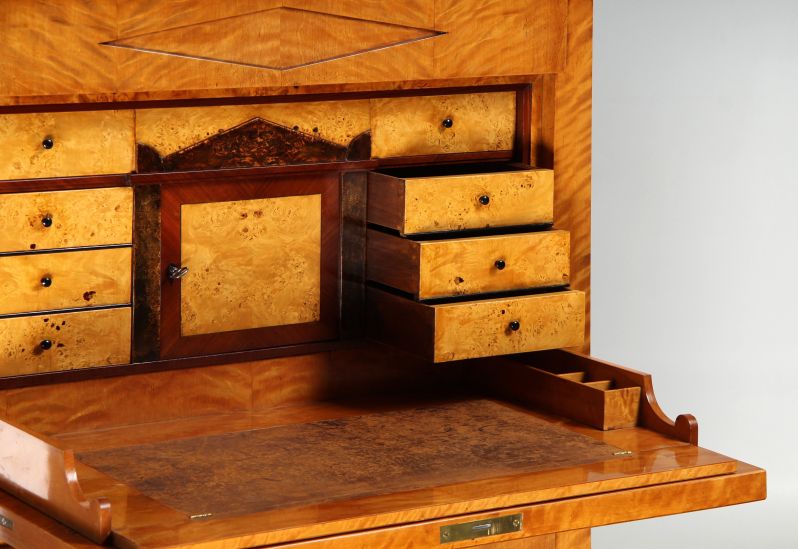
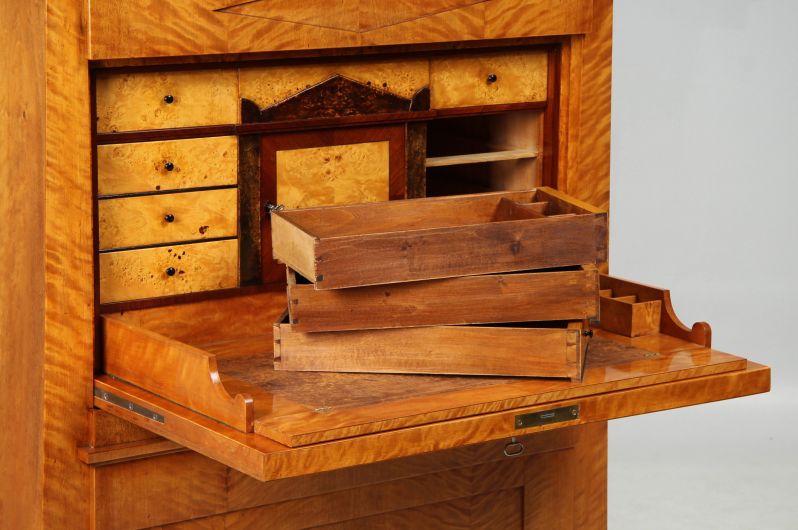
Opening the writing flap reveals a clearly structured interior veneered in light-coloured burl wood. In the lower section is a pull-out writing surface covered in leather, which protects the actual flap from signs of wear. It has a small organiser compartment that was originally used to hold inkwells, grit and nibs.
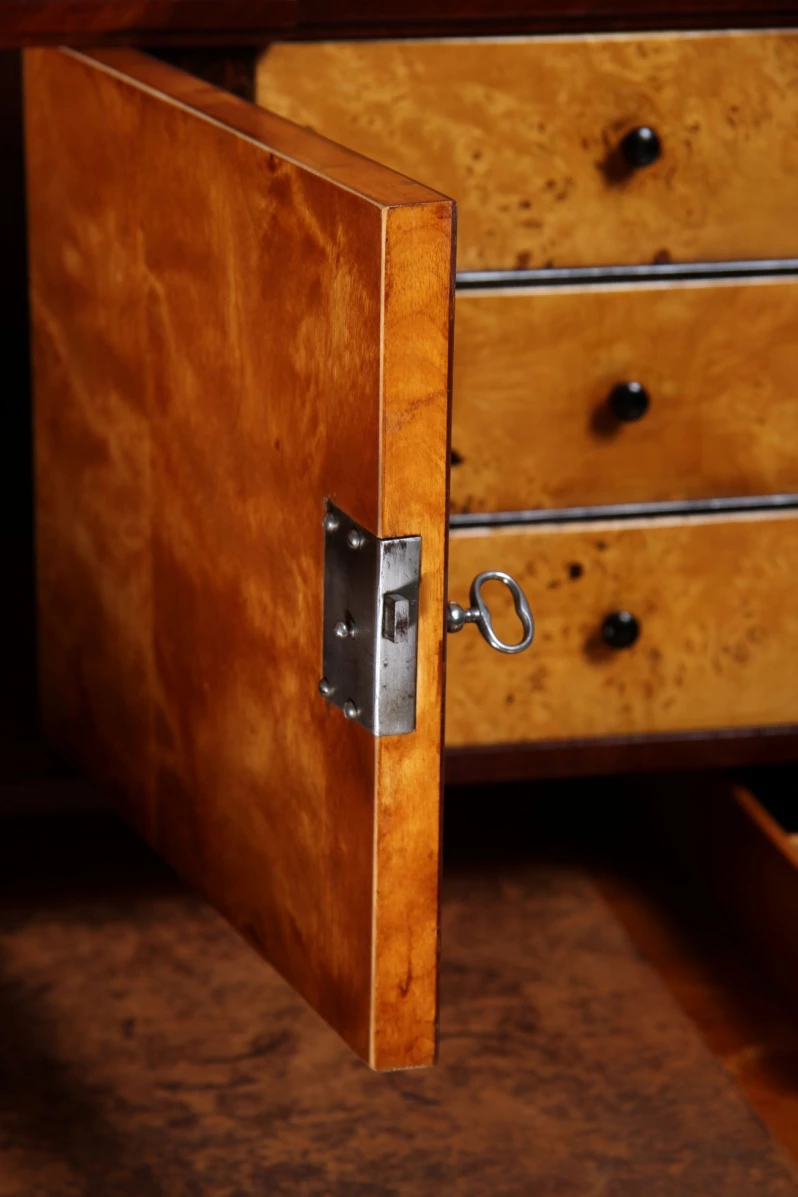
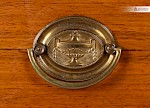
The central door is flanked by dark-stained pilasters that support a flat triangular pediment. The light-coloured wood of the drawer fronts is contrasted by dark pull handles and dark crossbars.
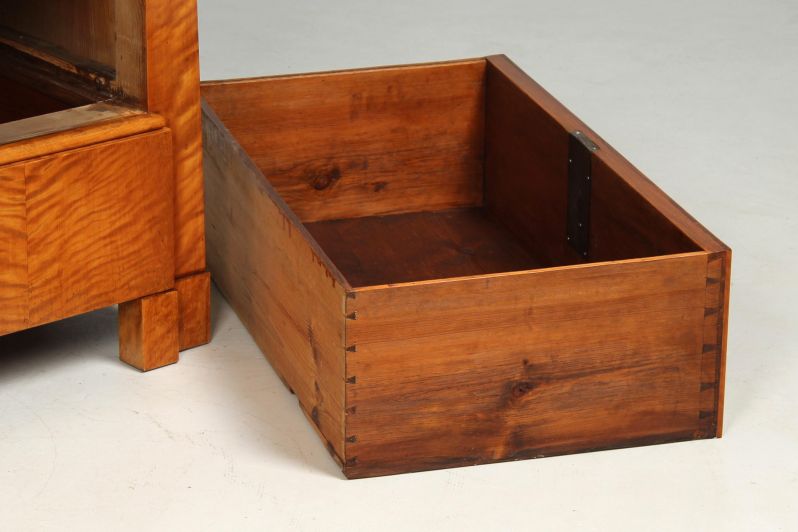
All box corner joints - both in the area of the inner compartment and the large outer drawers - are precisely crafted with classic dovetail joints.
Interesting facts:
At the beginning of the 19th century, people were looking for alternatives to the popular bronze for reasons of cost on the one hand and the threat of import restrictions due to the war with France on the other. Brass fittings were an inexpensive alternative, but because they were made from drawn, embossed or stamped sheet metal, they were limited to flat shapes and had little sculptural depth.
Against this background, so-called wood bronze gained in importance in Berlin from 1812. This new substitute material, consisting of finely ground wood shavings, clay and binding agents, could be moulded into voluminous and clearly contoured decorative elements. The inventors Schwenke and Mencke, both of whom had previously worked as modellers at the Royal Porcelain Manufactory, processed the material with remarkable finesse. As early as 1812, the material was presented in the Journal des Luxus und der Moden (Journal of Luxury and Fashion), where its precise drawing and the sharpness of even the smallest details were emphasised.
In 1815, Schwenke and Mencke applied for a patent for the "depiction of objects made from a pictorial wood mass" for Berlin and the Kurmark, which meant that wood bronze was also formally recognised as an innovation in its own right.
The production range included chandeliers and sconces as well as furniture parts such as mouldings and fittings. The rapidly growing demand meant that sixty people were already working in Mencke's workshop by 1819.
In 1822, Mencke was one of the founding members of the Association for the Promotion of Craftsmanship in Prussia. In 1823 and 1827, he was honoured with the gold commemorative coin at the Berlin trade exhibitions for his work in wood bronze.
Condition:
Excellent condition. Shellac hand polish. Leather surface with signs of wear.
Price: 10800,- €
Please compare the following specialised literature on this piece of furniture:
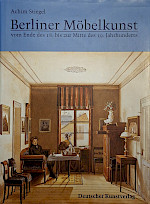
Achim Stiegel - Berliner Möbelkunst vom Ende des 18. bis zur Mitte des 19. Jahrhunderts
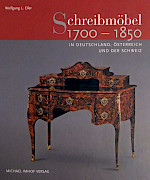
Wolfgang Eller - Schreibmöbel 1700-1850 p. 380
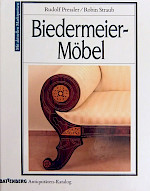
Pressler / Straub - Biedermeier-Möbel Fig. F30
Article found under: Secretaries
Add to shopping cartVideo conical Biedermeier secretary
Also interesting
Military Campaign Chest of Drawers Secretary
England
Mahogany, brass
Victorian around 1890
Classicist top-mounted secretary with elaborate marquetry
Southern Germany
Walnut and others
Classicism around 1790
Jaeger LeCoultre - Atmos Royale Ref. 5855
Switzerland
Gold-plated and lacquered brass
Year of manufacture 1980