Video cylinder secretary
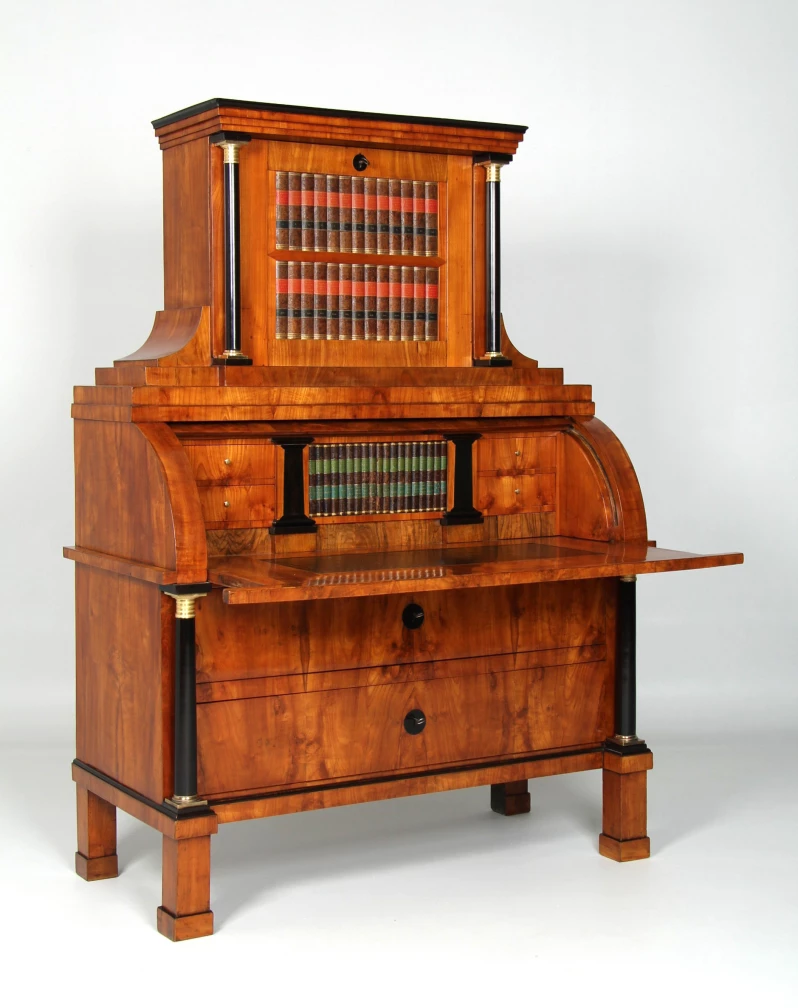
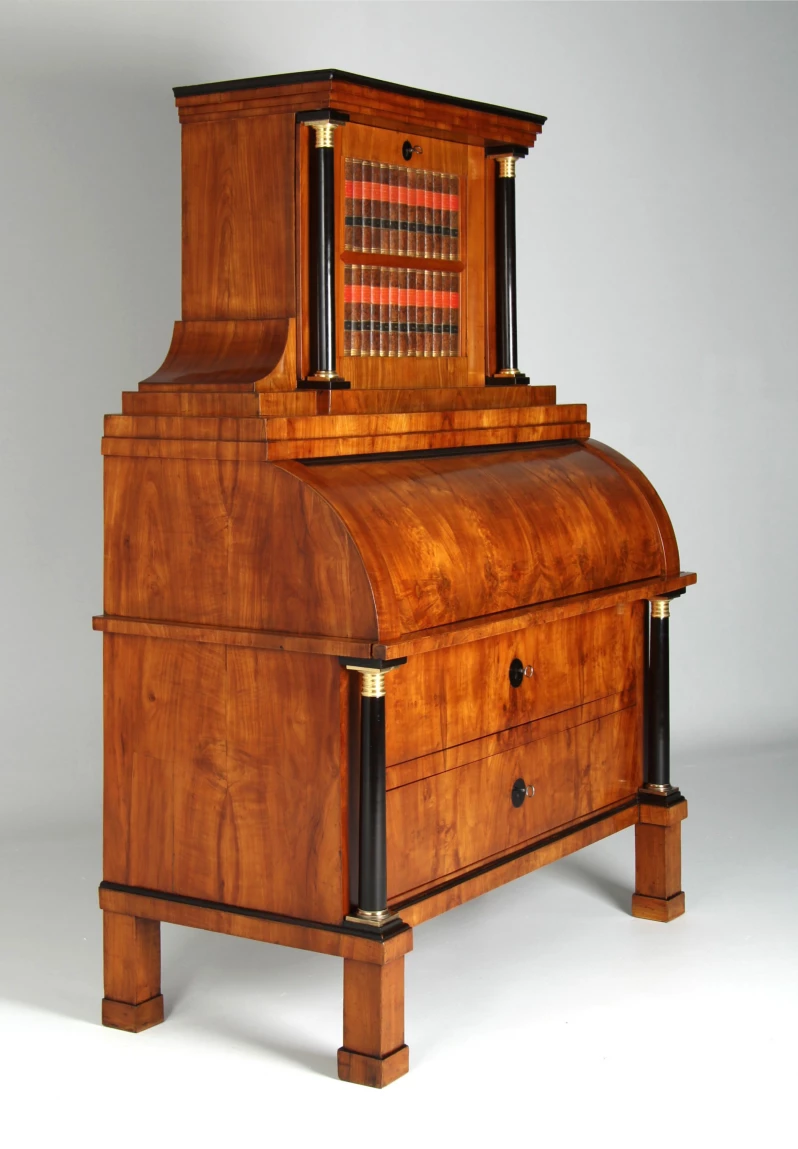
Antique Biedermeier secretary with rare mechanism
Middle German
Cherry
Biedermeier around 1815
Dimensions: H x W x D: 180 x 128 x 63 cm
Description:
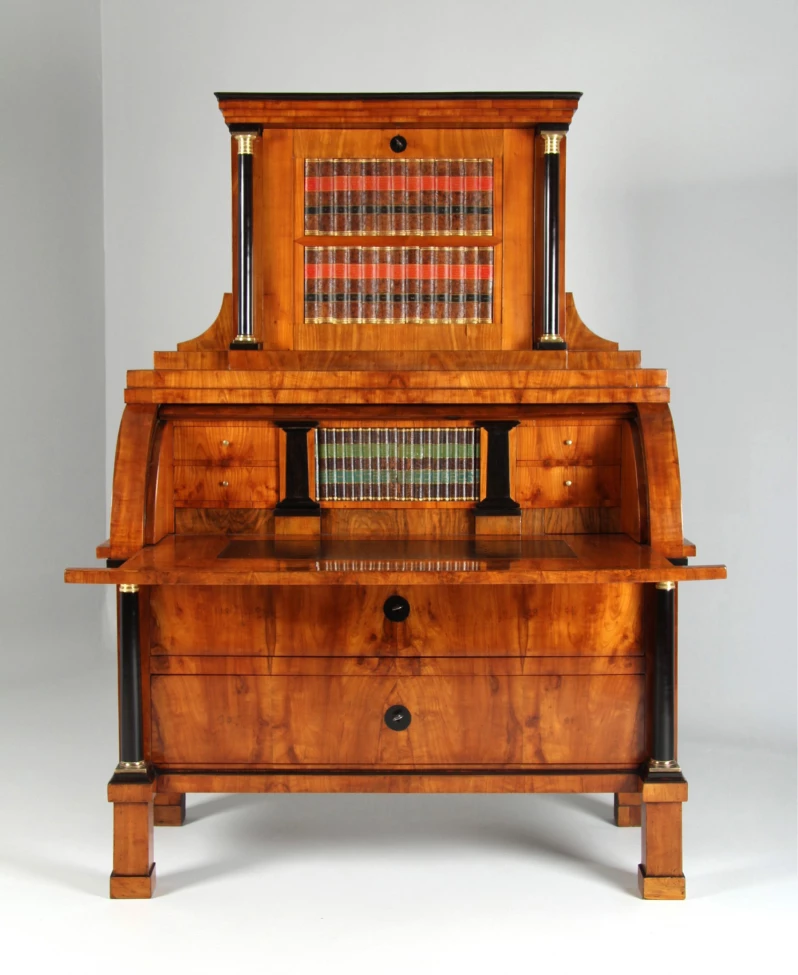
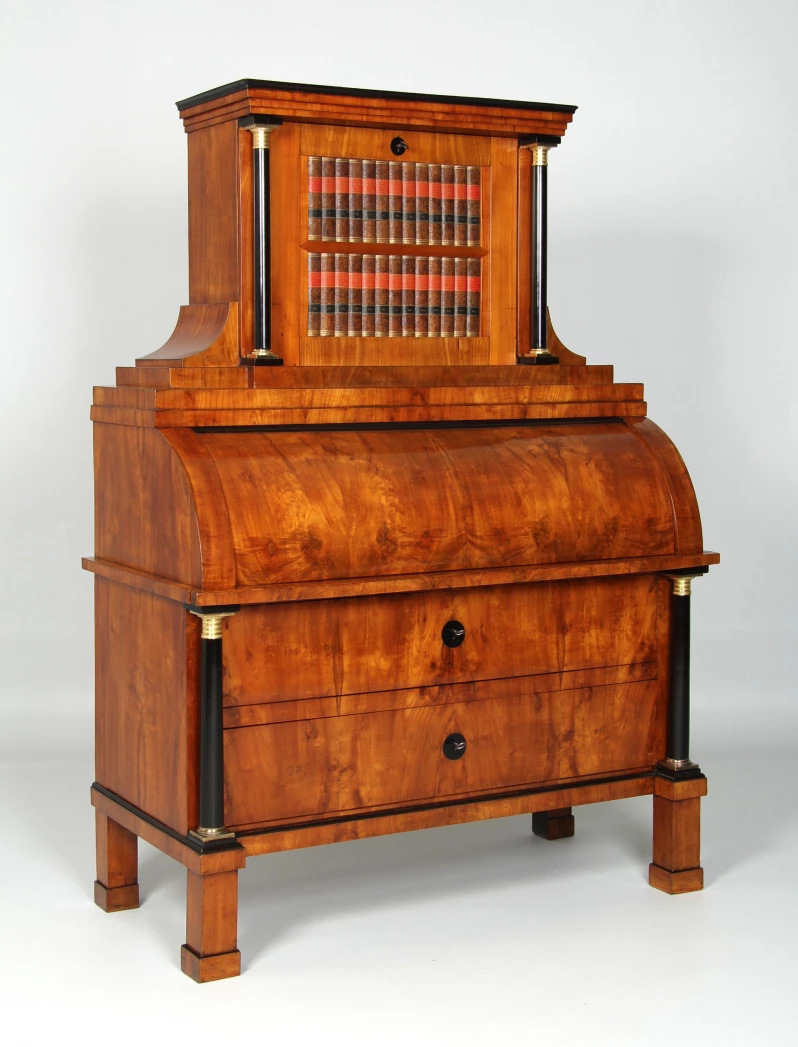
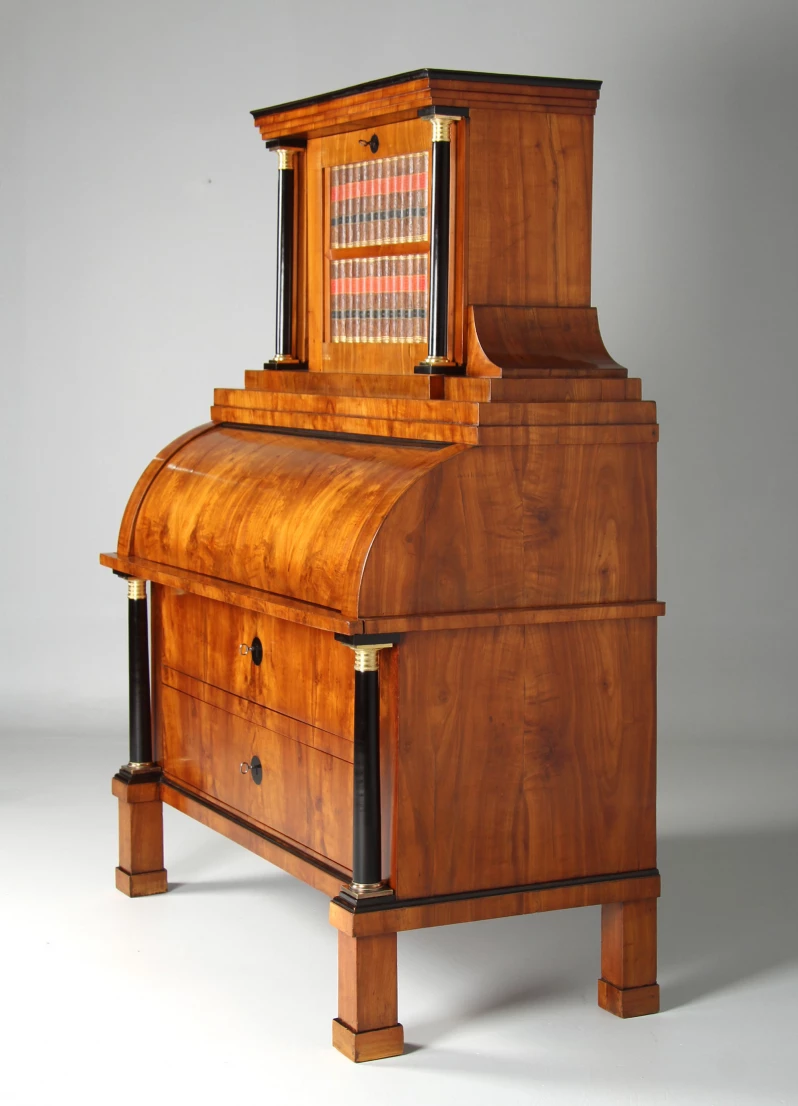
Antique cylinder secretary in masterly quality with extraordinary mechanism and numerous secret compartments.
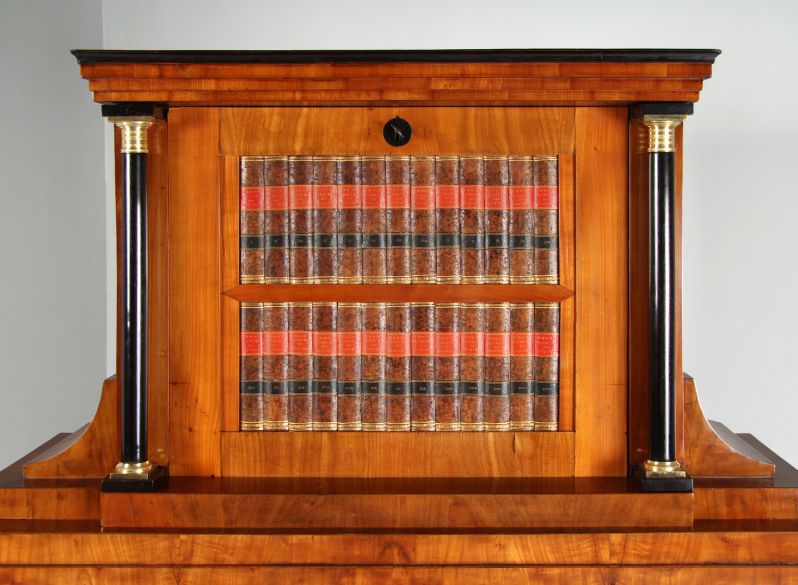
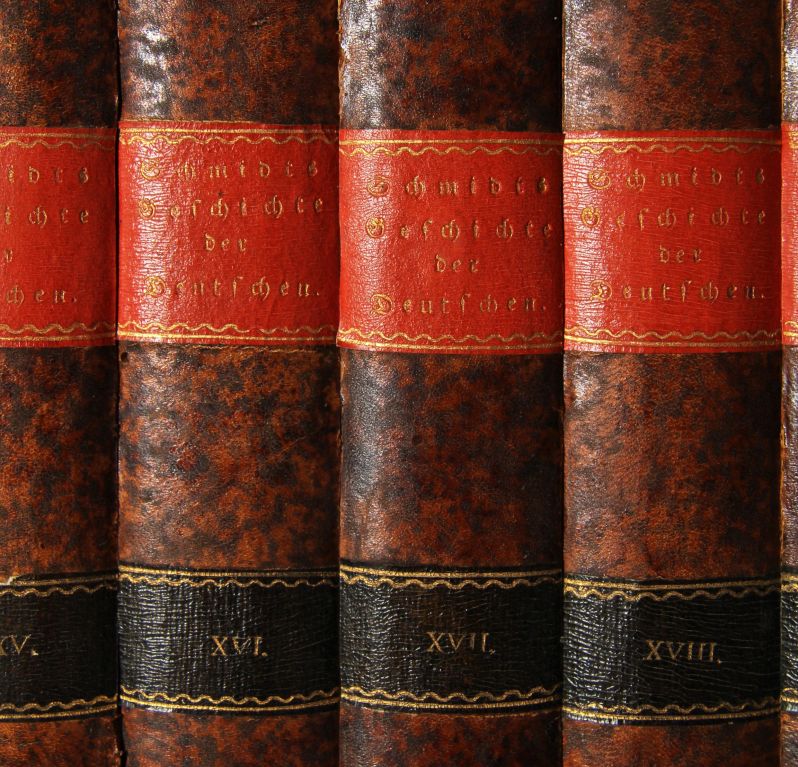
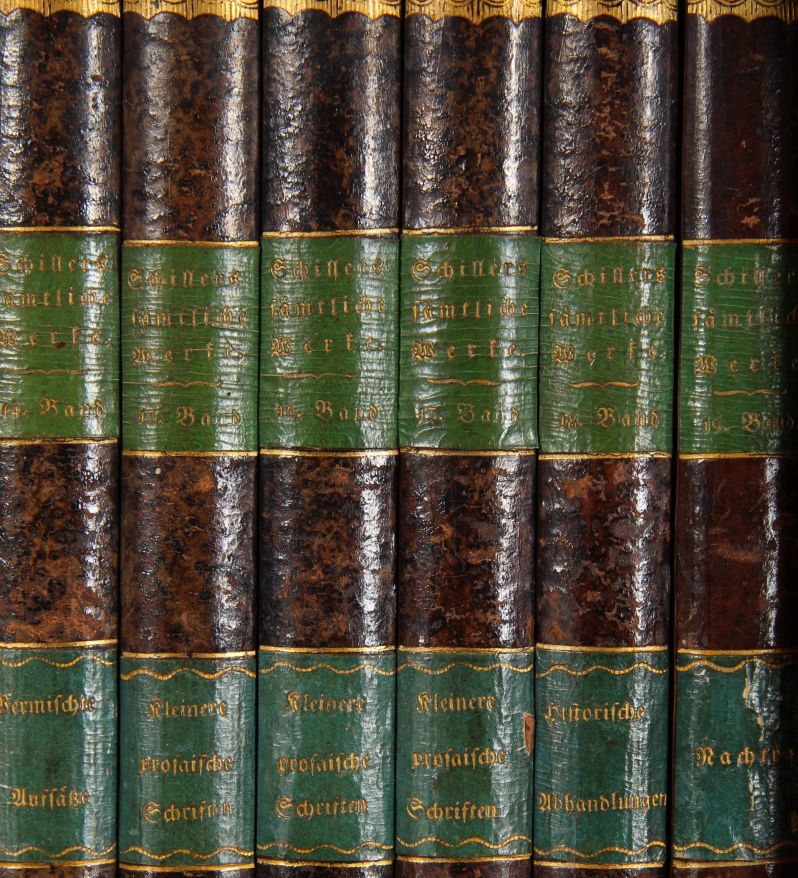
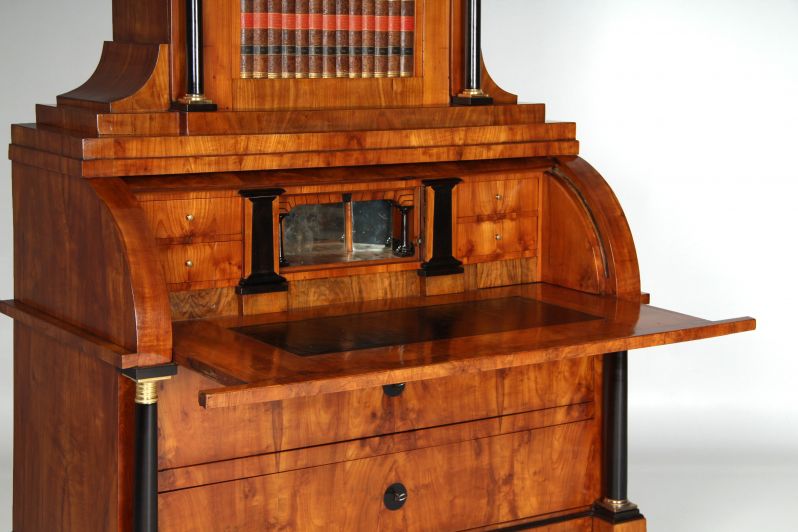
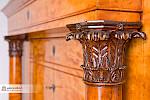
When closed, in addition to the clean cherry wood grain pattern and the ebonised full columns, the bookcase-style top is particularly striking. The very well-preserved spines, which are mounted on wood, are from the "Geschichte der Deutschen", written by Michael Ignaz Schmidt and continued by Joseph Milbiller after his death in 1794 until 1808.
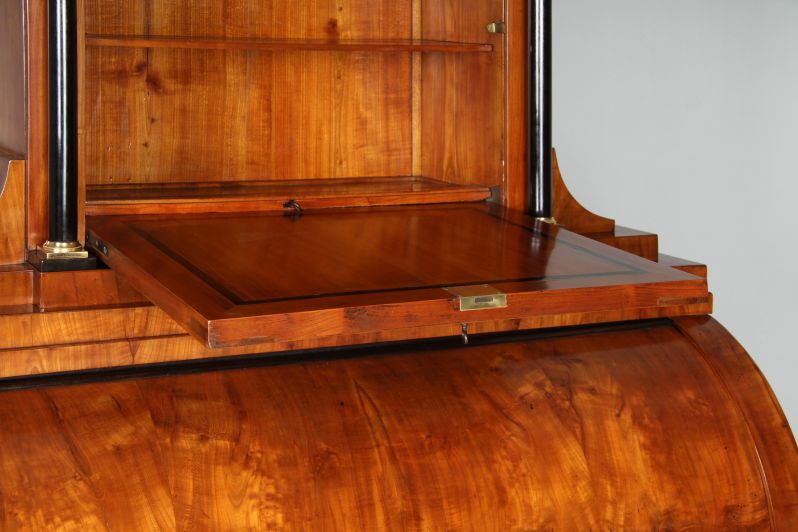
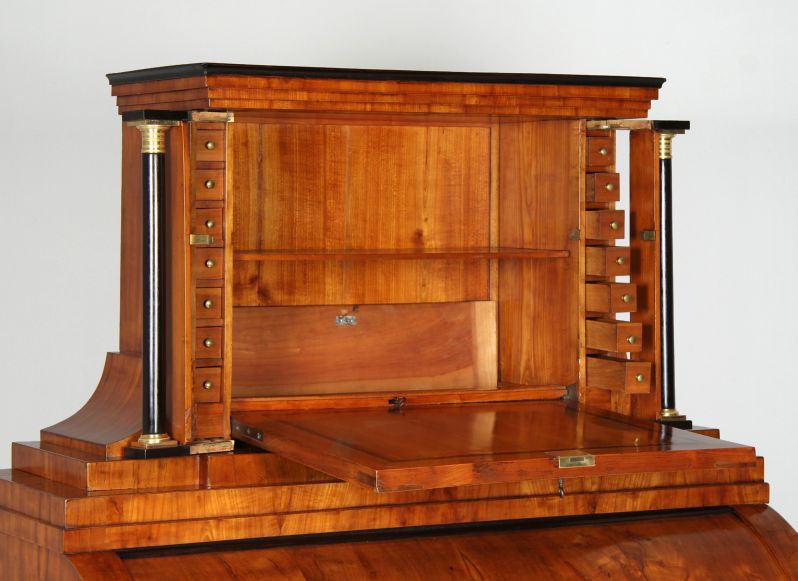
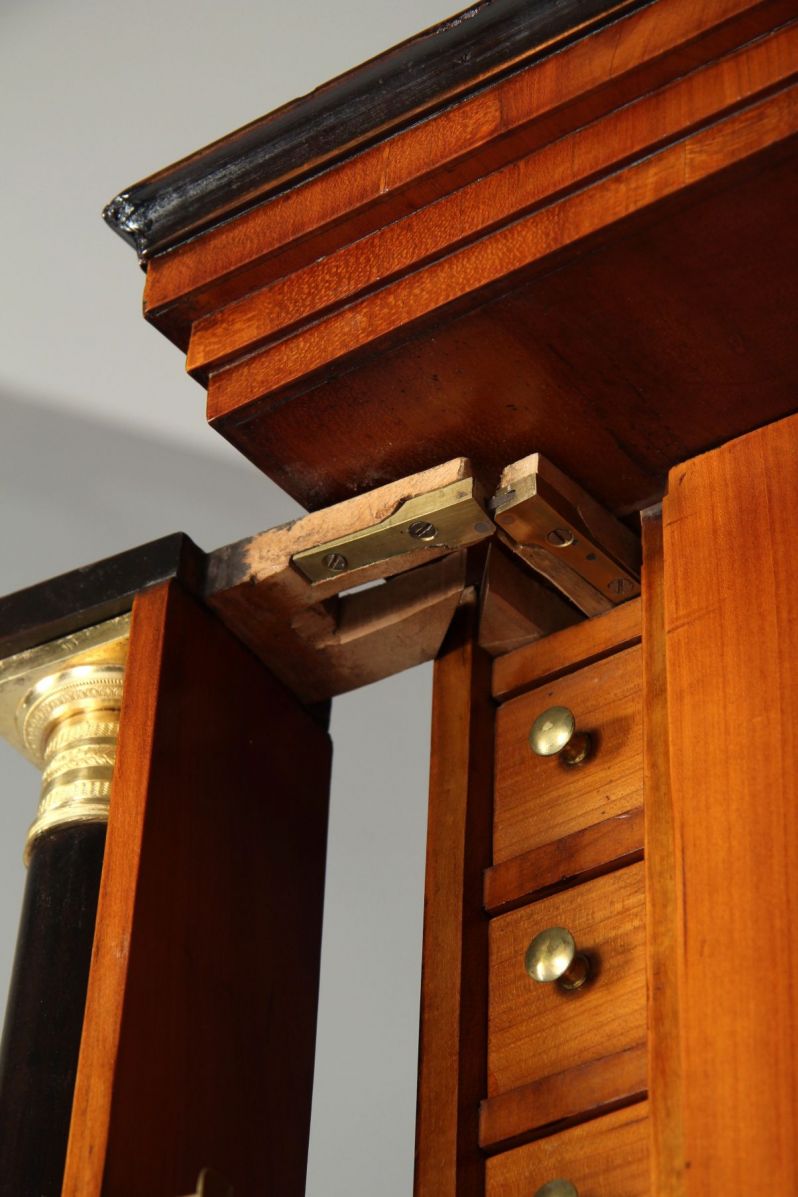
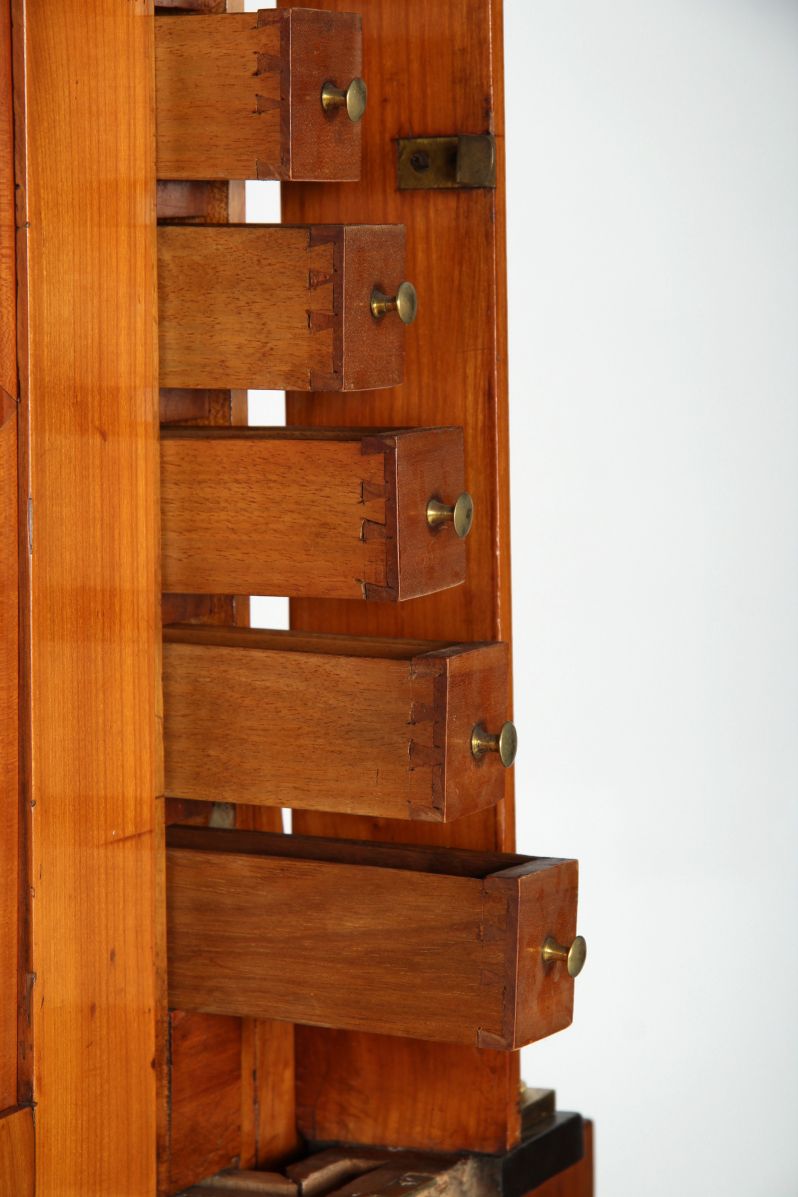
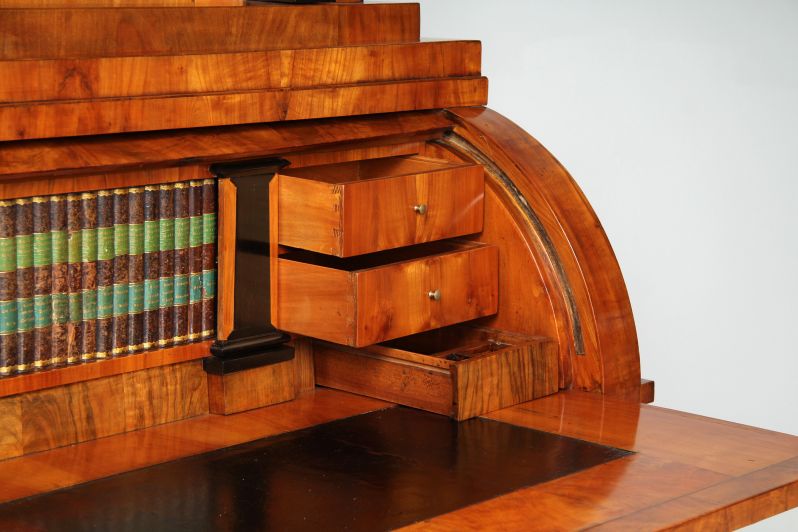
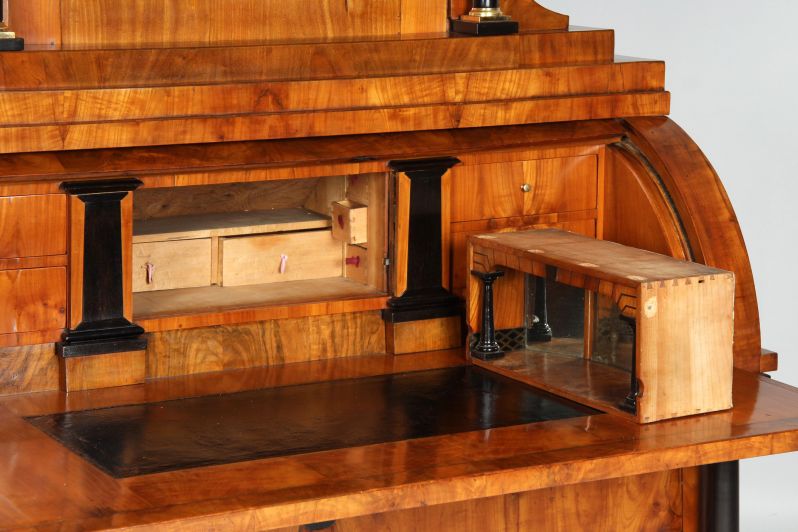
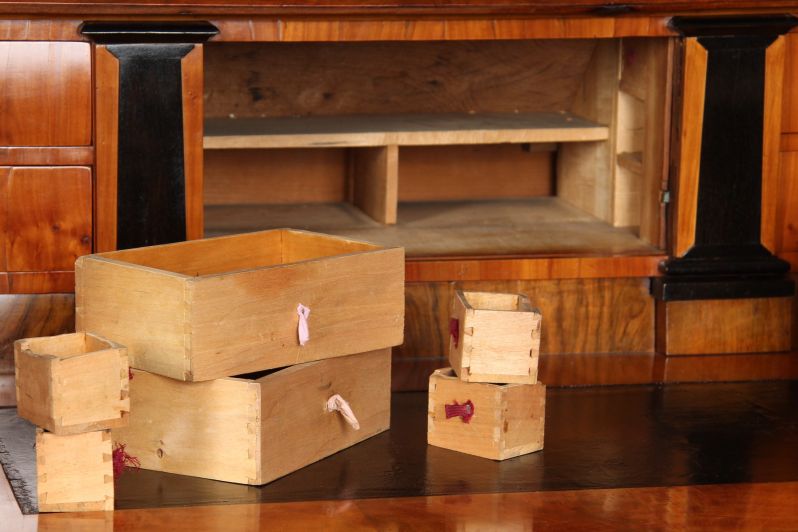
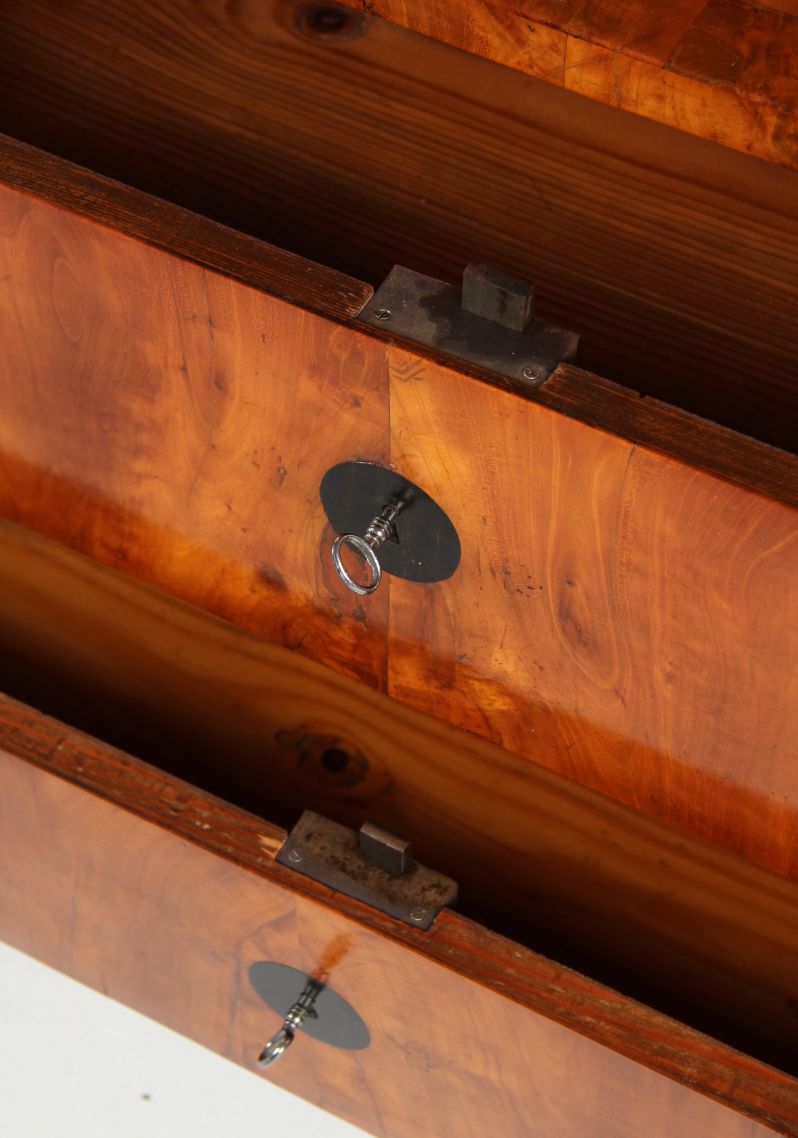
The surface can be folded down to the front, creating a writing and work desk that can be used standing up. Inside there are two large compartments suitable for storing book volumes. The lower shelf is held under tension by a metal spring. Once unlocked, the base automatically springs up to reveal a document compartment underneath. There are two levers on the left and right of the compartment, which can be used to release the previously locked columns. When pulled forwards and folded to the side, they each reveal seven secret drawers.
The main writing compartment of the cabinet is closed by a cylindrical flap, which gives the cabinet its name. If we pull on the writing surface, the flap opens automatically.
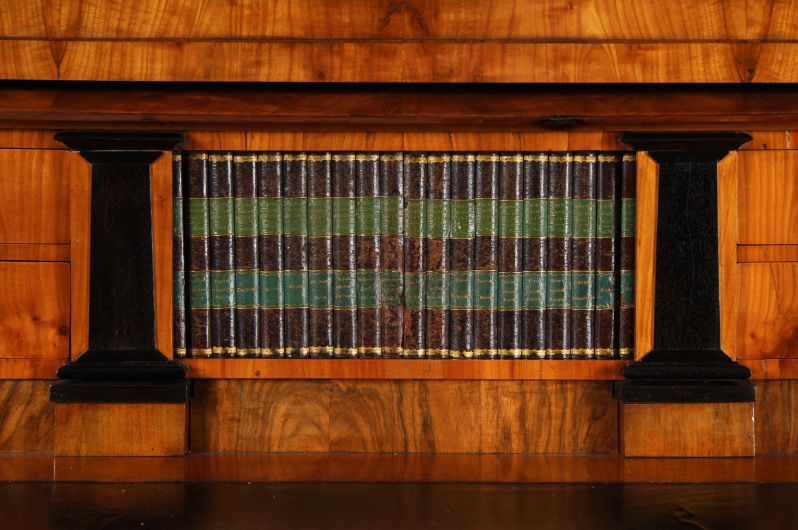
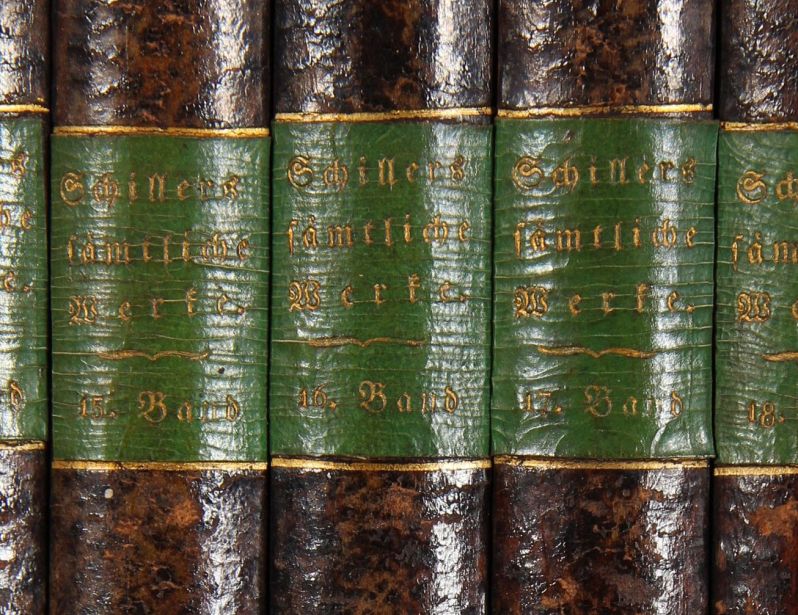
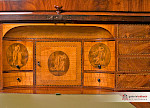
Inside, we see two stacked drawers on the left and right with a neatly laid grain pattern and another book volume, "Schillers sämtliche Werke" in 20 volumes. The book spines are flanked by two pilasters, the bases of which, when lightly pressed, set an interesting mechanism in motion that causes the book flaps, which appear to be roller shutters, to spring back to the left and right.
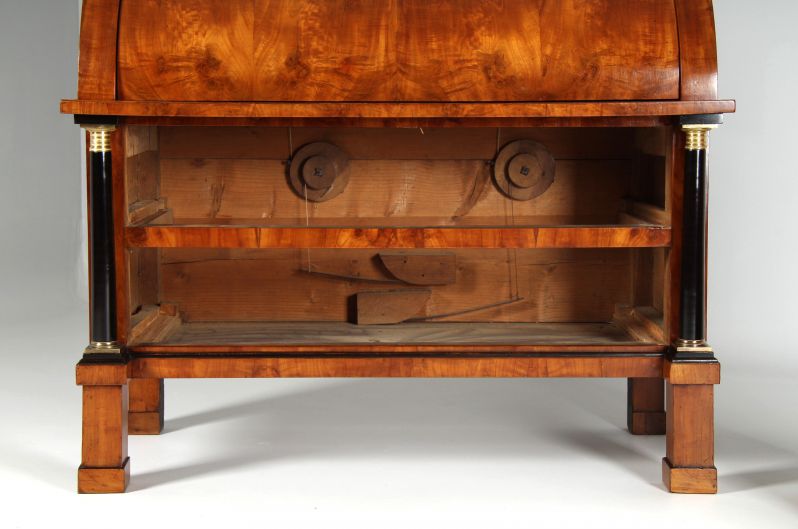
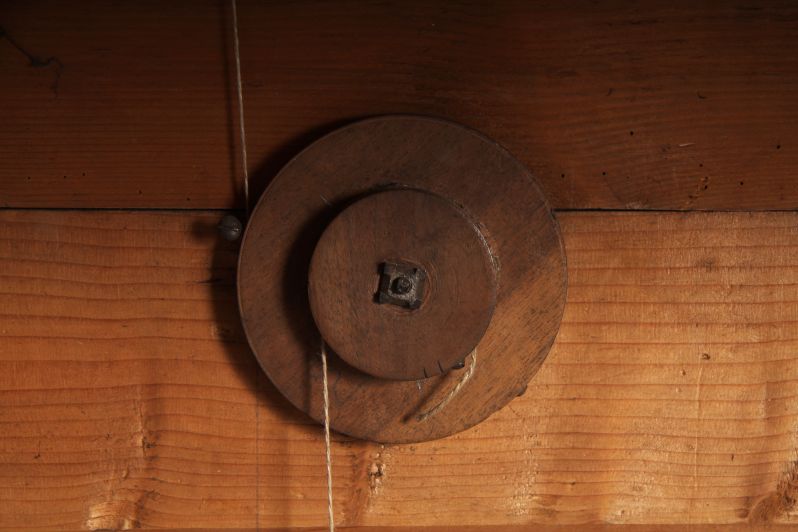
The mechanism is interesting in that the shutters are held in tension by leaf springs in the lower part of the body, which, when released, travel a distance of about 5 cm. In order to cope with the significantly longer travel of the roller shutters, the builder of the piece of furniture has fitted a transmission with pulleys of different sizes. A good and simple patent that works perfectly here.
The compartment, which is visible when open, has a round arch designed in masonry marquetry and supported by small columns above a base inlaid with acanthus tendrils with a mirrored back. The compartment can now be pulled out to the front, revealing a further eight secret drawers.
Worth knowing:
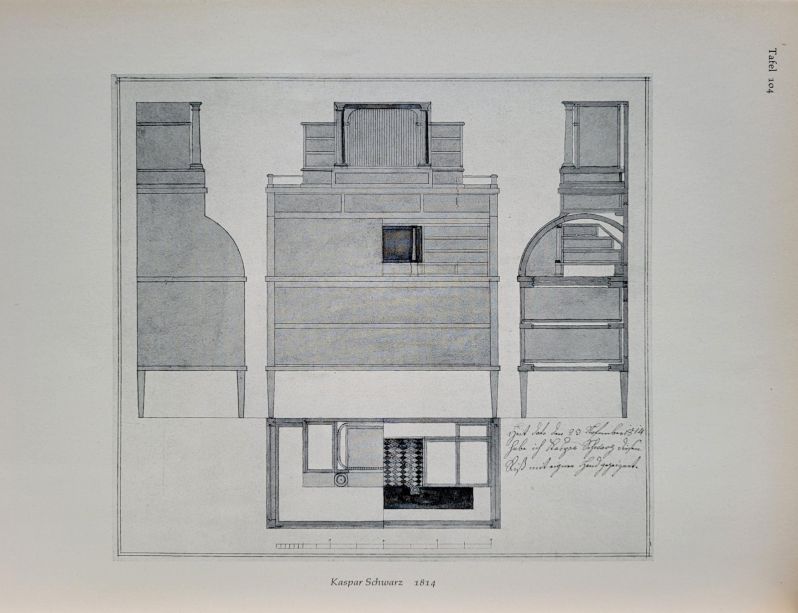
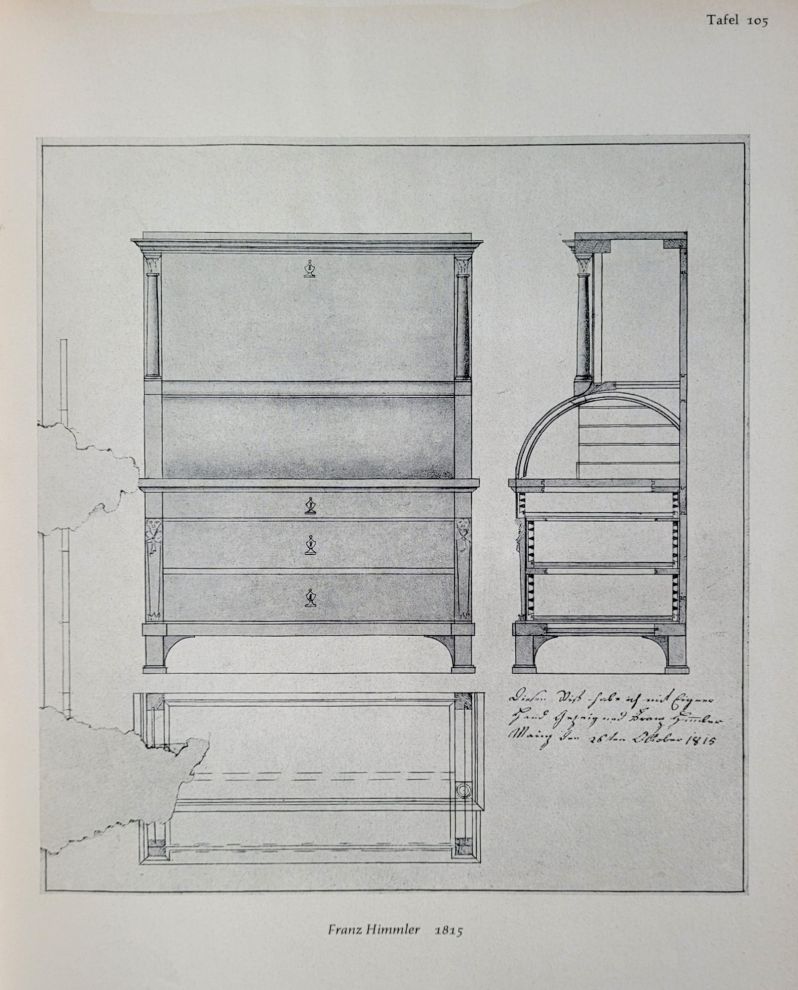
The piece of furniture offered here shows several similarities with documented Mainz writing furniture from the period between 1810 and 1820, in particular with the master cracks by Kaspar Schwarz and Franz Himmler from the years 1814 and 1815, which are illustrated in Fritz Arens - Meisterrisse und Möbel der Mainzer Schreiner on plates 104 and 105.
The multitude of technical refinements, the choice of materials and the broad spectrum of craftsmanship on display suggest that the secretary offered here could also be a piece of furniture made for the purposes of a master craftsman's examination.
Kaspar Schwarz's masterpiece is also a cylinder secretary with an attachment, which also has a corner-mounted shutter. Franz Himmler's cylinder secretary corresponds to the piece of furniture offered here in terms of its general structure, dimensions and the fact that the top can also be used as a standing desk.
A piece of writing furniture supplied by Johann Valentin Raab in Frankfurt for Homburg Palace also corresponds in general construction to the secretary offered here (cf. Kreisel/Himmelheber - Die Kunst des deutschen Möbels Fig. 391).
Pieces of furniture with mounted book spines based on the French model were extremely rare in German furniture making. One documented example is a small work table that can be found in Kreisel/Himmelheber - Die Kunst des deutschen Möbels Fig. 158, which is also attributed to the Mainz/Lower Franconia region and is now in the antechamber of Schönbusch Palace near Aschaffenburg.
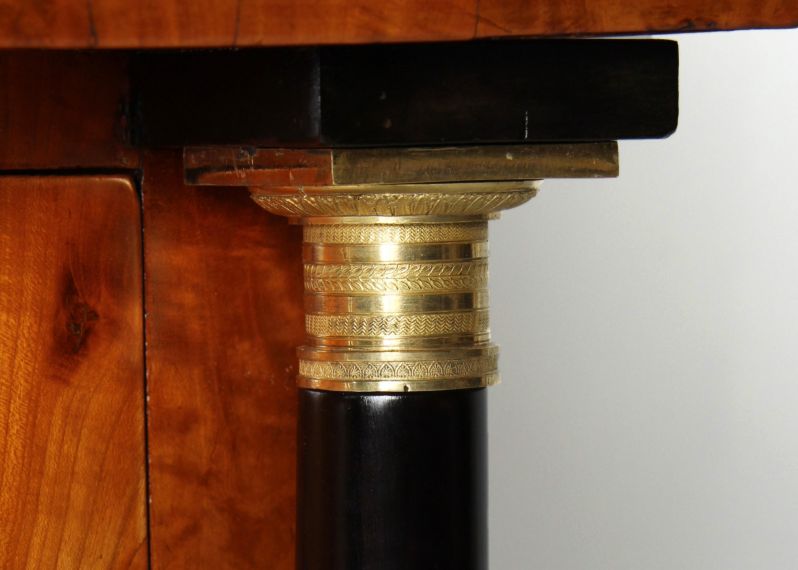
In addition to the book panels in the French style, the brass bases and capitals on this piece of furniture also indicate that it was made in the French area of influence. Mainz was under French occupation from 1797-1814, which led to the abolition of the guilds and thus to lively growth in the carpentry trade. Numerous stylistic influences ensured that, in contrast to guild-bound furniture centres such as Brunswick, there were a wide variety of types of writing furniture such as secrétaire à abattant, patent secretaries and the secrétaire à cylindre.
The social structure in Mainz had a direct impact on cabinetmaking, which explains the high number of cabinetmakers' workshops. In the late 18th century, it consisted of "a large electoral court, envoys, 80 noble families, a large number of distinguished foreigners who stayed here continuously, numerous clergymen who held richly endowed positions and dignities and owned large estates with significant incomes, a considerable civil service, a university with around 150 professors and other employees, as well as more than 1000 students, an industrious, order-loving middle class, among whom prosperity was widespread."
Condition:
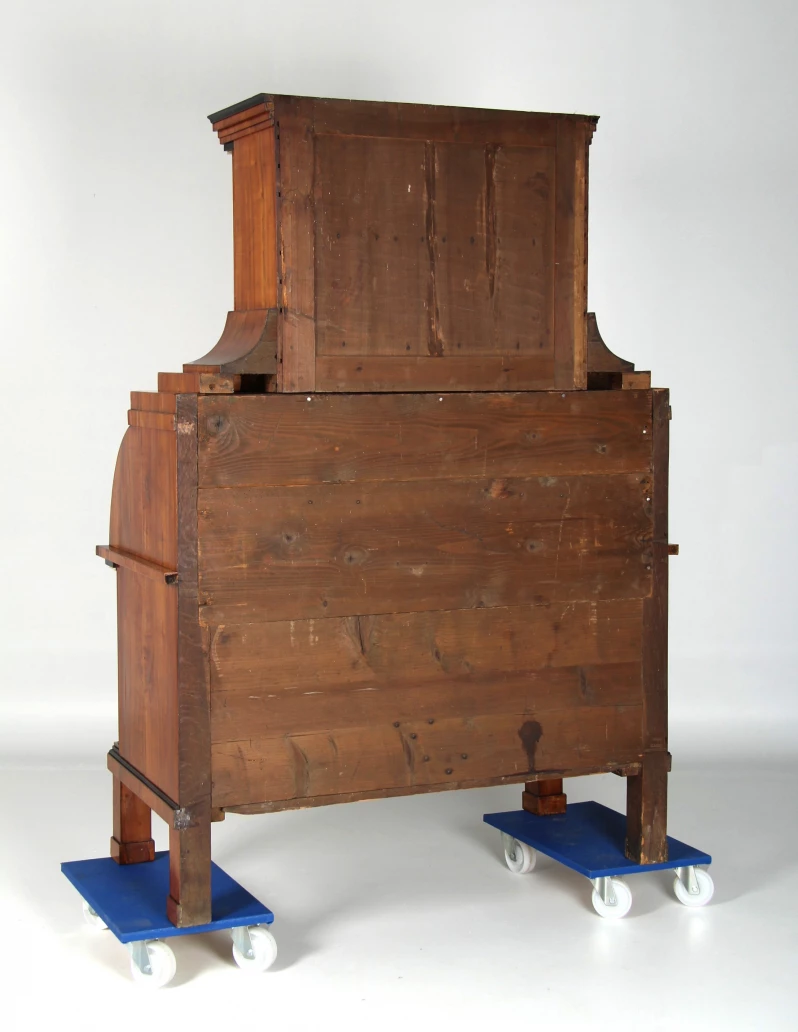
In refurbished condition with a shellac hand polish, preserving the patina. All mechanisms work.
Price: 22000,-€

You can find comparable pieces of furniture and interesting facts on the subject in the following literature:
Fritz Arens - Meisterrisse und Möbel der Mainzer Schreiner Plates 104 and 105
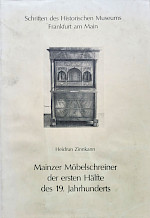
Heidrun Zinnkann - Mainzer Möbelschreiner der ersten Hälfte des 19. Jahrhunderts from p. 41 onwards
Kreisel / Himmelheber - Die Kunst des deutschen Möbels - Band III - Klassizismus - Historismus - Jugendstil Abb. 391
Wolfgang L Eller - Schreibmöbel 1700-1850 from p. 321
Article found under: Secretaries
Add to shopping cartVideo cylinder secretary
Also interesting
Small Flensburg secretary
Schleswig-Holstein
Mahogany and others
Biedermeier around 1815
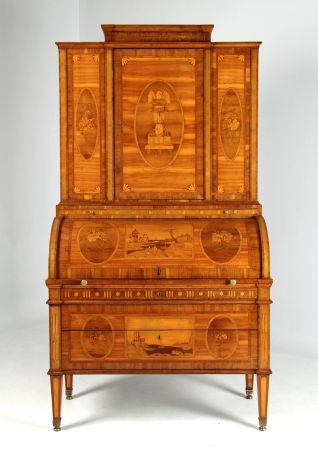
Classicist top-mounted secretary with elaborate marquetry
Southern Germany
Walnut and others
Classicism around 1790
Antique Vase Clock
France
fire-gilt bronze
Empire around 1820