
Video Biedermeier secretary in cherry


Antique Biedermeier secretary in cherry
Austria
Cherry and others
Biedermeier around 1830
Dimensions: H x W x D: 167 x 94 x 51 cm
Description:
Very well proportioned secretary from the Austrian/Hungarian Biedermeier period around 1830.
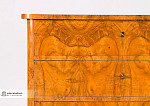
Writing desk with an interesting drawer layout, standing on round feet with columns on top. The front of the lower part of the piece of furniture is visually divided into three drawers and actually reveals itself as a division with a large drawer running across two fronts, a further drawer underneath and a plinth drawer at the very bottom.
Above this is the writing flap with a further drawer above it. At the very top we find a narrow head drawer above the flat triangular pediment.
The front and sides of the cabinet are neatly and symmetrically veneered in cherry with an absolutely detailed geometric structure of fine mahogany thread inlays. The threads not only form the framing on the drawer fronts, but also shape the capitals, emphasise the head drawer and the flap in a fanned and woven manner and decorate all the edges, heels and steps of the furniture. An incredible piece of work, executed to masterly perfection.
The keyhole frames made of embossed leather match the colour and play a key role in the design of the front of the furniture.
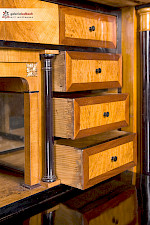
When we open the writing flap, we see a tidy interior with six drawers veneered in floral ash. There are two wide open compartments, originally intended for storing notepads or larger papers, which are now ideal for stowing a laptop. The central compartment is flanked by two small columns, which are detailed miniatures of the large columns on the outside and also support a triangular pediment.
Condition:
Restored and hand-polished with shellac. The drawers run cleanly and smoothly, the writing flap is stable and at right angles to the body.
An authentic piece of writing furniture rarely found in this design.
Price: 6850,-€
Article found under: Secretaries
Add to shopping cartVideo Biedermeier secretary in cherry
Also interesting
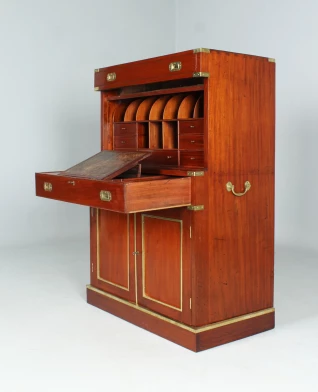
Military Campaign Chest of Drawers Secretary
England
Mahogany, brass
Victorian around 1890
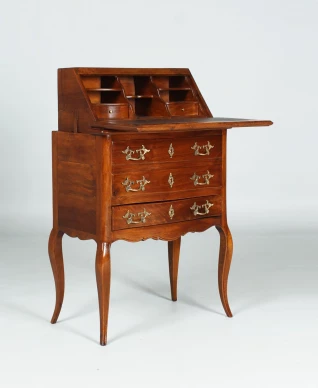
Small antique transformation table
France
Walnut
around 1860
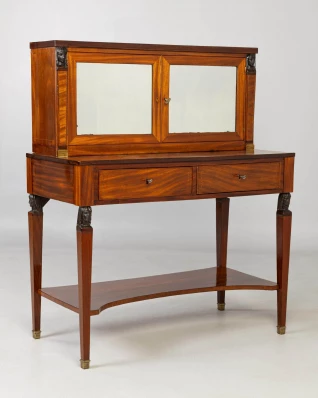
Retour d'Egypte console table with mirror top
England
Mahogany, marble, etc.
early 19th century