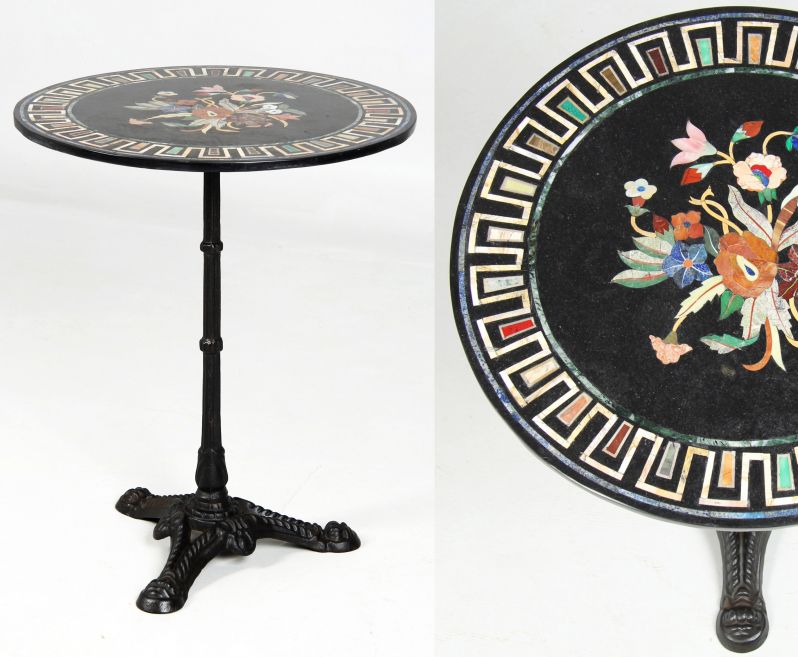
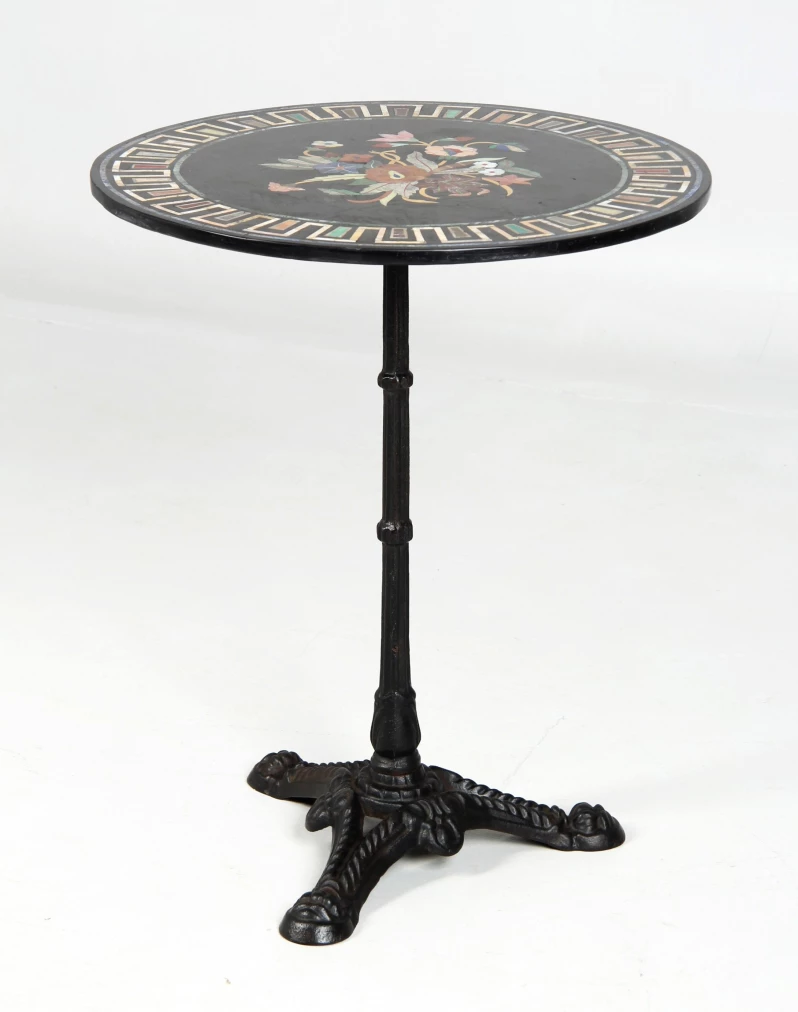
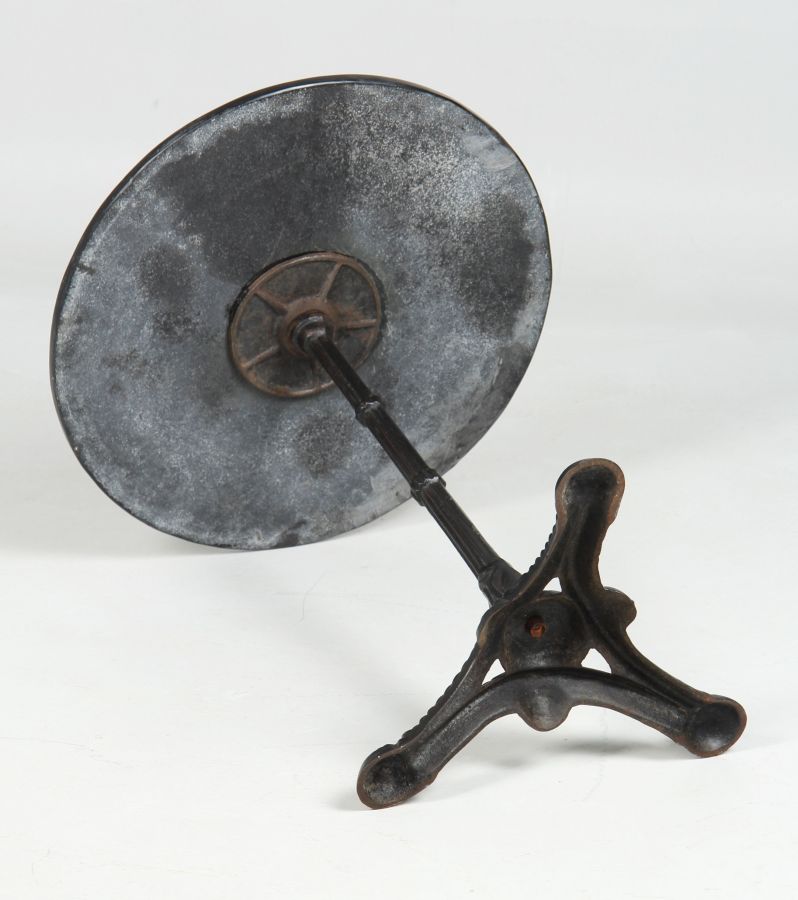
Pietra-Dura plate on cast-iron base
Italy
Marble, cast iron
19. / 20th century
Dimensions: H x D: 72 x 60 cm
Description:
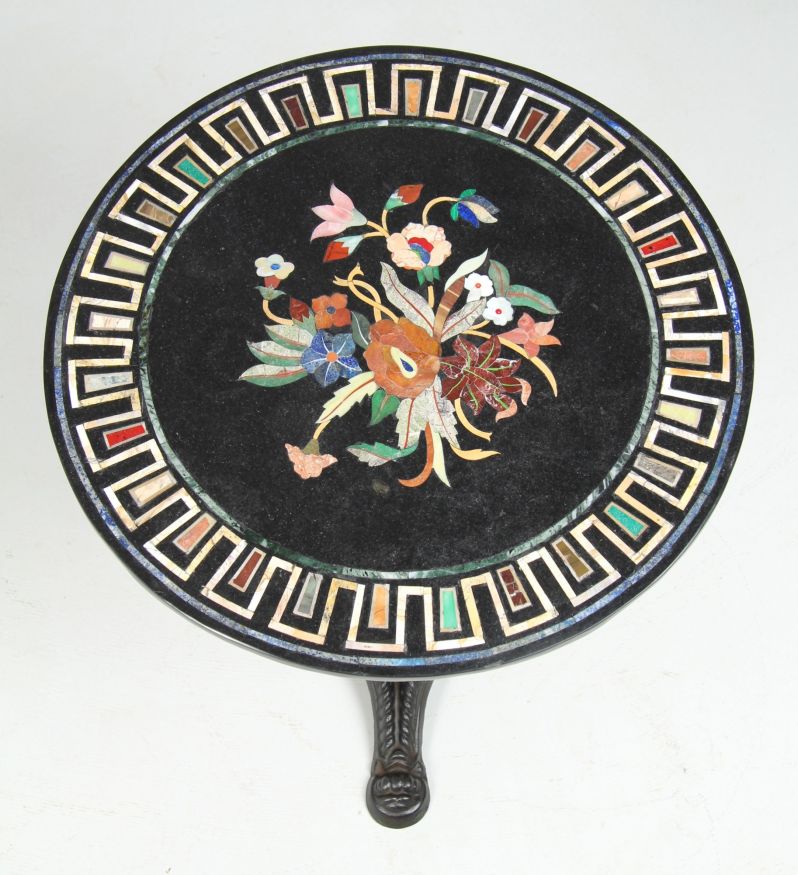
This finely crafted side table is made from different types of marble and showcases the beauty and complexity of the centuries-old pietra dura technique.
The piece combines the work of various European artisans and embodies the concept of globalisation within the decorative arts by bringing together an Italian top with a French base.
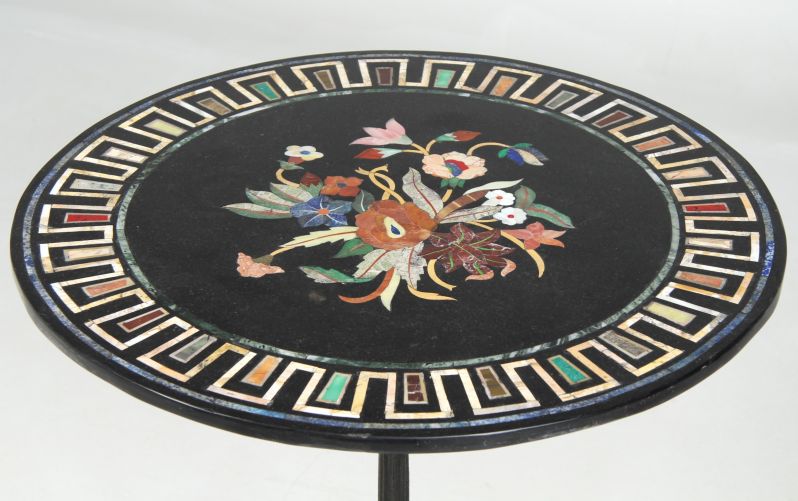
The round table top showcases the ancient and complex pietra dura craftsmanship. Translated from Italian as ‘hard stone’, this technique - also known as Florentine mosaic or commesso (meaning ‘fitting together’) - involves inlaying semi-precious and precious stones to form elaborate decorative patterns or images.
The origins of pietra dura work date back to ancient Rome, where it was known as opus sectile and was used for floor and wall decorations in buildings. The technique was later revived in 16th century Florence and developed into a refined form of "stone painting", which was used on decorative objects and furniture (mostly tables and cabinets) and not just on architectural surfaces.
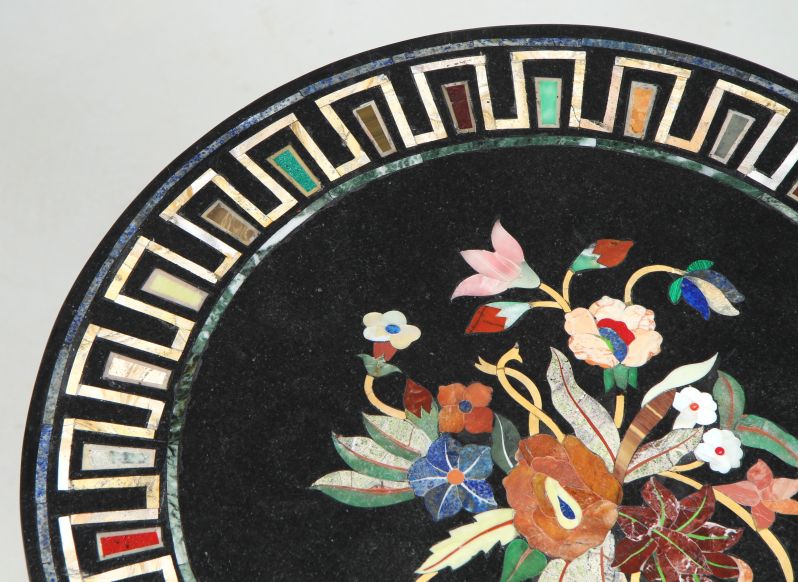
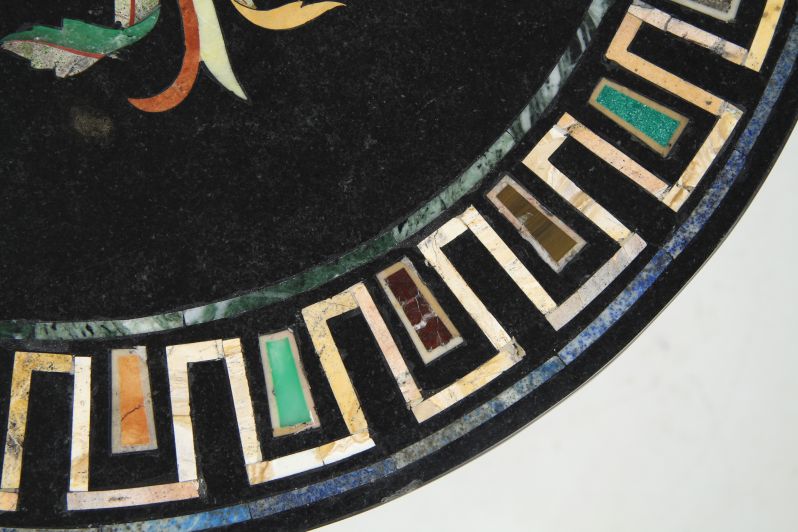
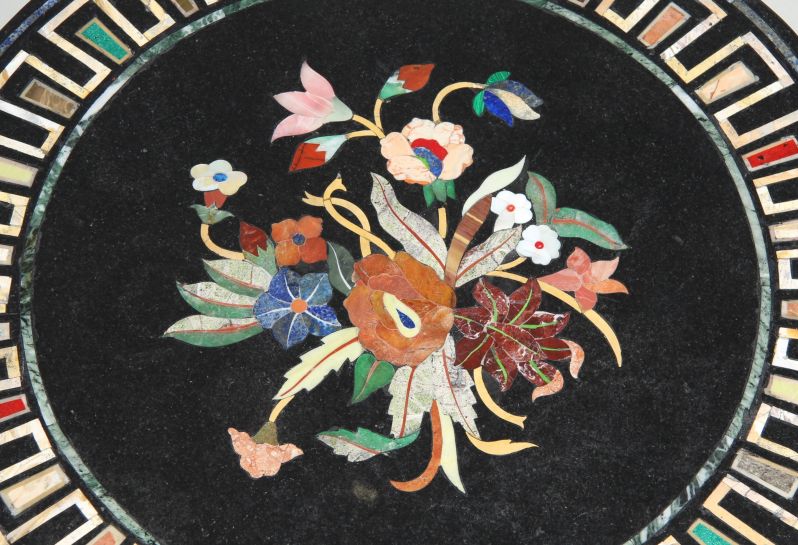
The table offered here shows a medallion filled with a lively floral composition typical of pietra dura work. Stones such as malachite, lapis lazuli, agate, jasper, rose quartz and chalcedony are among the precious materials used for this intricate decoration. The central motif is framed by a geometric, symmetrical border. A band of green marble and lapis lazuli surrounds the meandering pattern, adding depth and elegance to the piece.
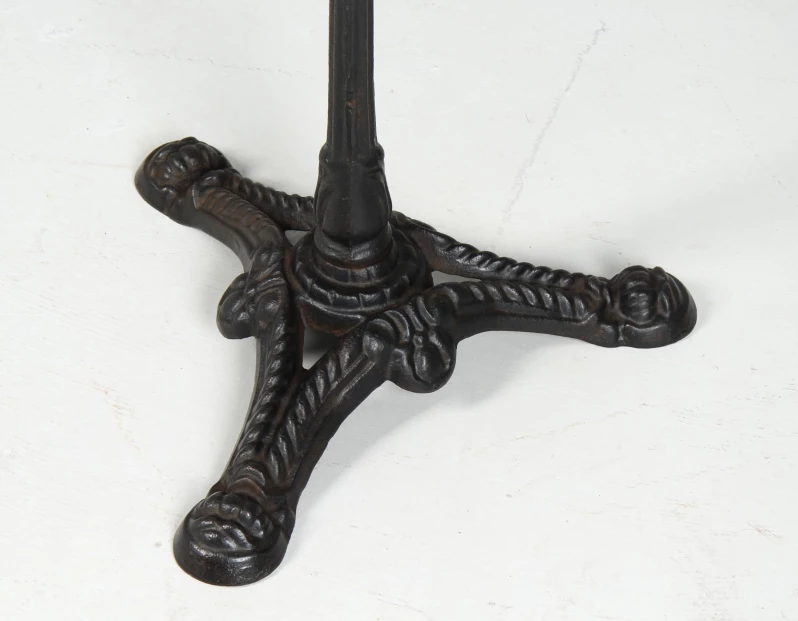
The exquisite top is supported by a cast iron monopodium stand. Cast iron furniture was made as early as the 18th century, but was particularly popular in the Victorian era (1837-1901). As the middle classes became more interested in ornamental gardens, cast iron furniture became a popular addition to outdoor areas due to its durability and decorative appeal. The cast material allowed for intricate designs that combined beauty and functionality. Because of its sturdiness and ability to be used outdoors, cast iron furniture was a popular choice for Parisian street bistros at the turn of the century.
The base used for this table is finely cast and has three round legs decorated with rope-like ornaments.
Manufacturing process:
The production of a pietra dura top was a process involving several skilled craftsmen. The process began with an artist producing a detailed design, often in watercolour, which determined the choice of stones. The artist carefully selected the colour palette, ensuring that it only contained shades and veins for which there were corresponding stones. The design was then traced in pen or pencil and the image was broken down into the components that were to be inlaid. Selecting the right stones was also an important task, with experienced craftsmen utilising the natural grain of the stone to create shading and texture in the final composition, as can be seen on the petals that adorn the table top on offer here.
Paper templates of the individual sections were glued onto the selected stones, which are usually 2 to 4 millimetres thick, and then cut to the desired size using a bow saw. For particularly small or fragile stones, a thin slate slab was used as a base to avoid cracks. The stone was clamped vertically on a workbench and the craftsman skilfully cut the shape using a bent chestnut branch strung with soft iron wire. To ensure a perfect fit, the edges were further refined with metal files and abrasive powders.
A mixture of heated beeswax and rosin was used to glue the parts together, which was applied to the backs of the parts. The pieces were then mounted on a support plate, often made of black Belgian marble. Gesso, a binding agent made from plaster and chalk, was used to fill the gaps and reinforce the slab.
After assembly, the slab was turned over and polished to smooth its surface. A final polishing of the surface with agate and increasingly finer types of emery brought out the shiny, colourful design, which could now be mounted on a piece of furniture or a decorative object.
Worth knowing:
The most famous mosaic workshops were located in Florence, in the galleries of the Uffizi Palace, and flourished under the patronage of the Medici family. In 1588, Ferdinand I de’ Medici elevated their status by designating them as the official Court workshop, further enhancing the prestige of pietra dura creations. Florentine artisans became highly sought after, and competing workshops in France recruited Italian artisans for their studios.
However, Italian pietra dura is not the only form of hard stone mosaic. In India, a similar technique known as parchinkari developed, directly inspired by Florentine art but adapted to reflect a distinctly Indian aesthetic. This style is best known for the intricate inlay work of the Taj Mahal.
Condition:
The condition of this table is very good. Both the pietra dura top and the cast iron base are well preserved and have been carefully cleaned.
We recommend the following literature on this topic:
Annamaria Giusti, The Art of Semiprecious Stonework, 2006
Judith Miller, Furniture, 2010
Article found under: Tables
Also interesting
Biedermeier hairdresser
Southern Germany
Cherry
early 19th century

Antique bureau desk
Vienna
Walnut
Biedermeier around 1820
Classicist chest of drawers
Southern Germany
Walnut and others
late 18th century