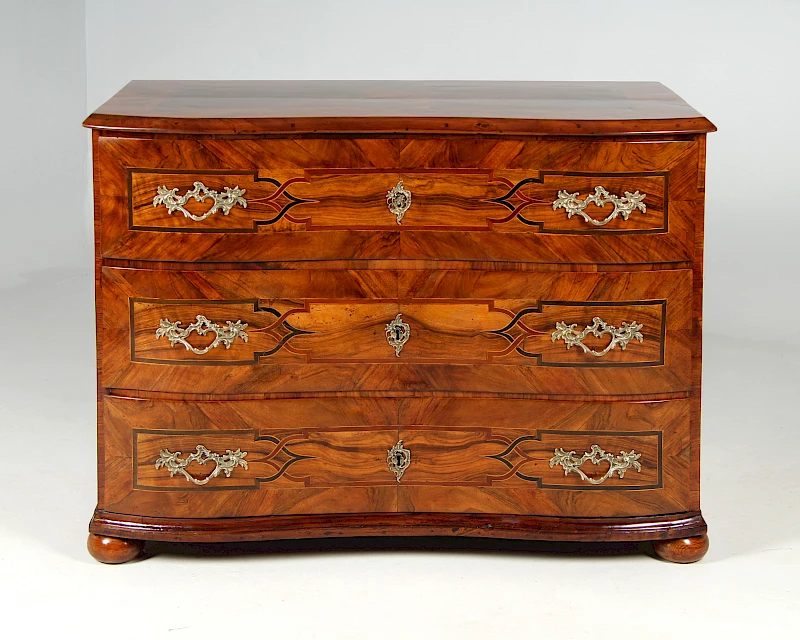
Video: Munich Baroque chest of drawers
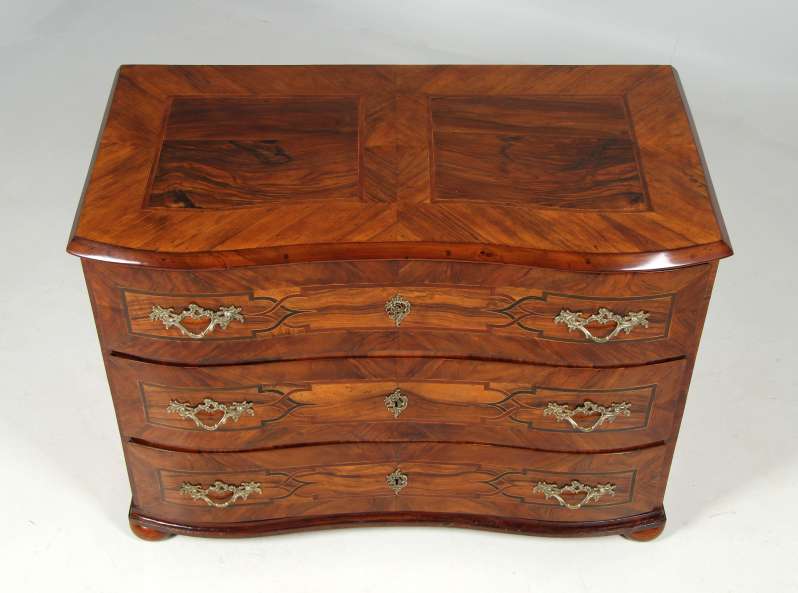
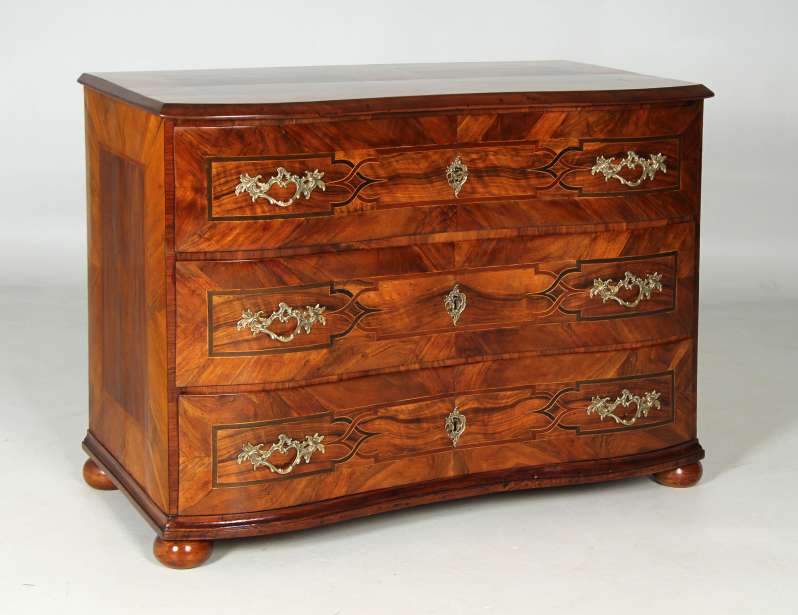
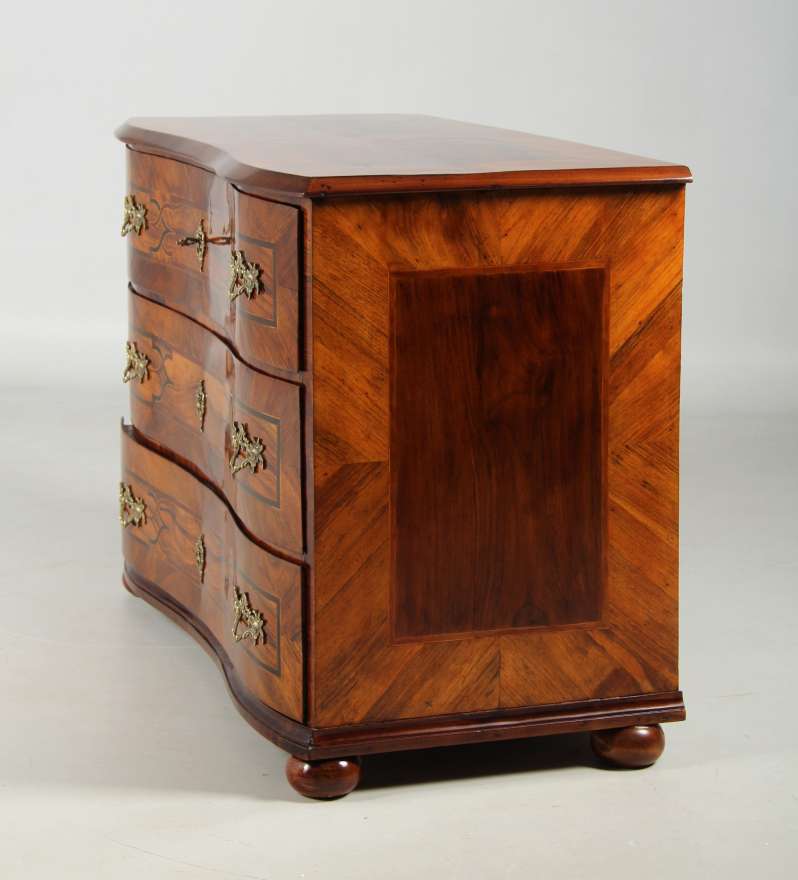
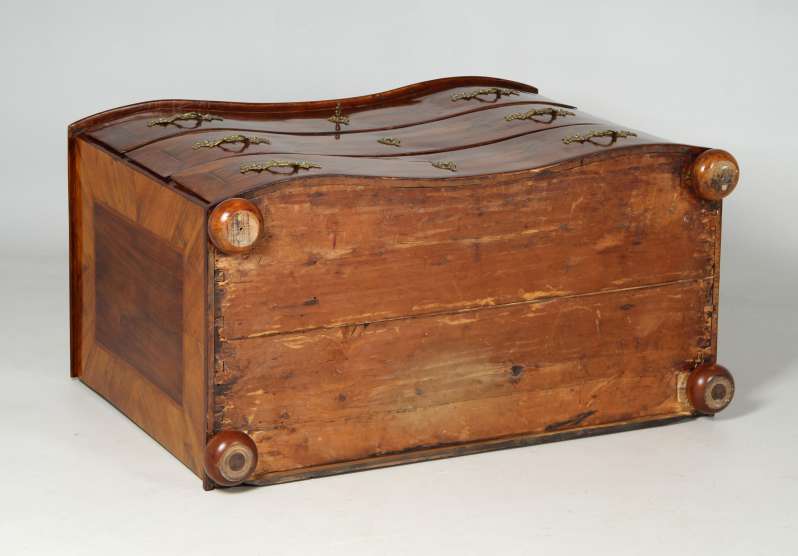
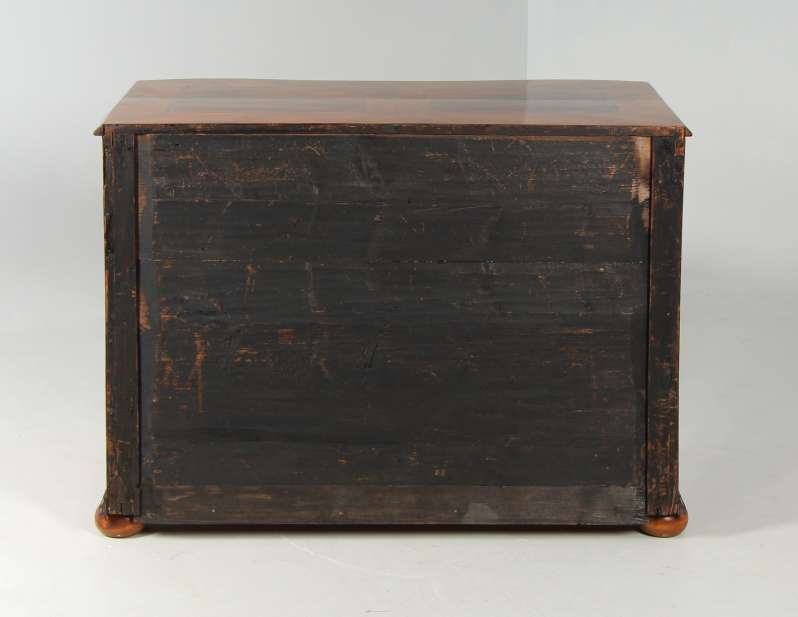
Munich Baroque chest of drawers
Southern Germany (Munich)
Walnut, etc.
Baroque, c. 1750
Dimensions: H x W x D: 87 x 116 x 60 cm
Description:
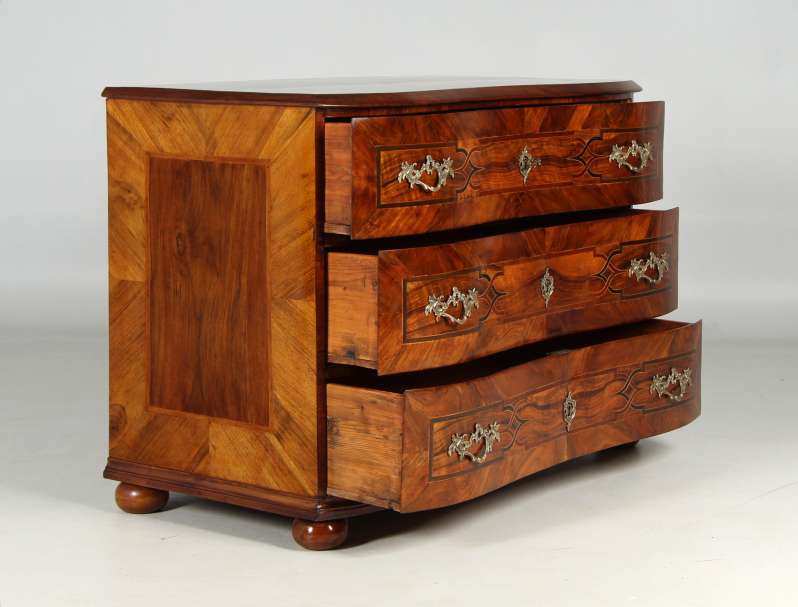
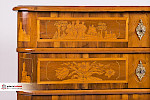
A South German Baroque chest of drawers with pleasing proportions and a typical Munich design.
A three-drawer cabinet standing on ball-and-claw feet, with straight sides and a subtle curve on the front.
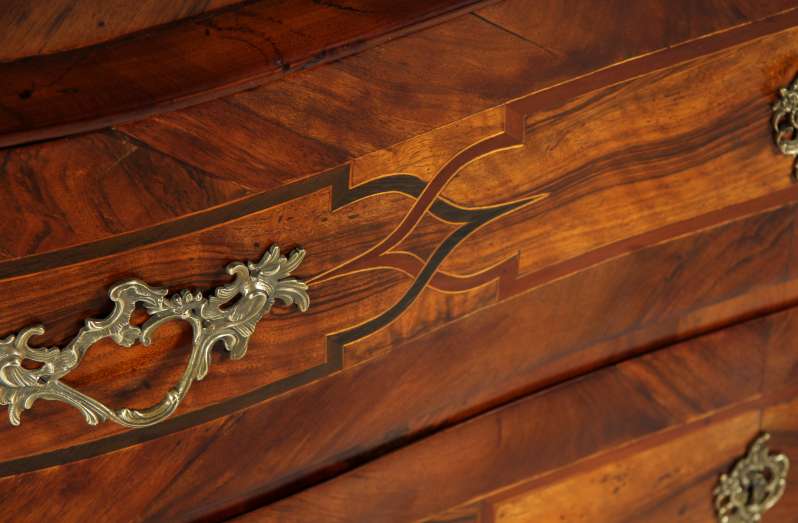
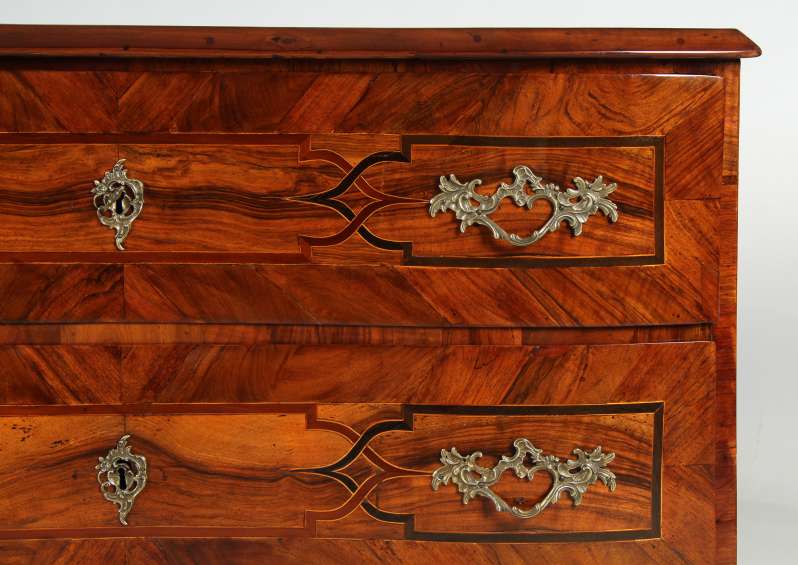
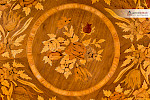
The scrollwork marquetry in plum and bog oak is accented by thin maple strips. These form three interwoven frames on the drawer fronts, within which the fittings are mounted.
Interesting facts:
This chest of drawers belongs to a distinctive group of veneered Rococo chests of drawers, referred to in art-historical literature as ‘Munich court chests of drawers ’. This type of furniture originated around the mid-18th century in the Kistler workshops of the Munich court and was produced in numerous variations for the state rooms of the electoral palaces. Inventories from Nymphenburg Palace document this type of chest of drawers as early as 1751 and 1758; however, production based on this basic design can be traced as late as the 1760s.
Possible makers include the Munich court cabinetmakers Simon Prugger (d. 1756) and his successor Tobias Grün (d. 1778) as well as the Nymphenburg court cabinetmaker Johann Caspar Hörspurcher, who invoiced for a large number of ‘Commodkästen’ during the relevant period.
Despite being mass-produced, each individual chest of drawers in this group is a unique piece of furniture, deriving its distinctive quality from the variation of certain design elements within a consistent basic type. The meticulous veneering and craftsmanship lend these pieces a refined appearance befitting the living quarters of the noble court staff.
The chests of drawers are generally veneered in walnut. Characteristic features include frame friezes arranged diagonally to the axes, made of evenly grained wood, as well as panels of richly figured walnut on the drawer fronts. The sides and tops, by contrast, mostly feature large, symmetrically arranged and beautifully flamed veneer panels.
The mouldings, accompanied by veins, serve to separate the friezes from the panels. Whilst the wood used for the mouldings varies, the veins are almost always made of maple. On the drawer fronts, the bandwork regularly forms three recesses for the fittings, the panels of which interlock in various ways at the narrow ends.
Owing to the only slightly differing designs of the marquetry and the distinctive stylistic language, these pieces of furniture form a closely related group, now referred to as ‘Munich court chests of drawers’.
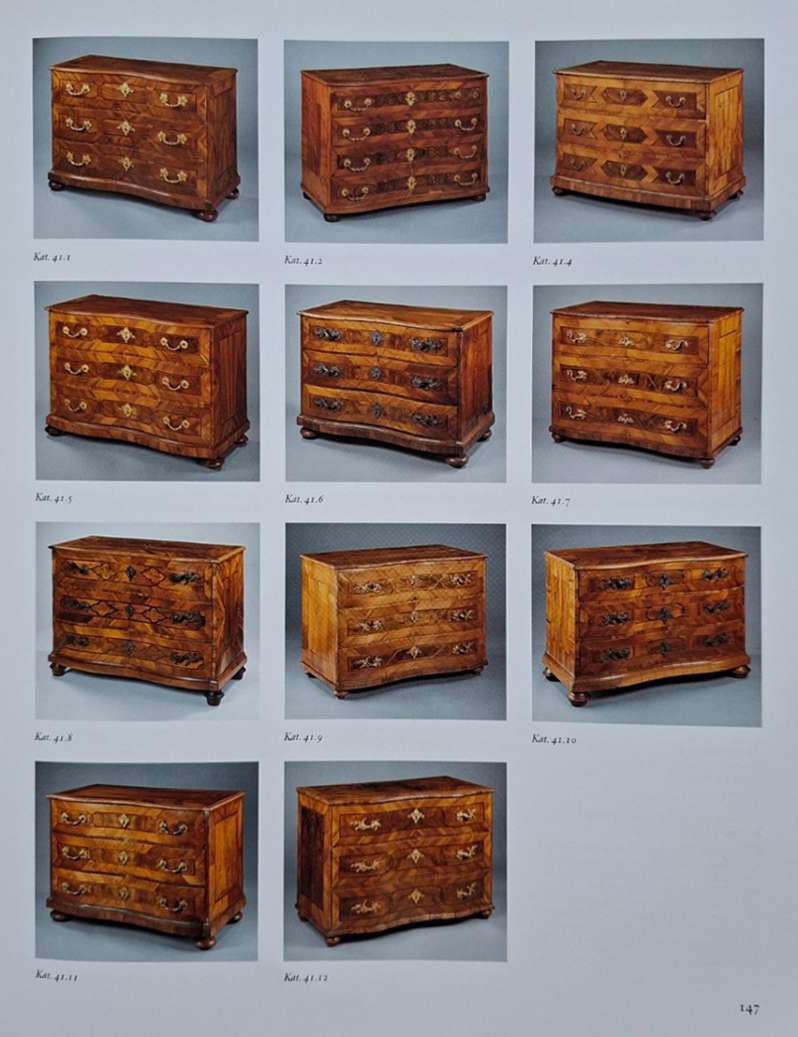
You will find a whole series of similar chests of drawers in the attached photographic extract from the furniture catalogue of Nymphenburg and Schleißheim Palaces. I already had another chest of drawers from this group in my collection a few months ago. You can find the piece, which has already been sold, via the following link: Munich chest of drawers.
Condition:
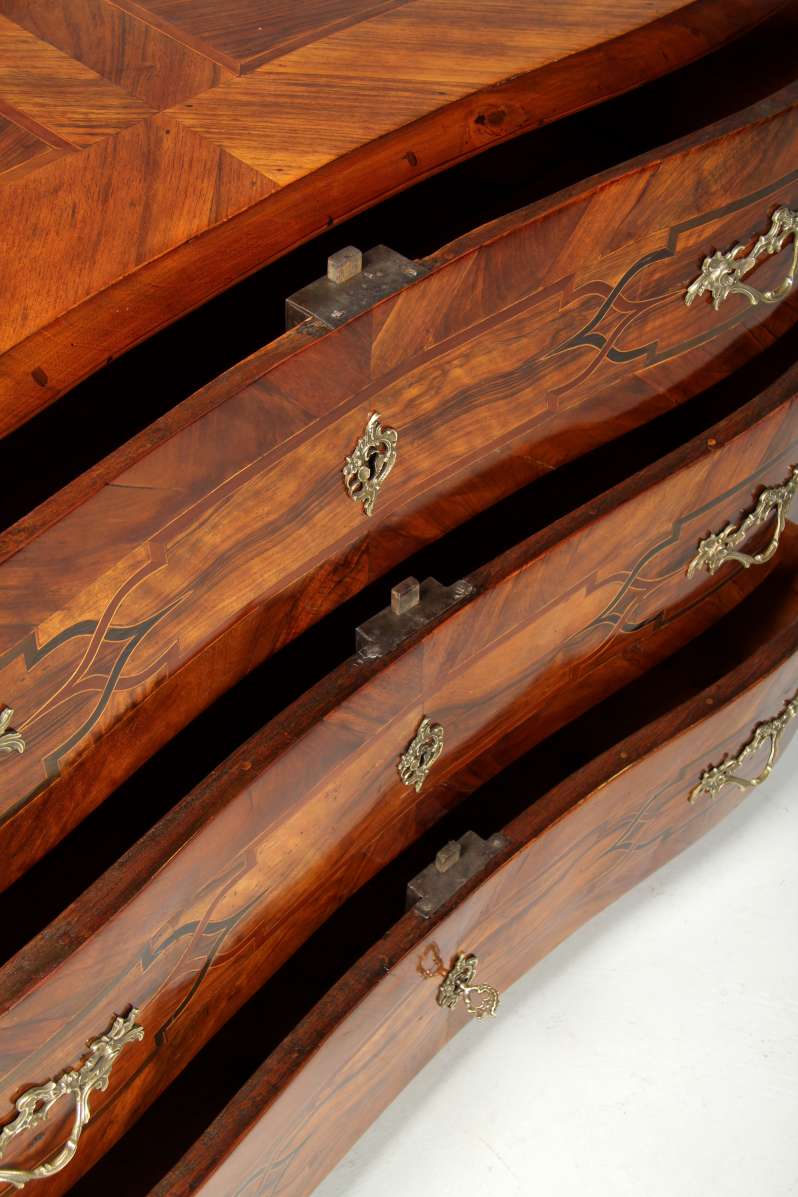
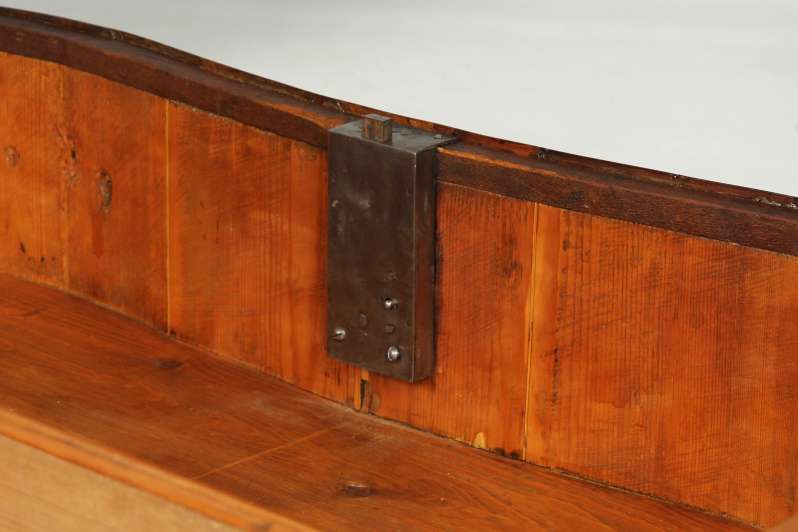
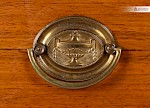
Restored with a hand-polished shellac finish. The drawers slide cleanly and smoothly; the locks are in working order. The fittings were added during a previous restoration in the style of the period.
Price: €5,400
You can find out more about Munich court chests of drawers in the following specialist literature:
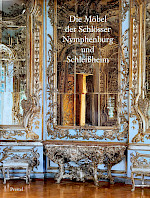
Brigitte Langer - Die Möbel der Schlösser Nymphenburg und Schleißheim from p. 143
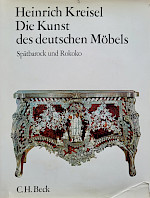
Heinrich Kreisel - Die Kunst des deutschen Möbels - Spätbarock und Rokoko Fig. 376
Article found under: Chests of drawers
Add to shopping cartVideo: Munich Baroque chest of drawers
Also interesting
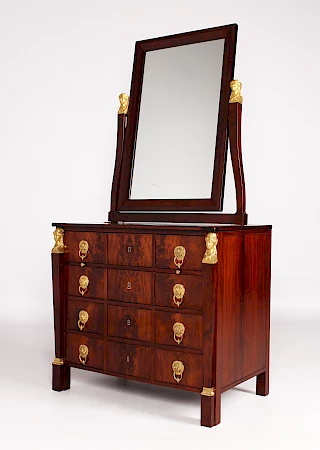
Antique dressing table - stamped Chapuis
Brussels
Mahogany
Empire around 1810
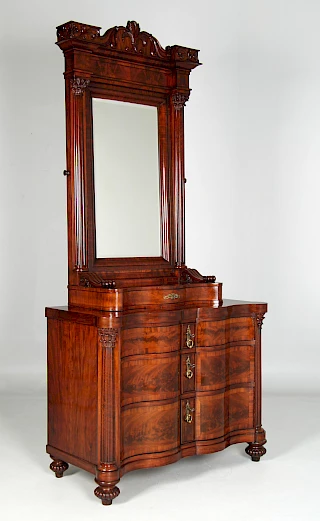
Chest of drawers with mirror
Northern Germany
Mahogany
Mid 19th century
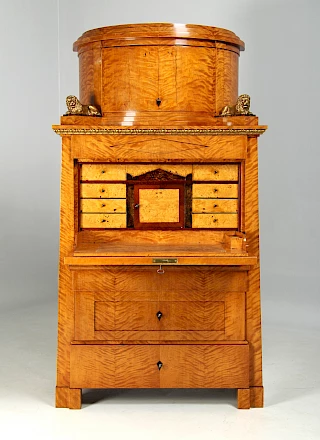
Conical Biedermeier secretary with lions
Berlin / Brandenburg
Birch tree
Biedermeier around 1825