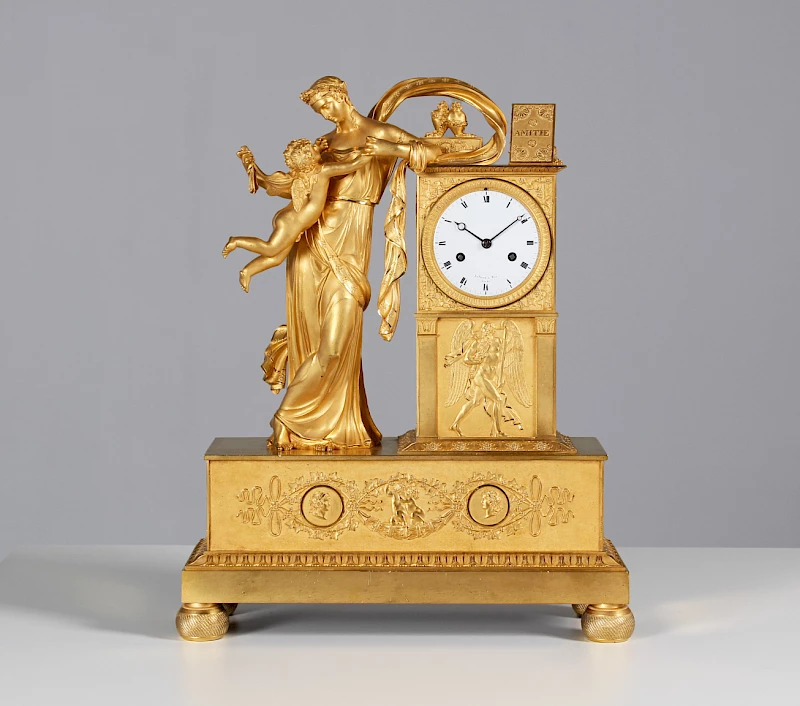
Pendulum with depiction of friendship and love
Video Empire Pendule
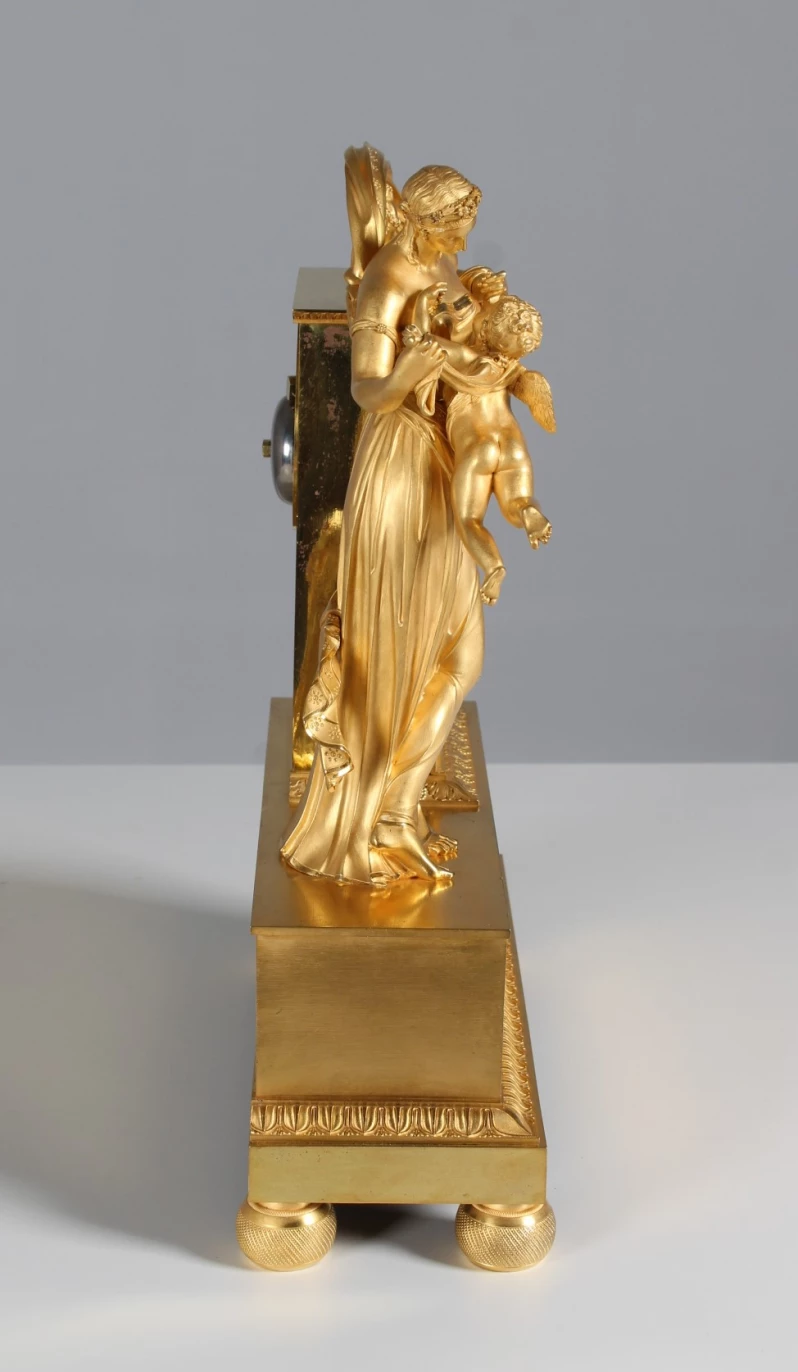
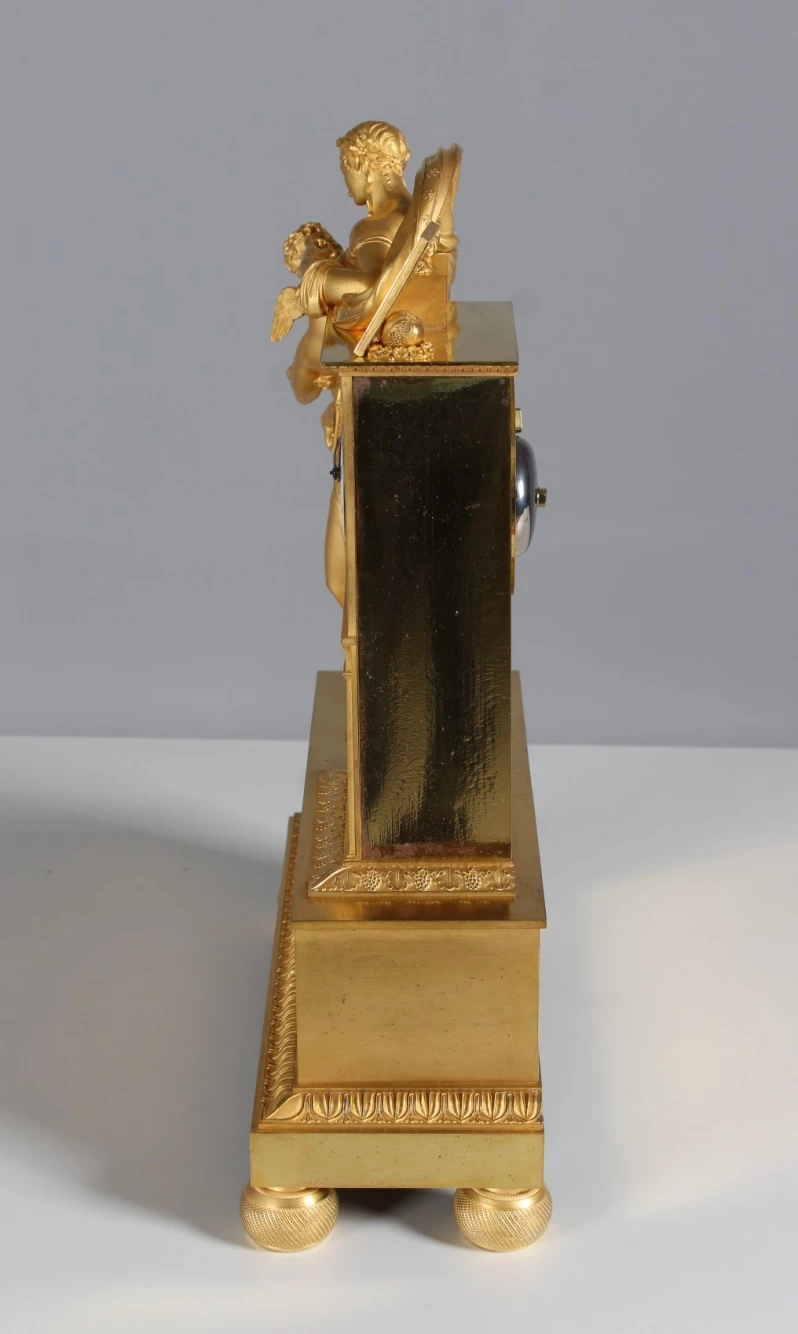
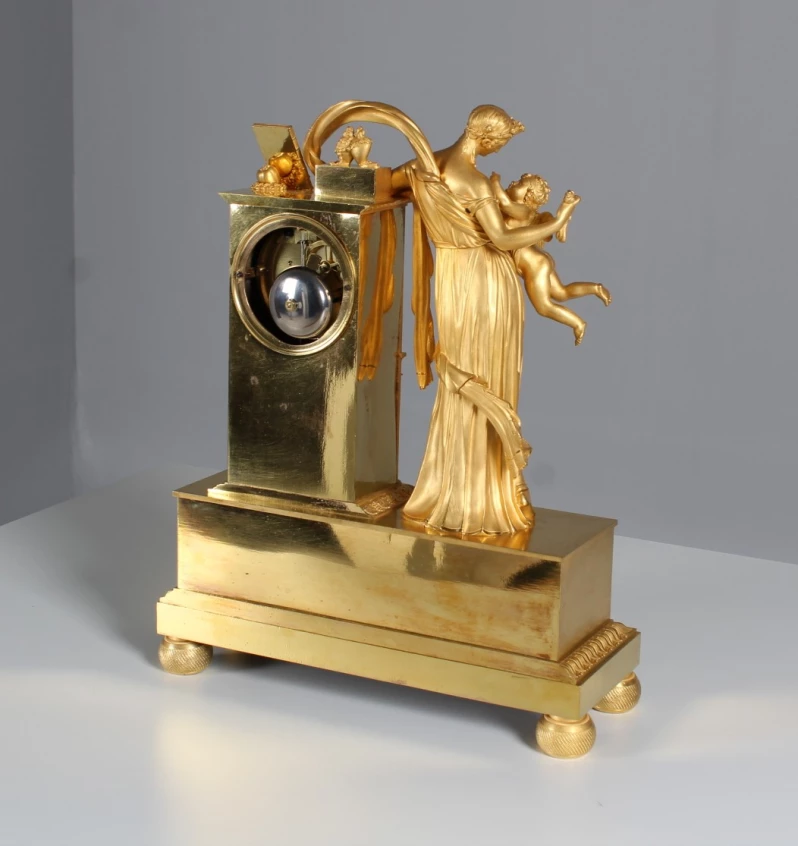
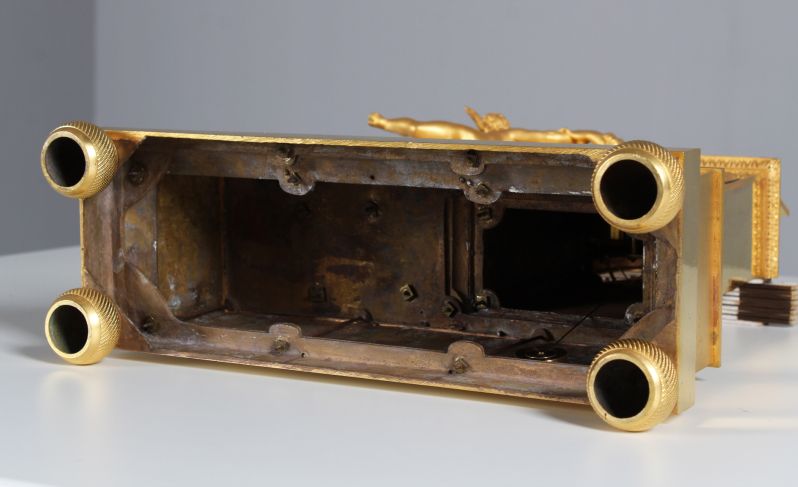
Pendulum with depiction of friendship and love
Paris (Lepaute, Thomire)
fire-gilt bronze
Empire around 1815
Dimensions: H x W x D: 44 x 36 x 13 cm
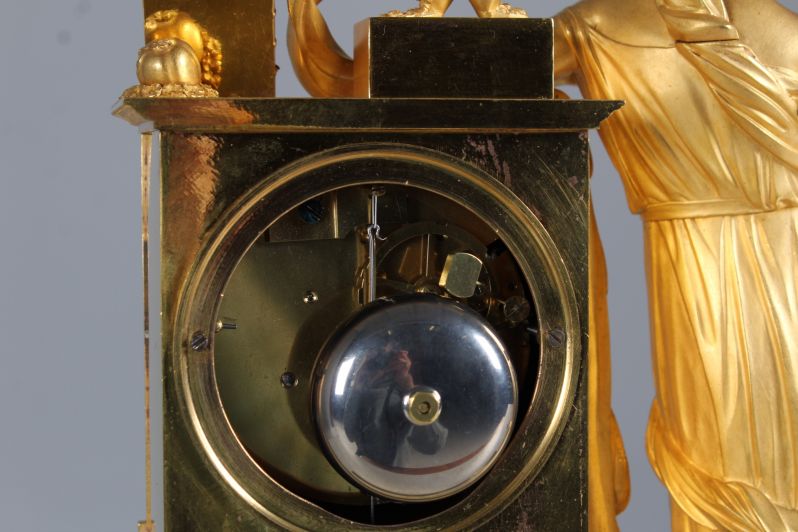
French pendulum movement with eight-day running time. Thread suspension and lock disc striking mechanism with strike on bell on the half and full hour.
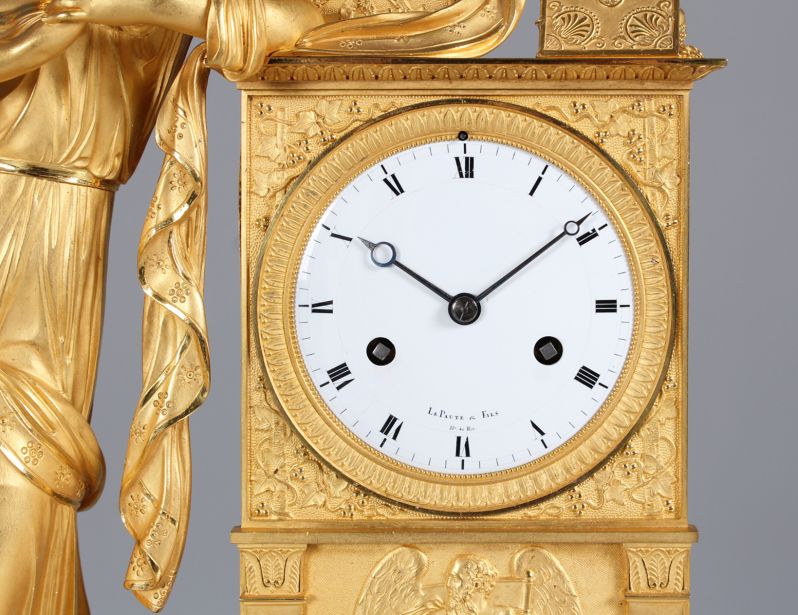
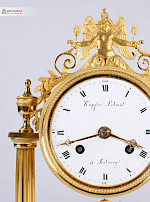
White enamel dial with Roman numerals and Breguet hands.
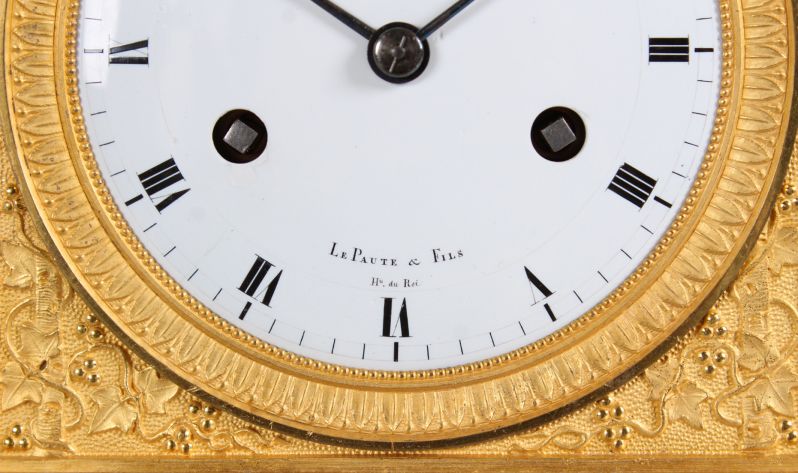
Signature: LePaute & Fils / Hrl. du Roi (Pierre-Basile Lepaute (1750 - 1843) with his son Pierre-Michel Lepaute (1785-1849); from 1811 in a joint workshop).
Description:
The extremely high-quality pendulum shown here takes up a profound theme: Friendship, which combines with love and can thus outlast time and death. As is typical of the Neoclassical period, personifications and symbols are taken from ancient mythology and art and then developed further.
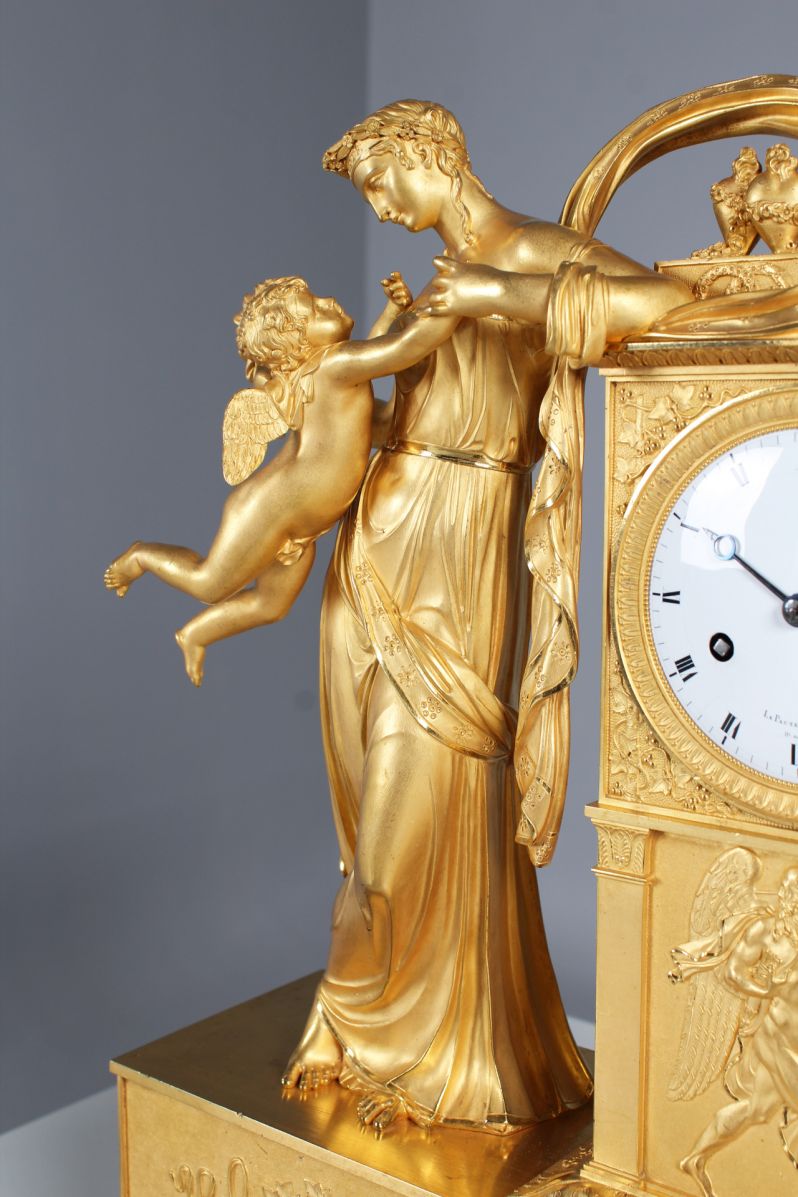
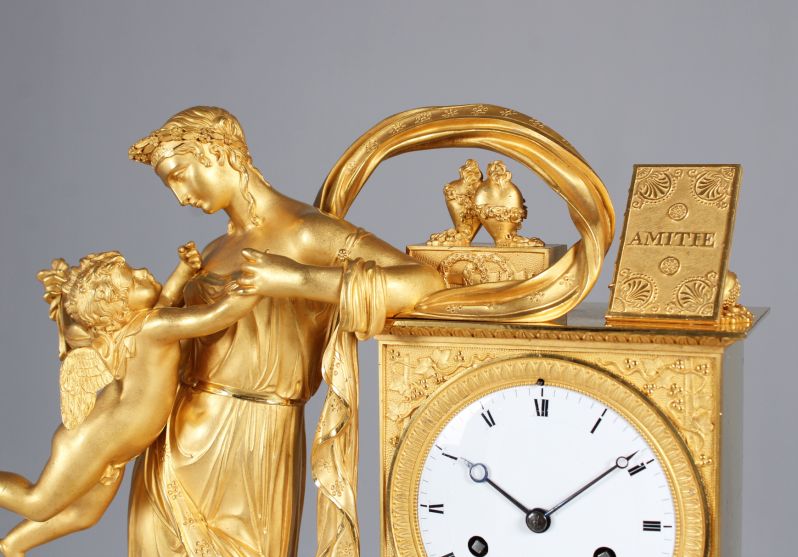
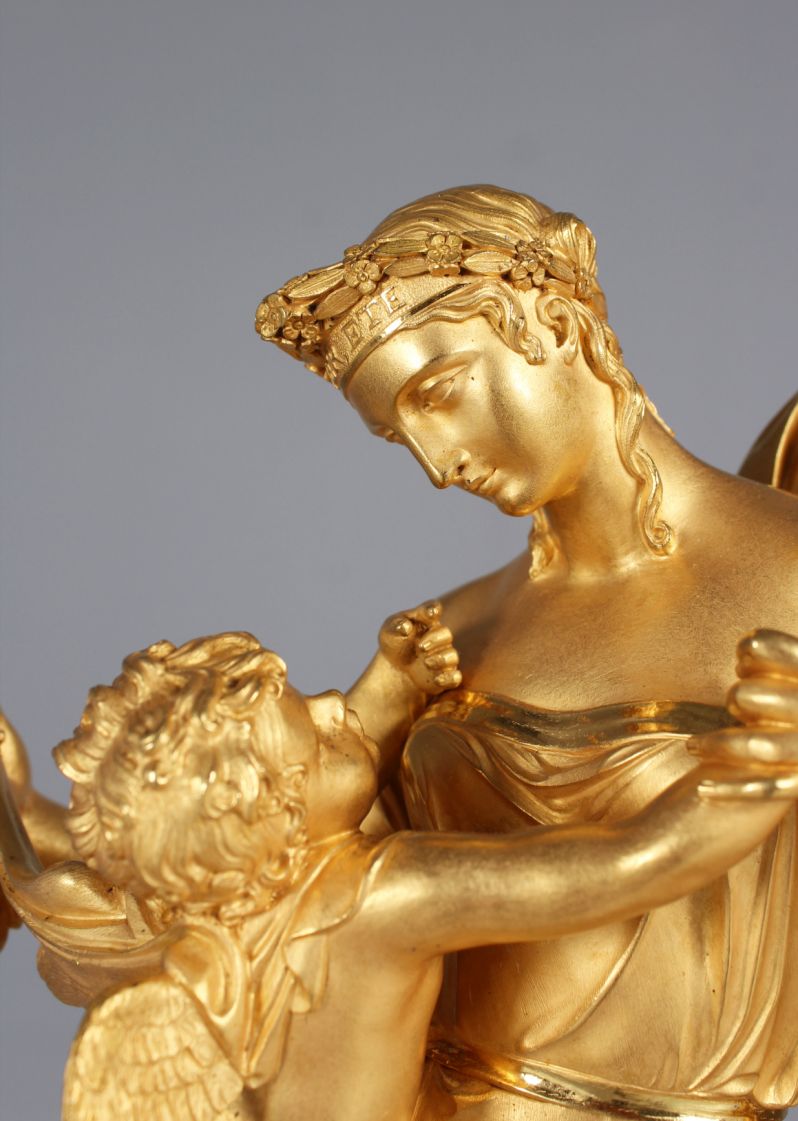
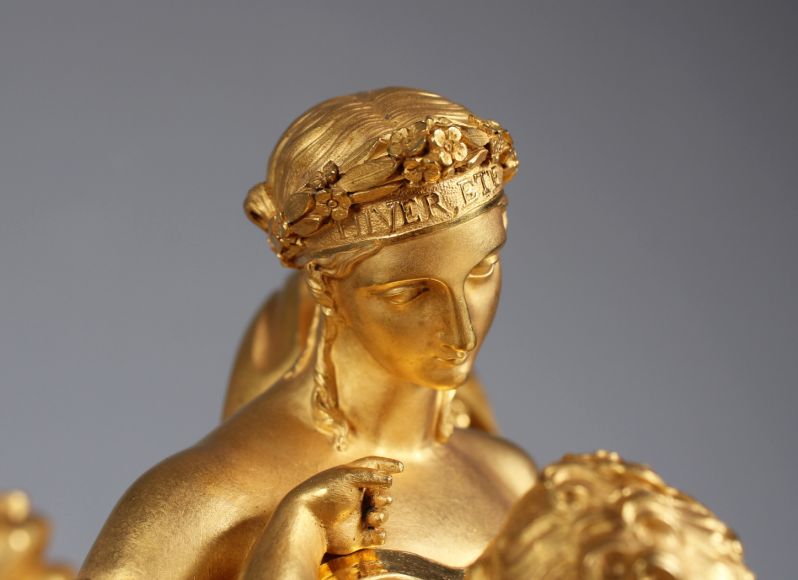
The main figure is a young woman in an antique, girded robe, standing barefoot and with her legs crossed next to an altar on which she is leaning with her left elbow. She gracefully bows her head towards a stormily approaching Cupid, grasps his right hand with her left and draws him to her bosom, the seat of her heart. The delicate ambivalence of approaching and being held culminates in the trustingly intimate gaze that the two cast at each other.
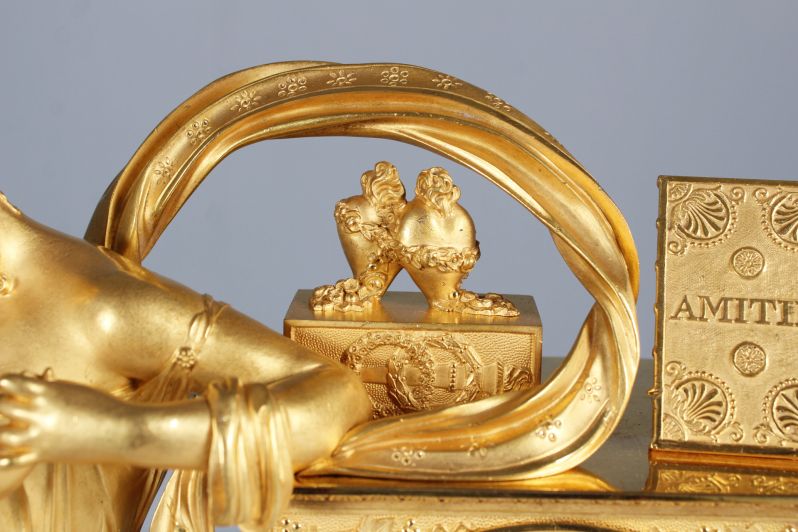
The young woman personifies friendship, the winged cupid symbolises love. As a sign of their intimate connection, two burning hearts appear on the altar next to the two, framed by the puffed-up scarf, which are closely bound together by a chain of flowers.
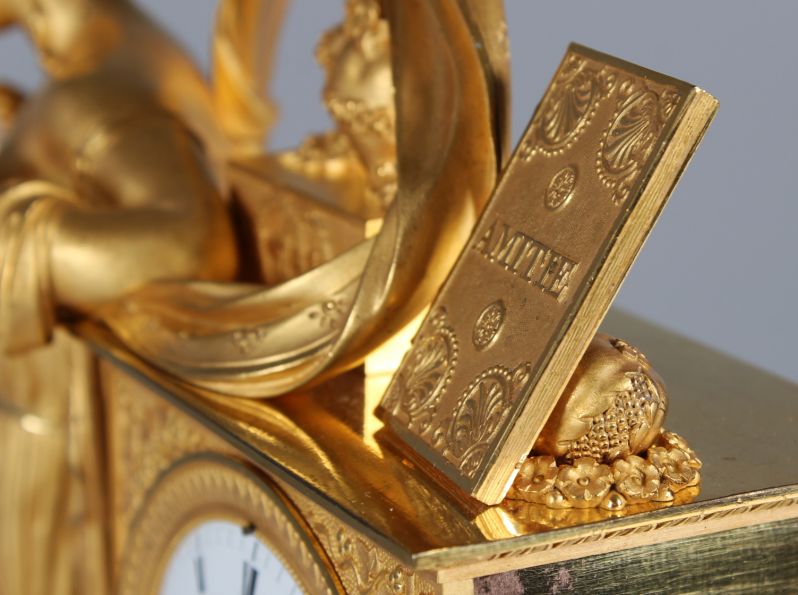
Next to them, on the altar plate, is a book with the title "Amitie" (French amitie, friendship). The book is supported by a pomegranate held by a ring of pomegranate blossoms. The plump seeds spill out of the burst skin. Since ancient times, the pomegranate and its blossoms have been dedicated to the goddess Persephone, symbolising the underworld and death, but also life and fertility. The myrtle woven into the pomegranate blossom wreath of "friendship" also has far-reaching symbolic power: the plant was dedicated to the goddess Aphrodite, stands for virginity, and was and is therefore obligatory in the bridal wreath. Above all, it symbolises love and fidelity beyond death.
The lettering "HIVER, ETE" at the top of the young woman's headband also refers to the dimension of eternity. The friendship lasts "winter and summer", even beyond death.
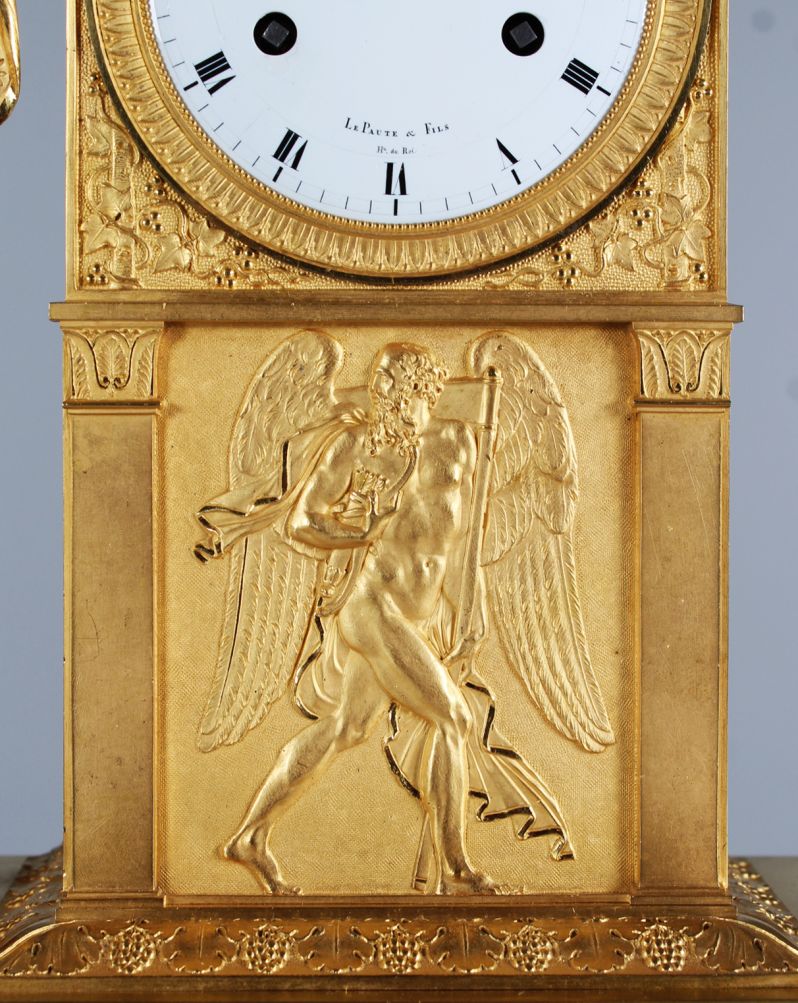
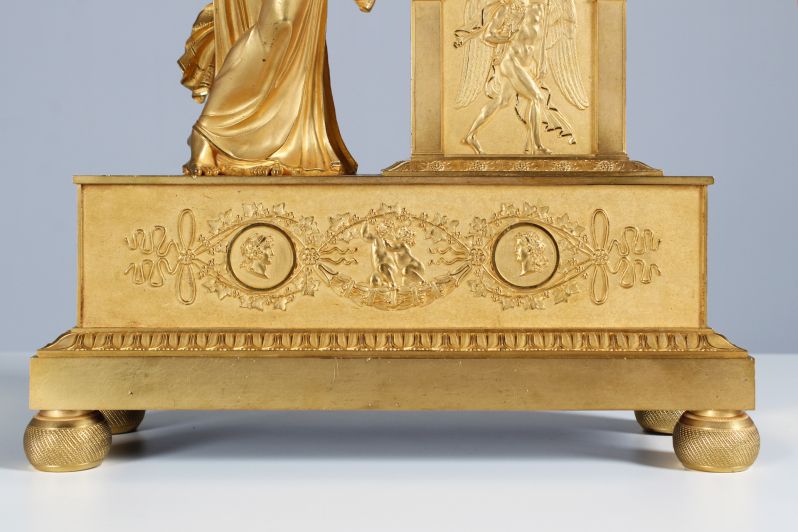
This is also indicated by the figure of Chronos in the relief field below the dial. The god of time is depicted as an old, but muscular and athletic man with a strong beard and mighty wings - time "flies". In his left hand he holds a large scythe with which he cuts off all life. Unusually, however, he is also clutching a bow with a quiver and arrows in his right arm. As he strides hastily to the right, he looks cautiously to the left as if he thought he was being followed. In fact, he has every reason to do so, as the bow and arrows originally belong to Cupid, the god of love. They are his weapons, feared by men and gods alike. For with the burning arrows of love, he strikes the hearts of men and wounds them severely. This kind of love wounds the heart, combining passion with desire, sexuality, jealousy, pain and loss. A Cupid deprived of these weapons would be the one, ideal love that overcomes physicality and transience.
It is precisely this kind of love that we see here in the form of the now disarmed Cupid flying to the heart of friendship in order to unite with it.
For French art, the theme of the transformation of passionate love into faithful friendship of the soul is directly and exemplarily linked in the figure of Madame de Pompadour (1721 - 1764), who was the official mistress of the French King Louis XV for over 20 years and was also one of the most intelligent and powerful women of her time. In 1750, however, her love affair with the king was transformed into a relationship of friendship. In order to legitimise this change of role before court and society, she commissioned the most important artists to create allegorical sculptures.
In 1758, Jean-Baptiste Pigalle created the marble group "Love Embraces Friendship", which can be seen as a direct model for the bronze of the pendulum shown here, especially the intimate look of connection between the two, but also the flowers and the vine-covered elm trunk (left and right above the dial).
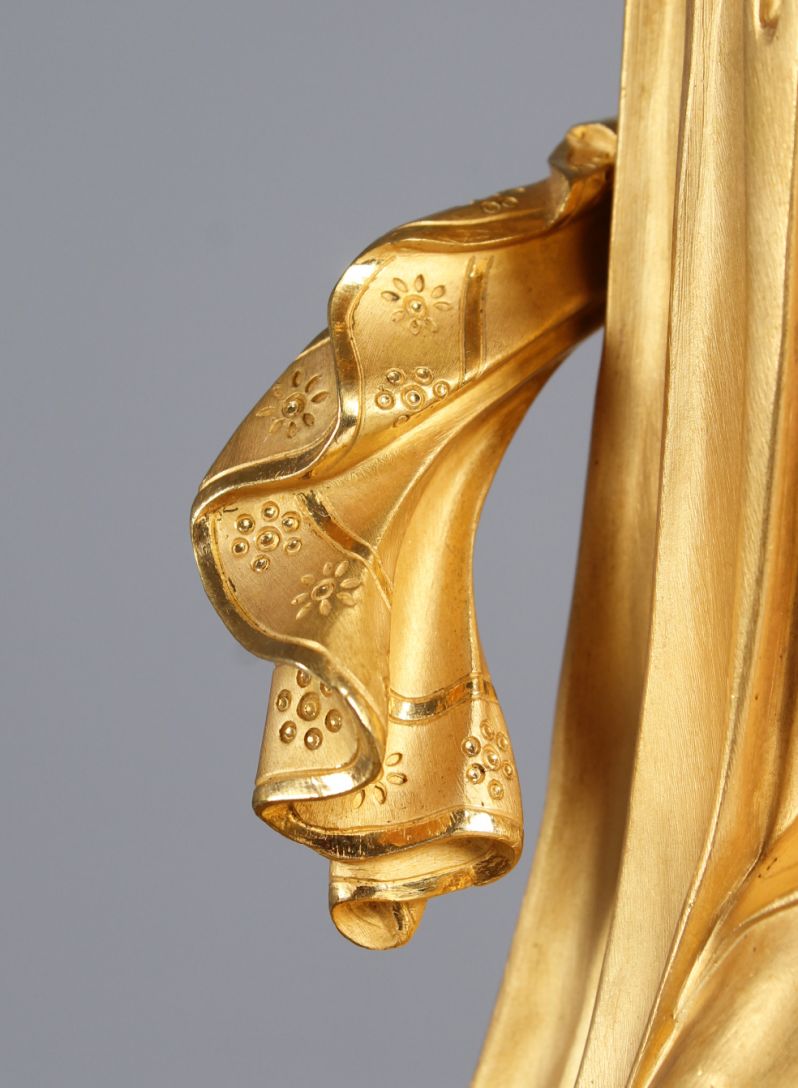
But it is not only the pictorial invention and composition of the bronze group that are outstanding. The fineness of the casting as well as the original fire gilding and the varied chiselling are of the highest quality.
This is particularly evident in the bas-relief of Chronos: here the background is chiselled in a grainy manner, while the wings reveal each individual feather. The body is chiselled in such a way that the surface emphasises the shimmering parts of the muscles, creating an extremely three-dimensional effect. As a literal highlight, individual areas, such as the edges of the fluttering cape, are polished to a high lustre and reflect the light brilliantly.
The quality of this bas-relief, which stands out only slightly from the surface and yet creates an astonishing plasticity, represents a high level of sculptural artistry.
Although the bronze is not signed - like almost all pendulums of this period - the composition and quality of the figures, the bronze work, the gilding and the chiselling allow Pierre-Philippe Thomire (1751 - 1843) to be taken into consideration. The most important bronzier of the Empire is known to have worked frequently with the Horloges Lepaute (Augarde, pp. 352-354).
A special quality feature of the work of art is the integration of the original movement with the white enamelled dial into the iconography of the bronze. It embodies the unstoppable progression of time in a sensually real way through the hour markings and hands, but also through its ticking. This progression is physically visualised by the dynamic chronos of the bas-relief below. In contrast, the dead elm tree with its vividly twining vine leaves is a reminder of the constancy within the passage of time.
Overall, this bronze pendulum with its well thought-out and finely crafted composition is a perfect symbol of an ideal, loving friendship that outlasts all time.
Worth knowing:
The Horloges of the Lepaute family form a dynasty of their own in Paris with outstanding workshops. They have held the honourable title of "Horloger du Roi" (watchmaker to the king) since 1751, during the reign of French King Louis XV. This continued under Louis XVI and after the end of the Bourbon kings with the revolution of 1789 under Emperor Napoleon I (1805 - 1814). Pierre Basile Lepaute and his son Pierre Michel were now given the title "Horloger de l'Empereur" (watchmaker to the Emperor).
Even after the end of the Napoleonic Empire, they retained their privileged position during the subsequent period of the Restoration, when the Bourbon kings were re-enthroned: in 1814, they became "Horloger du Roi" for the Bourbons Louis XVIII (1814 - 1824) and Charles X (1824 - 1830).
Throughout their creative period, the watchmakers of the Lepaute family were commissioned not only by the royal court, but by the entire high aristocracy. In keeping with the high standards of their clients, they worked together with the most important sculptors and bronziers, including P.-P. Thomire, R. Osmont, F. Vion and Clodion. Accordingly, their pendulums can be found in the world's most important palaces, collections and museums.
Condition:
Excellent condition of the movement as well as the original fire gilding.
The object is accompanied by an expertise written and signed by Dr Elke Niehüser. The majority of the above description is taken from this extensive expertise.

Comparative objects can be found in the following literature:
Jean-Dominique Augarde - Les Ouvries du Temps p.351-353
H. Ottomeyer / P. Pröschel - Gilded Bronzes p. 343-346
Elke Niehüser - The French bronze clock
Tardy - Dictionaire des Horlogers Francais p. 384
Gravelot / Cochin - Iconologie par Figures (23) AMITIÉ
Article found under: Clocks
Pendulum with depiction of friendship and love
Video Empire Pendule
Also interesting
Jaeger LeCoultre - red Atmos VII in original box
Switzerland
Gold-plated brass
Year of manufacture 1973
Pendule Urania - Allegory of astronomy
Montpellier
Bronze, marble, enamel
around 1825
Classicist chest of drawers with central locking
Southern Germany
Walnut, oak
early 19th century